Who should read this comparative analysis
Greg McKeown's Essentialism and Gary Keller and Jay Papasan's The ONE Thing occupy the same shelf for a reason: both books attack the problem of scattered effort, but they attack it from opposite directions. Greg McKeown's Essentialism framework builds an outer filter that decides what deserves a place on the calendar at all. Gary Keller's The ONE Thing priority model builds an inner engine that decides what to do the moment the calendar opens. A reader carrying too many half-finished commitments needs McKeown's elimination discipline first. A reader who already knows the priorities but cannot generate deep, sustained output on any of them needs Keller's time-blocking discipline first. Founders juggling a dozen simultaneous initiatives, corporate operators drowning in stakeholder requests, and individual contributors who feel busy but not productive will each find a different entry point into this comparison, and the sections below are built so a reader can jump straight to the framework that matches their current bottleneck.
This article treats the two books as complementary layers of a single operating system rather than as rival philosophies. Greg McKeown's Essentialism framework answers the question of what belongs in a life or a business. Gary Keller's The ONE Thing priority model answers the question of what to do right now with the space that essentialism creates. Readers who have already tried and abandoned generic productivity advice, such as flat to-do lists or time-management apps that treat every task as equally urgent, are the primary audience for this synthesis, because both authors explicitly reject that flattening of priorities.
Essentialism vs. The One Thing core philosophy comparison
Greg McKeown's Essentialism argues that disciplined elimination of the nonessential produces higher contribution than broad effort across many commitments, while Gary Keller and Jay Papasan's The ONE Thing argues that extraordinary results come from narrowing daily action down to a single, sequentially used priority rather than distributing energy across several tasks at once.
Greg McKeown's Essentialism framework starts from a diagnosis of what he calls the nonessentialist trap. A person who says yes to nearly everything ends up "majoring in minor activities," spread thin across a dozen initiatives, each one advancing by a fraction while none advance decisively. McKeown calls this the difference between motion and momentum: activity without direction feels productive but leaves almost nothing finished. His proposed corrective borrows a design philosophy from Braun's Dieter Rams, condensed into two words: less but better. Essentialism is not a one-time spring cleaning of the calendar; McKeown frames it as a permanent operating discipline applied to every new request, project, and opportunity that arrives.
Gary Keller and Jay Papasan's The ONE Thing starts from a different diagnosis. Their claim is that success is built sequentially, one domino at a time, rather than simultaneously across many fronts. Keller's central argument is that a narrow focus, sustained long enough, compounds in a way that scattered focus never can. Where Greg McKeown's Essentialism framework is primarily a filtering mechanism applied before commitments are accepted, Gary Keller's The ONE Thing priority model is primarily a sequencing mechanism applied after commitments are already on the table. Keller is less concerned with whether a project should exist at all and more concerned with which single action inside that project, if completed, makes every subsequent action easier or removes the need for it entirely.
The practical distinction shows up most clearly in how each author handles the number of things a person should be doing simultaneously. Greg McKeown's Essentialism framework still permits several essential priorities to run in parallel across different life domains, such as health, family, and a primary work objective, provided each one has passed a strict filter. Gary Keller's The ONE Thing priority model compresses even that shortlist down to a single dominant action for any given block of time, arguing that even two priorities pursued at once dilute the use that comes from a truly singular focus. The table below maps the two systems dimension by dimension.
| Dimension | Essentialism (Greg McKeown) | The ONE Thing (Gary Keller) |
|---|---|---|
| Core objective | Disciplined pursuit of less (selective elimination) | Extreme singular prioritization (domino effect) |
| Primary tool | The 90 percent rule and the trade-off matrix | The focusing question and the 4-hour time block |
| Default mindset | A borderline option is treated as a no | Ask what single action makes everything else easier or unnecessary |
| Filter criteria | Multi-point evaluative threshold across several life areas | Single leveraged domino focus, narrowed sequentially |
Strategic insight: The fundamental difference between Greg McKeown and Gary Keller lies in filter breadth versus filter depth. McKeown eliminates roughly 90 percent of noise to reveal the essential few, whereas Keller forces even that essential few down to a single leverage point.
Both authors build their filtering logic around a specific numeric threshold, and the contrast in where each author sets that threshold explains most of the practical friction between the two systems. Greg McKeown's Essentialism framework uses a 1-to-10 scoring scale where anything that lands at a 7 or 8 is treated as an automatic rejection, not a maybe, because a merely good option quietly displaces a genuinely great one. Gary Keller's The ONE Thing priority model applies Pareto's 80/20 principle recursively, cutting 20 percent of 20 percent of 20 percent of a list until a single, irreducible priority remains. Both mechanisms exist to prevent the same failure mode: a person mistaking "acceptable" for "essential."
Six specific beliefs, which Keller and Papasan label as lies, sit underneath the case for singular focus in The ONE Thing. The first lie treats every item on a to-do list as equally important, when in reality most such lists function as survival lists rather than success lists. The second lie treats multitasking as effective, despite research (Stanford's Clifford Nass among the cited sources) showing that people who regularly juggle tasks perform measurably worse than people who do not. The third lie assumes highly successful people are simply more disciplined, when Keller argues that a small number of well-chosen habits, not blanket self-control, does the heavy lifting. The fourth lie assumes willpower is available on demand throughout the day, when it is in fact a depleting resource best spent on the most important task first. The fifth lie is the pursuit of balance itself, which Keller calls bunk, arguing that extraordinary results require living at the extremes rather than the middle. The sixth lie is the fear that big ambition is inherently exhausting, when Keller argues the size of the goal sets the ceiling on the result.
Greg McKeown's Essentialism framework organizes its own argument into four sequential pillars rather than a list of myths to debunk. The first pillar, essence, overturns three assumptions that McKeown treats as the root of nonessentialist behavior: the belief that a person has to say yes, the belief that everything on the plate is equally important, and the belief that a person can do both of two competing options at once. In their place, McKeown installs three replacement truths: a person chooses how time gets spent, only a few things genuinely matter, and a person can do anything but not everything. The second pillar, explore, is where McKeown's approach differs most sharply from Keller's narrowing instinct, because McKeown insists that essentialists actually widen their search for options before committing, using unstructured time, deliberate observation, and strict evaluative criteria to separate a broad field of possibilities from the noise surrounding it. The third pillar, eliminate, is where the graceful no, the uncommitting from sunk-cost projects, and the setting of hard boundaries all live. The fourth pillar, execute, shifts attention from deciding what matters to making the chosen priorities nearly automatic, through buffers against the unexpected, small starting wins, consistent routines, and a disciplined focus on the present task.
McKeown also describes a recurring trap he calls the paradox of success, and this trap is arguably the strongest bridge between the two books. In McKeown's telling, clarity of purpose produces success, success produces more options and opportunities, those additional opportunities diffuse a person's efforts across too many fronts, and the resulting diffusion erodes the very clarity that produced the success in the first place. Left unchecked, this cycle means that becoming good at something is what eventually causes a person to lose focus on it. Gary Keller's The ONE Thing priority model describes almost the identical failure mode in different language: a person who refuses to counterbalance an intense professional focus with short, protected personal time eventually burns out the very capacity that made the focus possible. Both authors treat this as a systemic risk that grows, rather than shrinks, as a person becomes more capable, which is part of why neither book treats prioritization as a problem that gets solved once and then stays solved.
The mathematical leverage of singular focus vs. selective elimination
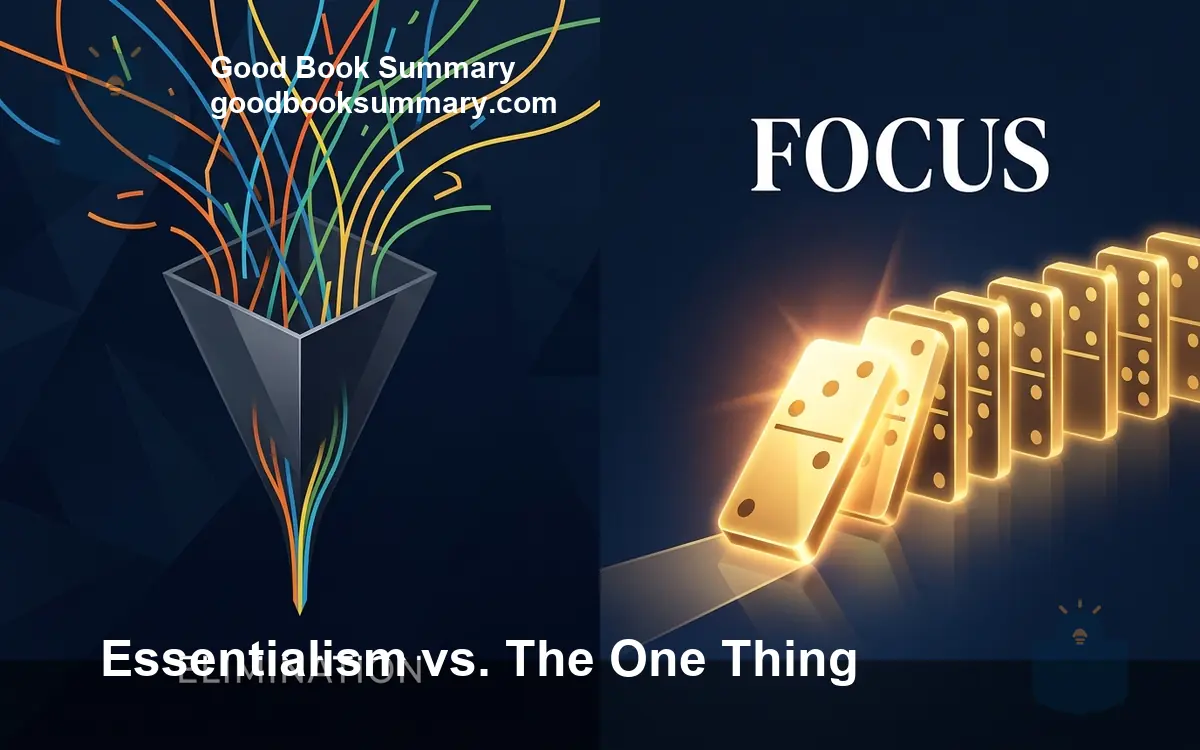
Understanding the mathematical use of singular focus vs. selective elimination begins with a demonstration borrowed from physics: a domino can knock over another domino roughly 50 percent larger than itself, and a chain of dominoes growing at that rate escalates geometrically rather than linearly. Keller uses physicist Lorne Whitehead's experiment to argue that a sequence of correctly ordered, appropriately scaled actions compounds far faster than intuition suggests. In Keller's illustration, a domino that starts at two inches tall reaches the height of a tall adult by the tenth domino, rivals a multi-story tower by the eighteenth, and would bridge an astronomical distance by the fifty-seventh, a progression meant to show why a single well-sequenced priority outproduces a dozen simultaneous ones.
Greg McKeown's Essentialism framework does not model use geometrically in the same way, but it produces an equivalent effect through subtraction rather than sequencing. Where Keller's model asks what single action generates compounding downstream ease, McKeown's model asks what volume of competing obligations must be removed before any single priority can receive enough sustained attention to compound at all. The two mechanisms are not mathematically identical, but they can be expressed as a single ratio that captures the shared underlying claim of both books: concentrated effort produces disproportionate results relative to the same effort spread thin.
Read against Greg McKeown's Essentialism framework, the denominator of that ratio shrinks every time a borderline commitment is declined, which raises the use available to whatever remains. Read against Gary Keller's The ONE Thing priority model, the numerator grows every time a genuinely used domino, rather than an arbitrary task, occupies the protected time block. The books converge on the same structural insight even though McKeown approaches it from the elimination side of the equation and Keller approaches it from the concentration side.
Keller's goal-setting sequence, moving from a someday goal down through five-year, one-year, monthly, weekly, and daily goals to a single "right now" action, functions as a nested version of this same ratio applied at every time scale. Each level narrows the previous one, so that a person's immediate task on any given morning is mathematically traceable back to a long-horizon target rather than chosen arbitrarily from a flat list.
McKeown supplies his own version of a quantitative filter through the essential intent matrix, plotted across two axes: how inspirational a statement is on one axis and how concrete it is on the other. A statement that is inspirational but too general, such as a broad mission to change the world, sits in one corner and fails to guide daily decisions because it is too abstract to act on. A statement that is concrete but bland, such as a plain quarterly revenue target, sits in the opposite corner and fails to motivate sustained effort because it carries no larger meaning. McKeown argues that only a statement occupying the inspirational-and-concrete quadrant, which he calls an essential intent, functions the way a single well-placed domino functions in Keller's model: it settles a wide field of smaller decisions in advance, because any option that does not serve the essential intent has already been answered before it is even proposed.
The two authors also apply near-identical logic to how buffers and contingencies interact with a used plan. McKeown points to Norway's decision to save its oil-tax revenue into a sovereign wealth fund rather than spend it immediately, as well as the biblical account of Egypt storing one-fifth of its harvest during years of surplus, as illustrations of building deliberate slack into a system before it is needed. Keller's model reaches the same conclusion through time blocking: the first priority in a time-blocked calendar is not the ONE Thing itself but time off, scheduled ahead of the focus block, because a depleted person cannot sustain the level of concentration a four-hour block demands. In both frameworks, the use ratio above only holds up over time if some capacity is deliberately withheld from full deployment and saved for the unexpected.
How to apply the key concepts of Essentialism vs. The One Thing in daily life
Applying Greg McKeown's Essentialism framework alongside Gary Keller's The ONE Thing priority model in daily practice means using essentialism to clear the calendar of nonessential obligations first, then using time blocking to protect an unbroken multi-hour window for the single highest-leverage task identified through Keller's focusing question.
The two systems slot together as an outer filter and an inner engine rather than as competing morning routines. Greg McKeown's Essentialism framework does the work of deciding what deserves space in a week at all, using tools such as the 90 percent rule and the essential intent matrix. Gary Keller's The ONE Thing priority model then takes whatever survives that filter and decides which single item goes first, protected by an unbroken block of time long enough for meaningful output. A daily routine built from both books in sequence looks like this:
- Protect the asset before the day begins. Wake at a consistent time that allows for full rest, treating sleep as a performance input rather than a flexible variable, following McKeown's guidance to protect mind and body before protecting the schedule.
- Create unstructured space for perspective. Spend a short block of quiet, uninterrupted time away from email or messages. This reflects rather than reacting, in the spirit of McKeown's argument that solitude is where clarity forms.
- Ask the small-focus version of the focusing question. Write down an answer to Keller's question: what is the one thing that, if done today, would make everything else easier or unnecessary. Trace it back to the weekly, monthly, and annual goal it serves.
- Prepare the environment before the block starts. Clear minor obligations, silence notifications, and close unrelated tabs so the coming focus block is not interrupted at minute five.
- Protect a four-hour unbroken block for the ONE Thing. Treat this window as an unmovable appointment, tackling the hardest and highest-leverage task first, when willpower is at its peak rather than depleted.
- Deploy a graceful no against interruptions. Have a scripted response ready for requests that arrive during the block, such as offering to follow up after checking the calendar, rather than breaking focus to negotiate in the moment.
- Reserve the afternoon for management, not creation. Route meetings, email, and administrative work into a separate afternoon block so the morning's creative capacity is never split across two modes of work.
- Build in a buffer for the unexpected. Use part of the late afternoon to scan for bottlenecks, identify whatever is slowing the overall system down, and address it before it becomes an emergency the next day.
- Close the day with a deliberate transition. Write down open items so they do not carry into personal time, and consciously shift attention away from work.
- Counterbalance personal life tightly and daily. Where professional focus can run long and unbalanced for a season, McKeown and Keller both agree that health, family, and personal integrity need short, consistent daily attention so nothing essential quietly erodes.
A useful negotiation script for interruptions, drawn from the time-blocking literature around Keller's model, is simply asking which existing commitment should be deprioritized in order to accommodate the new request. That single question forces the requester to confront the trade-off directly rather than treating the new ask as costless, which is functionally the same discipline McKeown applies through his trade-off matrix.
Key takeaways from Essentialism vs. The One Thing by Greg McKeown vs. Gary Keller
The core takeaway from comparing Greg McKeown's Essentialism framework with Gary Keller's The ONE Thing priority model is that elimination and concentration are sequential, not competing, disciplines: essentialism decides what belongs on the calendar, and the ONE Thing decides what gets done first once that calendar is already clear.
Greg McKeown's Essentialism framework is best understood as four sequential pillars: essence, which resets the underlying mindset from obligation to choice; explore, which widens the search for options before committing to any of them; eliminate, which applies extreme criteria to cut the trivial many; and execute, which builds friction-free systems so the essential few actually get done. A reader who only adopts the eliminate pillar without the execute pillar tends to end up with a shorter list of priorities that still never gets finished, which is precisely the gap Gary Keller's The ONE Thing priority model is built to close.
Gary Keller's The ONE Thing priority model contributes two mechanisms that Essentialism does not fully specify: a repeatable question for identifying the single highest-leverage action at any time horizon, and a concrete time-blocking structure, anchored by a four-hour minimum, for protecting that action from erosion. Where McKeown explains why a person should say no to the 90 percent, Keller explains what to do with the focused hours that the resulting no creates. Taken together, the trade-off matrix's essential intent and Keller's focusing question serve a similar strategic function: both compress a wide field of options into one decision that resolves many smaller decisions in advance.
The six lies Keller identifies, particularly the myth of balance and the myth that willpower is constant, map closely onto McKeown's own warnings about the paradox of success, in which early clarity produces more opportunities, which in turn dilutes the very focus that created the initial success. Both books treat this dilution as the default failure mode of anyone who becomes competent enough to attract more demands on their time, and both prescribe an active, ongoing defense rather than a one-time fix.
Actionable workflow integration for modern professionals
Two case studies illustrate how the outer filter and inner engine combine inside a real operating environment. A scaling technology company experiencing fragmented team priorities applied McKeown's framework first, banning phones and meetings on a recurring day each month to create space for reflection, then replacing a vague mission statement with a concrete essential intent that a broad audience could act on without further clarification. Once that filter was in place, the engineering team layered in Keller's time-blocking model, protecting a four-hour morning window for uninterrupted coding and clustering all manager-style meetings into the afternoon, using physical signals like closed doors or "do not disturb" markers to defend the block.
A second case study follows an overworked, high-performing executive who felt busy but drained. Applying McKeown's 90 percent rule to a backlog of professional invitations and requests, the executive rejected anything scoring below a 9 out of 10 and formalized a boundary with colleagues and family that reserved specific days for rest and personal renewal. Layered on top of that filter, the executive used Keller's focusing question to identify one small, repeatable health action, such as preparing meals in advance during a short weekly planning block, turning a single high-leverage habit into an automatic default rather than a daily decision.
Professionals who have already internalized Greg McKeown's Essentialism framework as their filtering layer often find the natural next step is Cal Newport's Deep Work attention system, which addresses the mechanics of sustained concentration once the calendar has already been cleared of nonessential obligations. Readers newer to either book may benefit from starting with the habit-formation groundwork in James Clear's Atomic Habits system before layering on the more advanced prioritization logic of either McKeown or Keller.
Conclusion and recommended reading sequence
Greg McKeown's Essentialism framework and Gary Keller's The ONE Thing priority model answer different halves of the same problem. McKeown explains why a shorter list of commitments produces more contribution than a longer one, and provides the emotional and structural tools, from the graceful no to the essential intent matrix, needed to keep that list short under social pressure. Keller explains what to do once that shorter list exists, providing a repeatable question and a defended time block that turn a cleared calendar into compounding results rather than merely quieter chaos.
For a reader starting from a genuinely overloaded schedule, the recommended sequence is Greg McKeown's Essentialism framework first, since eliminating the nonessential creates the space that any prioritization system needs in order to function. For a reader whose priorities are already reasonably clear but whose execution is scattered across too many simultaneous efforts, starting with Gary Keller's The ONE Thing priority model and its time-blocking discipline will produce faster visible results. Most professionals eventually need both: McKeown's filter to decide what deserves attention, and Keller's engine to make sure that attention actually produces something.
A practical way to decide where to start is to notice which failure mode is currently active. A person who agrees to nearly every meeting request, feels stretched across too many simultaneous projects, and struggles to name a single top priority without hesitation is living inside the nonessentialist trap that McKeown describes, and should begin with the elimination pillar before attempting any time-blocking discipline. A person who already has a short, well-defined list of priorities but still finds each day consumed by administrative noise, interruptions, and reactive work is living inside the failure mode Keller describes, and should begin by installing a protected four-hour block before revisiting the underlying priority list at all. Reading both books back to back, rather than choosing one permanently over the other, tends to produce the most durable result, because the elimination discipline needs periodic renewal as new opportunities and obligations accumulate, and the time-blocking discipline needs periodic renewal as old blocks get eroded by habit and social pressure.
The two frameworks also age differently across a career. Early in a career, when the primary risk is spreading unproven effort across too many unproven ideas, Greg McKeown's Essentialism framework and its emphasis on wide exploration before commitment tends to matter more. Later in a career, once a person's priorities are relatively fixed and the primary risk shifts to shallow execution on well-chosen goals, Gary Keller's The ONE Thing priority model and its emphasis on protected, unbroken time tends to matter more. Reassessing which discipline is currently the binding constraint, roughly once a quarter, keeps either framework from calcifying into a rigid routine that no longer matches the actual bottleneck in a person's work.