Unreason, the wider term Foucault uses for the category that Classical Europe expelled from public life alongside madness, includes libertinism, blasphemy, prodigality, and moral deviance. Madness is the narrower case within that larger exclusion, the one instance of unreason that medicine eventually claimed for itself. That distinction matters because the book's real subject is the boundary line itself, drawn and redrawn across three centuries and never reducible to a single stable illness.
What is the main summary of Madness and Civilization: A History of Insanity in the Age of Reason
Madness and Civilization: A History of Insanity in the Age of Reason by Michel Foucault summarizes how European society systematically silenced madness between 1500 and 1800. Foucault demonstrates that insanity transitioned from an open Renaissance dialogue into Classical confinement and modern psychiatric surveillance, establishing mental illness as an institutional mechanism of social and moral control.
Renaissance madness versus classical confinement at a glance
The book divides into two broad movements that a comparison table can clarify before the chapter-by-chapter analysis below.
| Dimension | Renaissance madness (before 1656) | Classical confinement (1656 to 1800) |
|---|---|---|
| Social status | Tragic knowledge, part of public dialogue | Silenced object of moral and economic policy |
| Governing institution | Ship of fools, town gates, wandering exile | Hopital General, workhouses, prisons |
| Governing logic | Cosmic and religious meaning | Bourgeois work ethic and police power |
| Scale of confinement | Individual madmen expelled from single cities | Over one percent of the Paris population, 5,000 to 6,000 people in 1656 alone |
| Response to madness | Observed and represented, not treated | Forced labor framed as moral redemption |
The right column describes the condition that every later chapter of the book modifies. The great fear, the new division, and the birth of the asylum are three separate ways the classical system of confinement eventually broke apart.
Stultifera Navis: the ship of fools before confinement
The book opens at the end of the Middle Ages, when leprosy withdrew from Europe and left behind an infrastructure of exclusion with no disease left to justify it. France alone maintained more than 2,000 leprosariums in the twelfth century, and by the fifteenth century most stood empty. The leprosarium was a physical and ritual structure that combined bodily exclusion with spiritual meaning, since the leper remained a visible sign of divine grace and anger even while banished from the city. Vagabonds, criminals, and the mad inherited these vacated spaces and the rites attached to them.
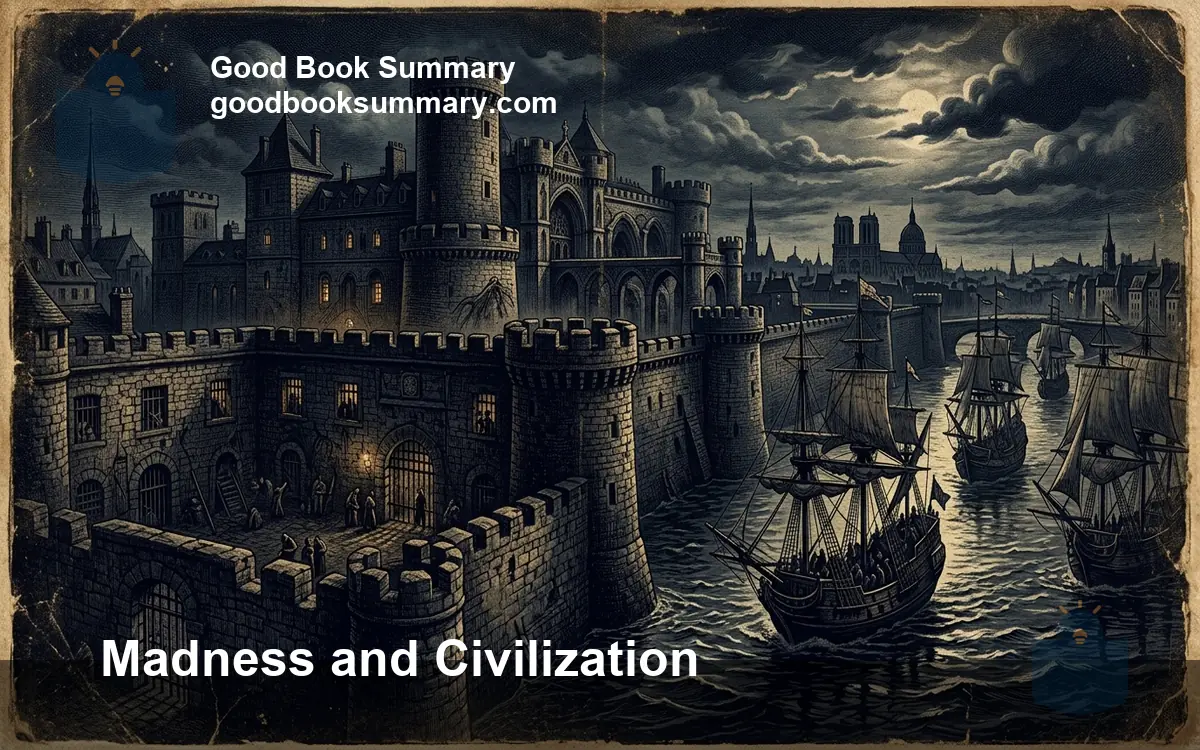
The Renaissance response to this inheritance was neither confinement nor medicine. Municipalities placed madmen aboard boats and sent them along rivers such as the Rhine, a literal practice documented in cases including the 1399 expulsion from Frankfurt, where seamen were ordered to remove a madman who had been walking the streets naked. The Stultifera Navis, or ship of fools, functioned as both an administrative act and a symbolic passage, a ritual crossing that fixed the madman at the threshold of the community, neither inside nor outside it.
Literature of the period treated the fool as a truth-teller. Shakespeare's fools and Erasmus's Praise of Folly gave the madman a stage on which he spoke reason from beneath a mask of nonsense, what the book calls the comedy of the second degree. Sebastian Brant's Narrenschiff and Hieronymus Bosch's painted Ship of Fools replaced the older imagery of the Dance of Death with the cap and bells of the lunatic. That shift is what Foucault means by the deja-la of death: madness understood as a vanquished, everyday form of death that had already emptied the skull. The madman's voyage was "at once a rigorous division and an absolute Passage," a line that captures how the Renaissance kept madness visible and in dialogue with reason instead of locking it away.
The great confinement and the founding of the Hopital General
The pivot of the book arrives in 1656, when a royal decree in Paris created the Hopital General by unifying several existing charity houses (the Salpetriere, Bicetre, La Pitie, and Scipion) under a single administration. The institution sequestered between 5,000 and 6,000 beggars, widows, and madmen in its first year. Read against the total population of the city, that figure means more than one percent of Paris disappeared behind its walls. Thirty-two provincial French cities built similar general hospitals within decades on the Paris model.
The Hopital General was an administrative and semi-judicial structure exercising police and punitive power outside the normal courts, with directors appointed for life who held stakes, irons, prisons, and dungeons at their own disposal. The institution was not medical. It judged and executed sentences on the poor through internal authority alone.
The moral logic behind confinement rested on a shift in Christian ethics. Sloth, not pride, became the supreme sin, framed by preachers such as Louis Bourdaloue and by royal edicts as a second rebellion against God's decree that man must work. Labor inside the Hopital General carried little productive value: the "great well" at Bicetre had prisoners and madmen replace horses to draw water from five in the morning until eight at night, work whose only purpose was to occupy the confined and not to generate income. Germany's Hamburg Zuchthaus, founded in 1620 as the first Protestant house of correction, forced internees to spin, weave, or shred logwood while paying them a quarter of what their labor produced. Confinement, in Foucault's phrase, reduced to silence "the madness whose voices the Renaissance had just liberated."
In this documentary analysis, philosophers and historians examine how Michel Foucault deconstructs the 1656 Great Confinement in Paris and the institutional separation of rational society from unreason.
The insane on display: animality and the menagerie asylum
Confinement treated most forms of unreason as a family scandal to be hidden. Madness proper received the opposite treatment: public exhibition. Bethlehem Hospital in London, known as Bedlam, charged visitors a penny to view chained lunatics on Sundays and drew as many as 96,000 visits a year, a figure that turned confined madmen into a paying spectacle.
Classical medicine explained this openness through a theory of animality. Doctors and keepers believed that extreme insanity stripped away the rational soul to expose a purely biological creature, unprotected by human fragility. This animal state supposedly granted the mad an invulnerability to cold, pain, and disease. Philippe Pinel himself described a Bicetre patient who threw off his blanket in temperatures sixteen degrees below zero to run naked into the courtyard and press snow against his bare chest.
That belief in animal invulnerability produced a therapeutic method built on taming. Herculean farmers in Scotland, associated with the physician James Gregory, used insane patients as beasts of burden on their land and broke their will with whips and rods until total submission replaced delirium. At La Salpetriere and Nantes, madwomen were chained at cell doors like dogs and fed through iron grilles with wooden shoes or rakes. When the inspector Godfrey Higgins searched York Asylum, he found a hidden room where thirteen naked women had been crowded together overnight in filth, evidence that the menagerie model was not confined to popular imagination.
Passion and delirium: the classical logic of unreason
The mechanism of madness, in the classical account, lies in passion itself. In classical medicine, qualities such as heat, cold, tension, and relaxation are shared between body and soul, so emotional disturbance could translate directly into altered nerve fibers and animal spirits. Passion alone does not produce madness. Madness begins at the moment the mind surrenders its freedom to an image and affirms that image as true through what Foucault calls delirious discourse.
That discourse, however chaotic it appears, follows a hidden and often faultless logic. A starving madman documented by the physician Diemerbroek refused food by completing a precise syllogism: the dead do not eat, I am dead, therefore I do not eat. The structure is proof, on Foucault's reading, that reason survives inside madness in disguised form. The ultimate language of madness is "that of reason, but the language of reason enveloped in the prestige of the image."
The classical definition of delirium as a waking dream extends this logic. A sleeper wakes and recognizes that death was only imagined; the madman continues affirming his own death as literal fact. The book's term for this condition is dazzlement, a state of night inside broad daylight where excessive light blinds reason and leaves only the void of hallucination. Diemerbroek's melancholic father, convinced he had killed his drowned son and therefore stood damned, generated a constant visible hallucination of an assigned demon. The case shows delirium as rigorous inference built on a single false premise, not random confusion.
The qualitative medicine of mania and melancholia
Classical physicians organized mental illness around qualities borrowed from nature, not clinical observation in the modern sense. Thomas Willis argued that mania and melancholia were a single disease unified by the shared chemistry of animal spirits: melancholia as an acid, cold, smoky vapor that dims the brain, mania as a sulfurous, hot conflagration that briefly burns off that same smoke.
| Category | Temperature and speed | Clinical picture |
|---|---|---|
| Mania | Hot, dry, rapid conflagration | Brittle brain, constant agitation, invulnerable to cold |
| Melancholia | Cold, humid, slow stagnation | Thick black bile, fixation on a single idea, deaf and blind affect |
| Hysteria | Ardent, mobile vapors | Womb is a heat source, spasms throughout the body |
| Hypochondria | Dry, acid, stagnant | Thickened blood in the stomach and intestines, spasms via the intercostal nerve |
This grid, reconstructed from Foucault's reading of eighteenth-century medical texts, explains why doctors treated mania and melancholia as points on the same cycle and not as separate conditions. Albrecht von Haller's autopsies found dry, brittle brain tissue in deceased maniacs, a result that supported the heat theory, while Hermann Boerhaave and Anne-Charles Lorry attributed melancholic slowness to thick, stagnant blood. Hysteria and hypochondria were reclassified under George Cheyne and Simon-Andre Tissot as diseases of the nerves and not of the womb or bowels alone. They entered the domain of unreason once physicians decided the mind could be blinded by excess feeling and not only by desire.
Doctors and patients: classical cures before the asylum
Outside the walls of confinement, private physicians developed cures aimed directly at the qualities described above. Consolidation treated weak nerve fibers by transferring the physical properties of iron into the body. Thomas Sydenham recommended iron filings, and prescribed 230 grains of iron a day for hypochondriacal weakness. Purification followed a parallel chemical logic: the physician Jean-Baptiste Denis performed a 1667 transfusion that replaced ten ounces of a melancholic patient's blood with calf blood in an attempt to remove corrupted humors.
Water offered a second category of cure. Pierre Pomme placed hysterical women in warm baths for ten to twelve hours a day and described the treatment as a physical descaling of shriveled nervous membranes. Jan Baptist van Helmont recorded a case in which a chained madman fainted after being thrown into a lake and woke with his spirits restored to natural order. The story reads as baptism translated into medical language.
A third category treated delirium as a debate to be won, not a body to be adjusted. When a delirious patient refused to eat because he believed himself already dead, his doctors staged a banquet of actors dressed as corpses and eating heartily. The patient was forced to conclude that the dead do eat and therefore he must still be alive. Bernardin de Saint-Pierre treated his own nervous anxiety by returning to agricultural labor and the direct study of plants, an approach Foucault classifies as a return to the immediate, one that discards novels, theater, and other artificial stimulation of the passions.
The great fear: miasma and the medicalization of confinement
By the mid-eighteenth century, confinement itself became an object of public terror. Parisians came to believe that putrid air and moral contagion were escaping the dungeons of Bicetre and threatening the city, a fear that revived the medieval logic of leprosy through the language of miasma. In 1780 a wave of panic over a supposed putrid fever spreading from Bicetre forced the police lieutenant to commission a formal medical inquiry.
Unventilated, stagnant confinement spaces were believed to release a physical and moral contagion capable of corrupting both the bodies and the ethics of the surrounding population. Bicetre itself was described in contemporary sources as "a terrible ulcer upon the body politic," language that fused literal disease with social decay. This panic, not humanitarian concern, brought the medical doctor into the world of confinement. The physician entered as a guardian protecting outsiders from contagion, not as a healer of the confined.
The same period generated a darker cultural byproduct. La Salpetriere's correction wards mixed forty-seven young women with hardened, depraved inmates, a combination the reformer La Rochefoucauld-Liancourt documented as a source of ongoing moral corruption. The book connects this gothic fascination with locked, forbidden spaces to the writing of the Marquis de Sade. Sadism became a cultural fact only at the end of the eighteenth century, he argues, when silent unreason found a vocal, delirious language of cruelty coupled with desire.
The new division that separated madness from poverty
Confinement collapsed from the inside once sane prisoners began protesting their forced proximity to violent madmen. A prior at Senlis petitioned police to remove six violent madmen from his fellow prisoners, who he said tormented them night and day, and the overseer of the Brunswick house of correction in 1713 made a similar appeal after screaming inmates halted the workshop's output.
The statesman Turgot was among those who argued that locking up the able-bodied poor immobilized capital and disrupted the labor market instead of curing poverty. A general hospital system that masked unemployment and failed to adapt to labor demand came to be seen as a macroeconomic mistake, not only a moral one.
The French Revolution formalized the split. In March 1790 the National Assembly decreed the release of all lettres de cachet detainees within six weeks but explicitly excluded anyone confined for reasons of dementia, who instead faced legal interrogation by magistrates and visits from physicians. That exclusion was decisive: madness became the sole remaining tenant of the crumbling structure of confinement, the residue of unreason that the labor market could not absorb. This slow separation freed the mad "not from the material constraints" of the old system but from "a much more binding, perhaps more decisive servitude" that had kept madness under the domination of unreason's own obscure power, a servitude the new asylum would soon replace with its own.
The birth of the asylum: Pinel, Tuke, and moral treatment
Philippe Pinel in Paris and Samuel Tuke at the York Retreat are usually credited with liberating the insane by striking off their physical chains. On Foucault's reading, their reforms were a transition to a subtler form of confinement. Moral treatment systematically replaced physical shackles with psychological coercion: work, isolation, and structured guilt forced self-restraint on the patient.
Tuke organized the York Retreat as a simulated bourgeois family, with keepers acting as parents and patients treated as minors who earned privileges such as tea parties in their best clothes through good behavior. When Pinel unchained a former priest at Bicetre who believed himself to be Christ, he answered the man's grandiloquence with total silence from staff and other patients. Isolation and shame collapsed the man's delusion until he voluntarily rejoined the group. Pinel also converted hydrotherapy into a tool of judicial repression: cold water was released on a patient's head while keepers lectured her on her moral faults until she wept in what staff read as repentance.
The doctor's role changed along with the method. The physician inside the new asylum was a father and judge, not a scientist. His authority to cure rested on moral domination more than on medical remedies. Tuke's own physician admitted that treatments were "concomitants rather than causes" of recovery and credited his personal moral influence instead. A keeper at the Retreat pacified three patients who each claimed to be Louis XVI by later introducing one pretender to another, and each man saw his own delusion mirrored and exposed as absurd in someone else. Foucault's judgment on the whole reform is direct: "the absence of constraint in the nineteenth-century asylum is not unreason liberated, but madness long since mastered."
Was Pinel's moral treatment more humane than physical chains
Moral treatment removed visible chains but replaced them with permanent psychological surveillance, structured guilt, and a family-like hierarchy that placed the doctor above the patient as a judging father figure. The change reduced physical suffering while deepening the patient's internal subjection. The new asylum was a more complete form of control, not a simple improvement over the old one.
Madness and the modern work of art
The book's conclusion turns from institutions to culture. Modern psychiatry, in Foucault's account, silenced unreason by folding it into the moralized concept of mental illness, yet unreason survived outside medicine in the work of artists who pushed language to its own limit. The sleep of reason is Francisco Goya's phrase for the bottomless void from which monsters emerge without field or origin, visible in his Disparates and the murals of the Quinta del Sordo.
The relationship between madness and art is one of mutual exclusion, not inspiration. A work of art stops at the exact point where madness begins. Nietzsche's collapse in Turin in 1889, Antonin Artaud's writing on the physical absence of language, Vincent van Gogh's refusal to seek his doctors' permission before painting: these mark the moments where creative work fell permanently silent. This silence is an arraignment of the world, not a personal tragedy. A culture that once tried to measure and justify madness through psychology is left having to justify itself before the unanswered work of its own mad artists.
How to apply the key concepts of Madness and Civilization in daily life
Applying the key concepts of Madness and Civilization: A History of Insanity in the Age of Reason by Michel Foucault in daily life requires critically analyzing institutional boundaries, questioning social categorizations of normal behavior, and recognizing how subtle psychological norms enforce conformity across modern workplaces and culture.
Foucault's method is a discipline of noticing exclusion before accepting it as natural, and it translates into a short, repeatable practice for reading any institution, workplace, or personal habit critically.
First, name the excluded category. Identify what a system, rule, or routine treats as disorder, waste, or deviance, the same way confinement treated poverty and madness as a single undifferentiated threat.
Second, ask who benefits from the current arrangement. Confinement traced back to the labor market and moral order of its time, not to medical necessity. That is a reminder to check economic and social motives before accepting a stated justification.
Third, look for the invisible chain. Moral treatment shows that removing an obvious constraint can introduce a subtler one, so any reform is worth checking for new forms of surveillance or guilt hidden inside its language of humane improvement.
Fourth, locate where the system falls silent. The book's conclusion finds meaning in the point where language and institutions stop working, often the clearest signal of where a structure's real limits sit.
Reading Foucault's history with a critical eye
Madness and Civilization built its case largely from French sources concentrated on Paris institutions such as Bicetre and the Salpetriere, and later historians have challenged some of its specific claims, including the sharpness of the break Foucault draws around 1656 and his reading of the ship of fools as a literal, widespread practice and not merely a literary motif. Foucault's defenders respond that the book was never meant as conventional institutional history. It is a genealogy of ideas that treats archives as evidence of shifting power relations, not neutral records of fact.
That tension is part of what keeps the book central to debates in the history of psychiatry, disability studies, and the philosophy of Michel Foucault more broadly. Readers approaching it today gain the most by treating its chapter divisions (Ship of Fools, Great Confinement, Great Fear, New Division, and Birth of the Asylum) as a map of arguments to test against other evidence, not a settled chronicle of events.
What are the key takeaways from Madness and Civilization: A History of Insanity in the Age of Reason by Michel Foucault
Madness and Civilization: A History of Insanity in the Age of Reason by Michel Foucault demonstrates that insanity is an institutional and historical category rather than a fixed biological truth. Across three centuries, Western society shifted from medieval spiritual tolerance to Classical confinement and psychiatric moral surveillance, systematically silencing unreason in the service of economic productivity.