Before the chapter by chapter breakdown, one term needs disambiguation because it recurs constantly across both books. Scenius, defined specifically as musician and producer Brian Eno's term for a communal form of genius produced by a whole scene or network of collaborators rather than a single individual, is the organizing idea behind almost every concept in this summary. Every technique described below, from selective stealing to acting as an open node, is a practical method for participating in a scenius instead of trying to generate ideas in isolation.
Mental Model: Scenius Network Dynamics
Genius is an ecosystem, not a solo effort. Participating as an open node in a creative scene yields far greater compounded output than isolating yourself to protect unrefined ideas.
Steal like an artist vs show your work at a glance
The two books share a thesis but split the labor of creative practice into two distinct phases. Steal Like an Artist governs the input side of the process: where ideas come from and how to study influences without simply copying them. Show Your Work! governs the output side: how to turn that private process into a public body of work that attracts collaborators and opportunities. The table below lays out where each book concentrates its advice.
| Dimension | Steal like an artist | Show your work |
|---|---|---|
| Primary focus | Gathering influence and generating ideas | Documenting and sharing the process publicly |
| Core unit of practice | The influence tree and the swipe file | The daily dispatch and the logbook |
| Main psychological obstacle | The lone genius myth and impostor syndrome | Fear of criticism and creative entitlement |
| Workspace model | The analog desk versus the digital desk | The open node versus human spam |
| Long term output | A personal cabinet of curiosities | A durable archive of stock built from daily flow |
What is the main summary of steal like an artist vs show your work
The combined philosophy argues that true creative freedom comes from embracing influence and operating out in the open. Instead of hiding behind the myth of the lone genius, creators should build in public, share their process to attract a like minded community, and allow their creative work to be remixed by others. That single sentence compresses roughly three hundred pages of practical advice, but the sections below unpack how each piece of the system actually works, starting with where ideas come from in the first place.
For a visual breakdown comparing Austin Kleon's creative process in Steal Like an Artist and Show Your Work!, watch the comprehensive video review below:
Nothing comes from nowhere: the scenius and selective stealing
Kleon opens Steal Like an Artist by rejecting the idea that any creative work is generated from absolute originality. Painter Pablo Picasso is credited in the book with the blunt claim that art is theft, and Kleon extends that claim into a working method rather than a moral excuse. The method starts with the influence tree, a structured way of studying by devouring one favorite thinker completely, identifying the three people that thinker loved most, and repeating that process upward until a whole family of influences becomes visible. David Bowie is cited as an example of an artist who openly admitted his art came from what he was able to steal, which the book treats as evidence rather than confession.
Selective stealing differs sharply from plagiarism because it filters influence through personal resonance instead of convenience. Filmmaker Jim Jarmusch is credited with the guiding rule that anything can be stolen from as long as it speaks directly to the artist's own soul, and this filter is what separates a remix from a rip off. The book's own matrix draws a hard line between the two: honoring a source means studying it, crediting it, and transforming it into something new, while degrading a source means lifting it wholesale from a single origin without alteration or attribution. A creator who studies twenty different photographers and lets their techniques argue with each other produces something new. A creator who copies one photographer's composition exactly produces a duplicate.
Quote Anthology: Key Insights on Creative Influence
"You are, in fact, a mashup of what you choose to let into your life. You are the sum of your influences." — Austin Kleon (Steal Like an Artist)
"Do good work and share it with people." — Austin Kleon (Show Your Work!)*
Remix Framework: 3 Techniques
The Remix Framework: 3 Techniques built from this chapter gives a three step method for generating ideas when a project feels stuck. First, collect material selectively by sifting culture for the specific pieces that connect rather than hoarding everything indiscriminately. Second, look for the negative space between two unrelated influences, since Kleon frames the arithmetic of remix as one plus one equals three rather than a simple average of two sources. Third, copy from many heroes rather than one, since reverse engineering a hundred different influences and letting them talk to each other is what produces a genuinely new voice instead of an obvious homage.
Amateur vs Professional: Steal Like an Artist vs. Show Your Work! Thesis-Antithesis
The second organizing idea across both books is that creative identity is discovered through action, not decided in advance. Kleon argues it is in the act of making things that a person figures out who they are as an artist, which reframes the common advice to wait until you know your style. The practical version of this is the fake it until you make it strategy, illustrated through Patti Smith and Robert Mapplethorpe dressing and behaving like bohemian artists in Washington Square years before either had produced work that matched the identity they had already adopted.
Reverse engineering is the specific technique for turning imitation into skill rather than mimicry. The book compares it to a mechanic taking apart a car to understand how it runs, and it points to the Beatles starting their career as a cover band working through Buddy Holly and Elvis Presley songs before writing anything original. The goal of reverse engineering is copying the thinking behind a piece of work, not just its surface style, because surface copies stay derivative while structural understanding becomes a transferable skill.
Once a creator starts producing work, Show Your Work! reframes the entire relationship between artist and audience around visible process instead of finished product. Astronaut Chris Hadfield is cited as an example of a public figure who built an enormous following by filming and posting ordinary daily activities aboard the International Space Station, activities that would normally stay invisible to anyone outside the astronaut corps. The book's argument is that audiences today have already seen the finished product category many times before, so the differentiator becomes the process footage nobody else is positioned to show.
The two desk method and the cabinet of curiosities
Kleon's chapter on using your hands makes a specific claim about tools rather than talent: computers are excellent at editing existing ideas and poor at generating new ones, because the ease of deletion tempts a creator to kill half formed ideas before they mature. To apply these concepts, establish a daily habit of creative practice and routine sharing. Use your hands to work on analog projects before utilizing digital tools for editing. Document your daily thoughts, references, and experiments in a notebook or blog, and share a small dispatch of your progress or process online every day.
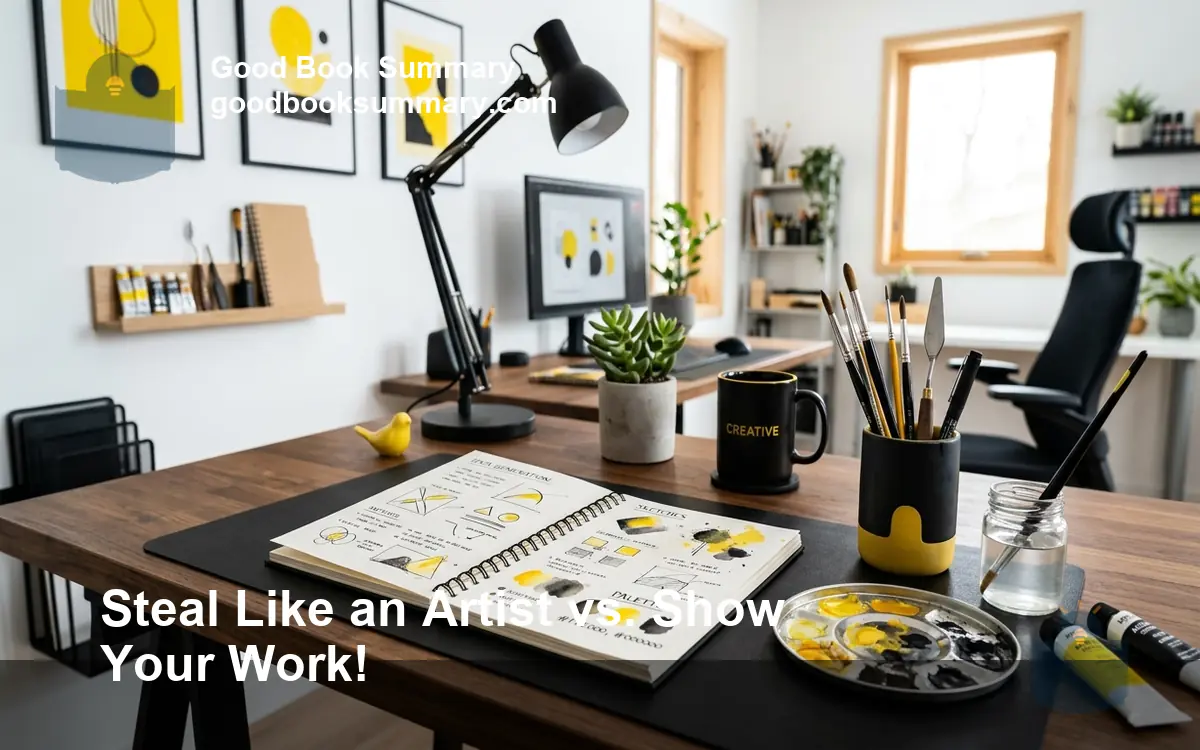
The structural fix Kleon proposes is the two desk workspace, physically separating an analog station stocked with markers, index cards, and notebooks from a digital station reserved for scanning, editing, and publishing finished material. Ideas get generated at the first desk without the temptation of a delete key, then get executed and shared at the second. Paired with this workspace split is the cabinet of curiosities, a personal, selective archive of found material that speaks to a creator's specific sensibility. New York City sanitation worker Nelson Molina is cited as an extreme example, having built an entire Trash Museum on East 99th Street out of objects he selectively rescued from the trash rather than hoarding everything he came across, which the book uses to argue that curation itself is a creative act.
Stock and flow: turning daily sharing into durable work
Show Your Work! borrows the economic concept of stock and flow to describe two different timescales of creative output. Flow is the stream of small, frequent updates such as a sketch, a link, or a short status post, while stock is the substantial, durable material such as a finished chapter or a completed project that continues to hold value long after it was published. A sustainable creative practice needs both categories operating simultaneously, with daily flow acting as the visible surface of a much larger body of stock being assembled in the background.
Before publishing any piece of flow, the book proposes a quick filter called the so what test, a simple check for whether a given update is useful or interesting to anyone besides the creator before it gets shared. Musician Bradford Cox of Deerhunter is offered as a case study of someone whose earliest flow, recordings he made as a kid imagining what his favorite bands' unreleased albums might sound like, eventually matured directly into real Deerhunter material, illustrating how flow can convert into stock over a long enough timeline. Roughly two to three concrete practices repeat across this section of the book: daily notebook entries, a swipe file of stolen references, and a public dispatch schedule measured in single digit minutes rather than hours.
Side projects, narrative value, and productive procrastination
Kleon's advice to write the book you want to read extends into a broader argument that side projects and hobbies deserve serious creative attention rather than dismissal as distractions. The practice is labeled productive procrastination, the habit of bouncing between multiple active projects when momentum on one stalls instead of forcing continued output on a single stuck idea. The book's claim, stated directly, is that whatever work a person does while procrastinating from their main project is often the work they should be doing permanently.
The other major concept in this section is narrative value, the measurable increase in an object's worth once it is wrapped in a compelling and truthful story. The Significant Objects experiment run by writers Joshua Glenn and Rob Walker is the book's central evidence: minor thrift store items purchased for an average of 1.25 dollars each were paired with invented short stories written by different authors, then resold on eBay for a combined total of 3,612.51 dollars. The gap between the purchase price and the resale price is presented as a direct, measurable demonstration that storytelling changes an object's value in ways buyers can act on, not just a marketing metaphor.
Obscurity, teaching, and the open node
Obscurity is described in Show Your Work! as a temporary gift rather than a problem to escape immediately, since a lack of public attention gives a new creator room to fail, experiment, and figure out their interests without an audience watching every misstep. Once a creator's skills develop past that early stage, the book pivots to an argument about generosity: sharing techniques, recipes, and process details openly is framed as promotion rather than risk. Professional chefs are cited as the model, since an entire industry built around publishing cookbooks and opening kitchens to the public has not destroyed the value of restaurant meals.
This generosity principle extends into the idea of the open node, a term the book credits to writer Blake Butler for describing a creator who actively listens, shares other people's work, and participates in a network instead of only broadcasting personal updates. The opposite behavior, referred to as human spam, is a creator who treats every online interaction as a chance to point back to their own material. Apply these concepts by dividing your creative practice into active sharing and structured execution. Treat your digital network as an open node where you share others' work, and write public fan letters to build a community of collaborators. Maintain a stable, boring day job to secure financial independence, and use strict creative constraints to overcome creative block.
Public fan letters, meaning blog posts or dedicated pieces of work made in open tribute to an admired creator and linked back to that creator's own site, are offered as the specific tactic for becoming an open node without waiting for permission or an existing platform.
Handling criticism without losing momentum
Putting work into public view guarantees exposure to criticism, and both books treat thick skin as a trained skill rather than a fixed personality trait. Illustrator Natalie Dee's observation, that museums never install a comment box directly under a painting for visitors to record their opinions, is used to argue that public creators do not owe every critic a forum either. The practical technique built from this idea is described as a cleanup routine: nasty comments get deleted or blocked the same way a mess in a living room gets cleaned up immediately rather than debated.
Underneath the specific tactic is a broader claim that validation is for parking, meaning external approval should function as a brief, situational check rather than the fuel driving the entire creative practice, since a creator loses all control over how an audience reacts the moment work is released.
Resistance: Steal Like an Artist vs. Show Your Work! Philosophy for Creators
Across both books, resistance functions as the umbrella term for the internal and external forces that stop creative output before it starts. The Forms of resistance: 3 Types Table below organizes the specific forms of resistance the books name along with the protocol each book proposes for working through them.
Forms of resistance: 3 Types Table
| Type of resistance | Core barrier | Protocol to overcome it |
|---|---|---|
| The lone genius myth | Believing creativity requires a solitary connection to inspiration | Adopt the scenius model and treat ideas as a product of a collaborative network |
| Impostor syndrome | Feeling unqualified to start before a personal style exists | Use the fake it until you make it strategy and perform the work until it becomes real |
| Perfectionism and screen fatigue | Editing ideas to death before they are fully formed | Separate the workspace into an analog desk and a digital desk |
| Creative entitlement | Broadcasting only personal updates without engaging the wider network | Act as an open node by listening, sharing, and attributing others' work |
| Fear of public criticism | Avoiding release of work due to anticipated trolling | Apply the living room cleanup rule and treat validation as incidental, not required |
| Option paralysis | Freezing under the belief that any tool, time, or budget is available | Embrace subtraction and work inside deliberate, narrow constraints |
Financial stability and the case for a day job
Show Your Work! pushes back directly against the idea that commercial stability compromises creative integrity. The book states plainly that funding has always been part of the creative process, pointing out that even Renaissance era artists depended on patrons to sustain their output. Musician Bill Withers is cited defending the word entrepreneur over the word sellout, arguing that a sold out sign is the best sign any business, including a creative one, can put up. Poet Philip Larkin's approach of keeping a day job as a librarian is presented as a working example of using steady, unrelated employment as a refuge that protects creative energy rather than draining it.
Choosing collaborators and partners carefully is treated as part of the same financial and emotional infrastructure. Musician Tom Waits credits his wife and collaborator Kathleen Brennan with helping him escape a period of creative stagnation, which the book uses to argue that a supportive personal circle functions as practical infrastructure rather than a purely sentimental benefit. On the habit side, a simple logbook, a physical calendar marked with each day's progress, is offered as the low tech tracking method Kleon used while writing his first book, turning slow, incremental progress into something visibly measurable over months.
Creativity is subtraction: constraints and starting over
The final concept threading through both books reframes limitation as an engine rather than an obstacle. Author Dr. Seuss is cited twice for this idea: The Cat in the Hat was written using only 236 different words, and Green Eggs and Ham was written on a bet to use no more than 50 different words total. Both results are treated as proof that narrow constraints force sharper, more memorable creative choices than unlimited freedom does. What are the key takeaways from steal like an artist vs show your work by Austin Kleon? Key takeaways include: nothing is completely original since all creative work builds on precedent, imitating heroes reveals a creator's own unique flaws and style, thinking in terms of process rather than product turns a creator into a documentarian, owning a small corner of the internet turns daily flow into durable stock over time, and deliberately building an influence tree keeps the intake of new ideas structured instead of random.
The practice never fully concludes according to this framework. Chain smoking projects, the habit of starting a new piece of work directly from the momentum of the one just finished rather than pausing indefinitely between projects, is the book's proposed defense against the flat, directionless period that often follows a launch. A creator who has just abandoned one project, since the book insists work is never finished, only abandoned, is instructed to already have the next constraint chosen before the current project ships.
The Practice Protocol: Steal Like an Artist vs. Show Your Work! Numbered Routine
The numbered protocol below compresses both books into a repeatable daily and weekly routine rather than a one time reading exercise.
- Build an influence tree. Pick one creator whose work connects, identify the three people who most influenced them, and study each of those three in turn before moving further up the tree.
- Set up two desks. Keep one analog station stocked with paper and markers for generating raw ideas, and one digital station reserved strictly for editing and publishing finished material.
- Document daily. Keep a notebook or swipe file of references, half formed thoughts, and photographs, and run each entry through the so what test before deciding whether it becomes a public post.
- Share one small dispatch every day. Post a single sketch, link, tip, or progress note publicly, prioritizing consistency over polish.
- Act as an open node. Spend at least as much time sharing, attributing, and responding to other people's work as promoting personal updates.
6. Protect the practice financially. Keep a stable source of income, whether a day job or another form of steady work, that removes the pressure for every creative output to generate income immediately.
7. Work inside a constraint. Choose one deliberate limitation, a word count, a color palette, a tool restriction, before starting the next project rather than working with unlimited options.
Reader perspective: where the system holds up and where it strains
The combined framework has clear strengths for creators working in visual art, writing, music, and design fields where a personal body of work and an online audience genuinely compound over time. The stock and flow model in particular maps cleanly onto how blogs, newsletters, and social platforms actually reward consistency, and the influence tree gives beginners a concrete research method instead of vague advice to find their voice.
The system strains in a few specific places worth naming honestly. The day job advice assumes a level of schedule flexibility and physical or mental capacity that not every reader has, and the advice to ignore public criticism can be harder to apply for creators in fields where feedback carries professional consequences rather than just emotional discomfort. The open node model also depends on platforms that reward attribution and sharing, and algorithm changes on major platforms since the book's original publication have made pure chronological sharing less reliable as a discovery method than it was when Show Your Work! was first released. None of these gaps undermine the core argument about process and influence, but a reader applying the system today should adapt the specific platform tactics rather than following them literally.