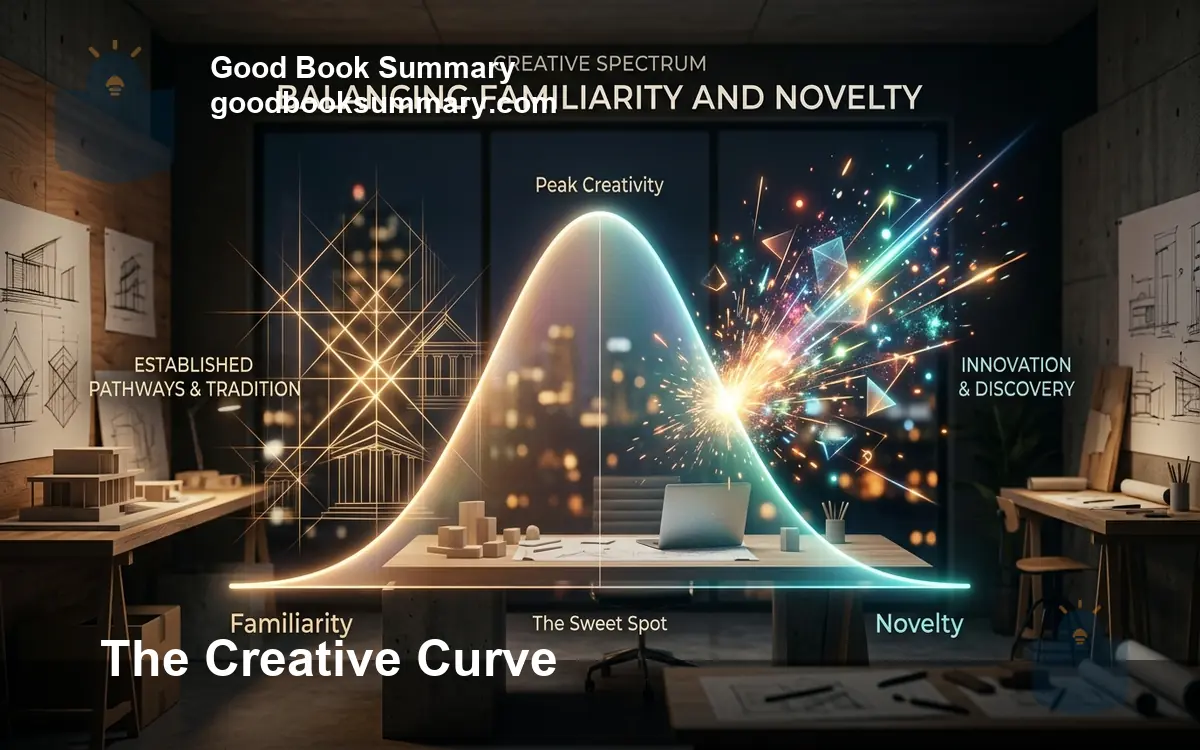
The creative curve is Allen Gannett's model for predicting mainstream creative success. In his 2018 book "The Creative Curve," he defines it as the bell-shaped relationship between how much an audience has been exposed to an idea and how much that audience prefers it. Two terms carry the argument. Familiarity is how easily a person's brain processes a stimulus after prior exposure. Novelty is the dopamine-linked reward signal the brain releases when it meets something new. Gannett's central claim is that creativity is a learnable output of four repeatable behaviors: consumption, imitation, community building, and iteration. It is not a fixed trait that some people are born with and others lack. Commercial hits, he argues, land at one specific point on the curve. They are familiar enough that an audience processes them with ease, and novel enough that the same audience still gets a reward signal for paying attention.
| Aspect of strategy | The creative curve system | The inspiration theory |
|---|---|---|
| Core philosophy | Creativity is a learnable, systematic process | Creativity is a mystical spark reserved for a few |
| Time allocation | 20 percent of waking hours on niche-specific consumption | Passive waiting for a moment of insight |
| Execution method | Daily routine of deconstruction, imitation, and structured feedback | Unstructured, free-flowing brainstorming |
| Validation loop | Data-driven cycles of conceptualization, reduction, curation, and feedback | Isolated confidence in a single idea |
| Role of community | A structured four-person network of specific roles | A single creator working alone |
Why the inspiration myth about creative genius does not match the evidence
The book opens by taking apart what Gannett calls the inspiration theory of creativity, the widespread belief that breakthroughs arrive as sudden, uncontrollable flashes and not as the product of structured effort. Paul McCartney has described waking up with the finished melody for "Yesterday" already in his head around 1964. Musicologists who studied the song afterward noted its resemblance to earlier standards McCartney had absorbed during the Beatles' years of constant performance in Hamburg and Liverpool. What looked like divine inspiration lines up with years of subconscious processing of music he already knew. J.K. Rowling's account of dreaming up Harry Potter on a Manchester to London train ride follows the same shape. Her surviving archives show years of outlining, character dossiers, and drafting behind that one remembered moment.
The myth carries costs beyond storytelling. Survey data cited in marketing research reports that only a small minority of consumer advertising campaigns hit their stated business targets. Gannett puts this down to unstructured brainstorming sessions and open office layouts that do not reliably produce usable ideas. A separate global benchmark study of 5,000 respondents, commissioned by Adobe as the "State of Create" study, found that roughly 75 percent of participants felt they were not living up to their own creative potential. Gannett calls the result consumer pacifism. People who assume creativity requires innate genius quietly give up on original work and settle into passively consuming what others make.
The brainstorming fallacy makes the problem worse inside organizations. Open floor plans and free-association whiteboard sessions rest on a common assumption that stripping away structure will unlock breakthrough ideas on its own. Yet the marketing failure rates above describe workplaces built almost entirely around that assumption. Gannett's alternative is active preparation: deliberate consumption and repeated practice inside one medium, which lets the subconscious run background work on material a person already knows well. Chef Jose Andres has described the idea for his salt air margarita arriving suddenly while he was walking, a moment that felt spontaneous but reflected years of culinary technique recombining below conscious awareness. The same pattern runs through McCartney, Rowling, and Andres. What looks like a single lightning strike traces back to a long, unglamorous stretch of preparation.
Where the genius myth in creativity originated and why IQ stops predicting it
The idea that creativity depends on innate gifts goes back to the ancient Greeks, who treated poets as passive vessels for the Muses, unable to compose rational verse until some outside force possessed them. Twentieth-century psychology dressed this old belief in scientific clothing through the spread of IQ testing. For decades people simply assumed that high intelligence predicts high creative output, and no one tested the assumption directly.
Lewis Terman's long-running Genetic Studies of Genius tracked roughly 1,500 children with exceptionally high IQs starting in the 1920s and followed their careers for decades. His subjects became successful, well-adjusted professionals, but not one became a world-class creative figure on the scale of a Nobel laureate or a major artist. Two children were turned away from the study for scoring below the entrance threshold, William Shockley and Luis Alvarez, and both later won Nobel Prizes in Physics. A subsequent study by Donald MacKinnon at UC Berkeley found that IQ tracked the quantity of ideas a person generated only up to an IQ of roughly 120, before the correlation flattened out entirely. Psychologists call this the threshold theory. Past a moderate IQ level, a large share of the general population shares the same baseline creative potential as certified geniuses. Intelligence sets a floor for creative output, not a ceiling.
The Greek framing behind the myth is worth pinning down, because it still shapes how modern culture talks about inspiration. Plato described poets as holy vessels who could not compose until an outside divine power displaced their own reason. That picture of the artist as a channel for forces beyond personal control survived centuries of Western art criticism and came back almost unchanged when twentieth-century psychology needed a way to explain why some people scored higher on newly invented intelligence tests. Terman's study matters here because it ran for decades and followed real careers, not just test scores. That is what makes a comparison this sharp possible: two rejected applicants went on to win Nobel Prizes in Physics, while the study's own high-IQ group produced accomplished professionals and no comparable creative legends.
What builds real creative talent when genetics do not
Gannett treats talent as a product of neuroplasticity, the brain's physical capacity to rewire itself in response to sustained, targeted effort. It is not a genetic lottery result. That mechanism is distinct from the popularized 10,000-hour rule, which implies that simple repetition builds mastery. Psychologist K. Anders Ericsson, whose research on elite violinists became the raw material for that popularized rule, has said publicly that his findings were mischaracterized. Passive repetition does not build expertise on its own. Expertise comes from deliberate practice, which combines specific goals, expert supervision, and immediate corrective feedback that keeps pushing a person past their current skill ceiling.
Jonathan Hardesty is a concrete case. He started in his early twenties with no formal training, committed to daily drawing and painting, and enrolled in a classical atelier program, where he trained under direct supervision for long daily sessions across more than a decade before he became a recognized hyperrealistic painter. Neuroplasticity research supports the mechanism behind that change. Research led by Eleanor Maguire on London taxi drivers who memorize the city's complex street grid showed measurably larger posterior hippocampi than non-drivers, and adult brains keep generating new neurons in the hippocampus throughout life when challenged with unfamiliar tasks. Talent, in this framing, sits closer to a trained physical skill than a fixed inherited trait.
Deliberate practice differs from ordinary rehearsal in four specific ways. It needs a defined goal for each session, supervision from someone more skilled than the practitioner, feedback fast enough to correct the next attempt, and a difficulty level that stays just past the practitioner's comfort zone. Hardesty's atelier years met all four conditions at once, which is much of why Gannett treats his case as representative and not exceptional. Ericsson's correction of the 10,000-hour rule matters because it draws a sharp line between how much time is spent and how the time is structured. Someone who repeats the same unsupervised routine for a decade builds comfort with that routine, not necessarily expertise. Someone who trains under the four conditions above can compress years of progress into a fraction of the calendar time.
What genius means once gatekeepers get involved
Even flawless technical skill does not guarantee recognition, because Gannett treats genius as a social label and not an objective property of the work. He draws on psychologist Mihaly Csikszentmihalyi's systems model of creativity, which holds that creative status comes from three interacting elements: the domain, meaning the established standards of a craft; the individual, who produces the work; and the field, the network of critics, editors, and gatekeepers who decide whether the work counts as valuable. A painting only becomes creative in the cultural sense once critics, galleries, and institutions validate it.
Csikszentmihalyi's long-running study of art students found that the reclusive, lone-genius personalities praised in art school rarely succeeded afterward. The graduates who built lasting careers paired technical skill with practical self-promotion. Charles Darwin and Alfred Wallace independently arrived at the theory of natural selection, yet Darwin alone is remembered as the sole genius behind it. Gannett puts that gap down to Darwin's wealth, academic standing, and active cultivation of relationships with scientific gatekeepers, not to any difference in the underlying insight. Romance novelist Kristen Ashley shows the same dynamic in reverse. After traditional publishers rejected her manuscripts, she used self-publishing platforms to go around those gatekeepers, and she sold millions of copies across dozens of novels by building a relationship with readers instead of editors.
The domain, the accumulated standards and historical output of a craft, is the familiarity half of the equation this article builds toward below. A composer needs working knowledge of prior symphonies before a new musical choice registers as a meaningful twist and not noise, and a startup founder needs working knowledge of prior product launches before a pitch reads as genuinely novel to an investor and not just unfamiliar. Csikszentmihalyi's field, the network of critics, editors, and producers who decide what counts as valuable inside a domain, is what converts technical competence into the social label of genius. Skip either half of that equation, master the domain without engaging the field, or court the field without mastering the domain, and the usual result is technically capable work that never gets public recognition.
How the creative curve balances familiarity and novelty
The mechanism at the center of the book rests on two competing evolutionary drives. Neophobia is the brain's inherited caution toward unfamiliar stimuli. Neophilia is its competing pull toward novel ones. Psychologist Robert Zajonc ran exposure experiments that repeatedly showed participants nonsense characters, and he found that repeated harmless exposure to a stimulus reliably raises a person's preference for it, a pattern researchers call the mere exposure effect. Separate fMRI research led by neuroscientist Gregory Berns has shown that novel images fire the brain's midbrain reward center, including the ventral striatum, releasing a dopamine response Gannett calls the novelty bonus. Zajonc's data also showed the limit of exposure. Preference climbs with repeated contact up to a point, then reverses once a stimulus grows so familiar that its novelty bonus decays to zero. Gannett calls that inflection the point of cliche. He points to the Ed Hardy clothing brand's fast rise and collapse in the late 2000s as a commercial example of overexposure destroying a once-novel product.
The familiarity-novelty matrix below maps four resulting zones.
| Low novelty | High novelty | |
|---|---|---|
| Low familiarity | Obsolete: no relevance, no reward signal | Avant-garde: triggers avoidance, appeals only to fringe audiences |
| High familiarity | Cliche: easy to process but past the reward threshold | Sweet spot: familiar baseline with a smaller novel twist |
The mathematical modeling of this preference curve represents the trade-off between exposure and novelty reward:
In prose, Gannett describes the relationship as an inverted U-shape. Preference climbs as growing familiarity makes a stimulus easier to process, peaks at the point of best tension between the familiar and the novel, then falls past the point of cliche once repeated exposure erases the novelty bonus. Musicologist Tuomas Eerola charted the Beatles' use of sitar and other experimental instrumentation across their catalog and found it followed this exact arc: it rose gradually as listeners grew used to it, peaked on "Sgt. Pepper's Lonely Hearts Club Band," then receded before it turned into a stale gimmick. Facebook's early product team ran the same logic against a failed competitor, CampusNetwork, which overwhelmed new users with an unfamiliar wall of simultaneous features. Mark Zuckerberg's team held Facebook's early feature set down on purpose and introduced complexity gradually, so novelty never outran the audience's tolerance for the unfamiliar.
The creative curve framework explained
The creative curve framework brings together the biological mechanics of novelty with four practical laws of execution. Rather than treating creativity as an unpredictable spark, the framework divides creative output into four observable, trainable phases:
- Phase 1: Deep immersion (20% Principle): Flooding the subconscious mind with historical domain data to establish clear benchmarks of familiarity.
- Phase 2: Structured deconstruction (Franklin Method): Re-engineering proven masterworks to discover the hidden mechanics and constraints of great work.
- Phase 3: Network cultivation (The Four-Person Group): Establishing a diverse social brain trust that sharpens execution, covers blind spots, and unlocks distribution.
- Phase 4: Algorithmic iteration (Data-Driven Refinement): Testing prototypes objectively to validate audience preference before committing production capital.
Law I: consumption and the 20 percent principle
Gannett's first law asks creators to spend roughly 20 percent of their waking hours, about three to four hours a day, on focused consumption inside their chosen field. He calls it the 20 percent principle, and its purpose is to build cultural awareness, a working sense of what counts as familiar, good, or already cliche inside a specific domain. Ted Sarandos started his career at a video rental store in the early 1980s, watching films for entire shifts until he could predict what a given customer would want next. That library of examples became the foundation for his later work as Chief Content Officer and Co-CEO of Netflix, where he has described designing hits like "Stranger Things" by keeping one foot in familiar 1980s genre conventions and one foot in modern storytelling.
Entrepreneur Kevin Ryan applied the same principle outside entertainment. After he watched a long line of shoppers wait for a designer sample sale in New York, he connected the pattern to Vente-privee, a French flash-sale site he had studied, and used that match to launch Gilt Groupe with no direct fashion industry experience. Neuroscientist Edward Bowden's research on insight supports the mechanism behind these moments. Sudden flashes of insight correlate with activation in the brain's right hemisphere, but that activation only yields a usable idea once a person has built a dense baseline of prior knowledge to draw on. In this model, consumption is the raw material insight is built from, not a substitute for it.
The mental library built this way is what Gannett calls a set of exemplars and prototypes, cognitive reference points the brain uses to place a new idea in a category and gauge how far it sits from that category's norms. Without a stocked set of exemplars, a person can still generate ideas but loses the ability to judge whether an idea reads as familiar, novel, or simply confusing to an outside audience. The 20 percent principle exists to build that judgment. Four hours a day sounds steep in isolation, yet Sarandos's video-store years and Ryan's retail-floor observation both happened inside ordinary jobs, not dedicated study time. That suggests the principle works as well through targeted attention during existing routines as through blocked-off study sessions.
Law II: imitation and the Franklin method
The second law reframes imitation as a legitimate creative technique, not a shortcut around originality. Gannett names it the Franklin method after Benjamin Franklin's own writing practice. As a young man ashamed of his prose, Franklin read essays from the British publication "The Spectator," outlined their arguments, rebuilt the essays from memory days later, then compared his version against the original to find specific gaps in vocabulary and logical structure. He repeated the cycle until his writing matched the models he studied.
Author Andrew Ross Sorkin followed a similar process before writing "Too Big to Fail" and co-creating the television series "Billions." He studied the pacing and scene construction of writers he admired and applied those structural patterns to complex financial reporting. Kurt Vonnegut mapped recurring story shapes, patterns like "Man in Hole," onto a simple graph of fortune against time. A University of Vermont research team led by Andrew Reagan later ran computational sentiment analysis across thousands of novels and confirmed that commercially successful stories tend to follow these same basic emotional arcs. Constraints do the same structural work at a smaller scale. Sitcom creator Kenya Barris has said the rigid three-act, 22-minute sitcom format he uses on "Black-ish" organizes his thinking instead of limiting it, because the format guarantees a baseline of familiarity that frees his creative energy for the show's specific cultural content.
Gannett's broader term for this is remix culture, his observation that almost all creative output recombines existing material and does not invent something with no prior reference point. George Lucas built the original Star Wars trilogy by taking the familiar structure of Joseph Campbell's hero journey and classic Westerns and moving it into a space setting with laser weapons and starships, a swap that kept a recognizable story shape while introducing a visually novel world. Constraints are the delivery mechanism for that familiarity. A sitcom's runtime, a sonnet's line count, and a recipe's ingredient ratios all force a creator to work inside a known structure, which frees attention for the smaller share of the work where genuine novelty belongs, and spares the creator from reinventing structural basics on every project.
Law III: building a four-person creative community
Gannett's third law treats creativity as a social process that depends on a specific network, not on individual willpower. He describes four distinct, non-overlapping roles a creator needs. A master teacher supplies deliberate practice and structured feedback, the role producer Max Martin has filled for pop songwriters and vocalists. A conflicting collaborator covers a creator's weaknesses directly, the pairing Brenda Chapman relied on while directing Pixar's "Brave," where story artists, animators, and sound engineers handled technical territory outside her expertise. A modern muse supplies motivation and competitive pressure, the function YouTuber Connor Franta has described finding among successful musicians and apparel designers as he moved beyond video into retail. A prominent promoter lends existing credibility to a newcomer, shown by country band Rascal Flatts hiring a teenage Taylor Swift as their opening act in 2006, and by Swift later returning the favor by bringing an unknown Shawn Mendes onto her 1989 World Tour.
Csikszentmihalyi's study of art students found that several of the most successful graduates rented shared lofts before finishing school, informal spaces where they hosted gatherings, met gatekeepers, and built reputations well before their formal careers began. Sociologist Harriet Zuckerman's research on Nobel laureates found a similar concentration effect: laureates were disproportionately trained under other laureates, because established mentors who shared credit and co-authored papers with younger scientists gave their students a compounding advantage later on. Knowledge spillover, the informal sharing of techniques and ideas inside dense professional networks, shows up repeatedly across these cases as the mechanism that connects individual skill to eventual recognition.
Gannett is careful to keep these four roles separate, and not to treat community as one undifferentiated support network. A master teacher without a conflicting collaborator can sharpen a creator's technique yet never catch the specific blind spots that only surface once a second, differently skilled person examines the same work. A modern muse without a prominent promoter can keep a creator motivated indefinitely yet never connect that motivation to an audience large enough to matter commercially. The Rascal Flatts and Shawn Mendes example works precisely because it shows the promoter role passing forward: established figures lend credibility to newcomers who later become established themselves, the same compounding pattern Zuckerman documented among Nobel laureates decades earlier.
Law IV: the data-driven iteration loop
The final law swaps guesswork for a structured four-stage feedback cycle: conceptualization, reduction, curation, and feedback. Ben and Jerry's flavor development process, planned roughly two years ahead of launch, walks through all four stages. The team starts with a large pool of candidate flavor concepts, tests purchase intent and novelty ratings through a large subscriber newsletter to cut the list to a short list of finalists, develops physical test batches of the survivors in scoop shops, then tracks real sales data before retiring underperformers to what the company calls its flavor graveyard.
Film producer Nina Jacobson, known for "The Hunger Games" franchise, runs a comparable process through test screenings, using structured audience feedback on pacing and character likability to guide post-production edits before a film's release. J.K. Rowling's planning for the Harry Potter series shows the same discipline at the writing stage. Her archived materials include multiple separate drafts of the first chapter alone, plus character dossiers and spreadsheets mapping chapters against subplots across all seven books, evidence that the finished series came out of iteration and not a single unrevised flash of inspiration.
The four stages work together as a funnel, not as independent checkpoints. Conceptualization deliberately produces far more raw ideas than a team could ever ship, on the theory that volume at this stage guards against anchoring on the first plausible option. Reduction then applies audience data instead of internal opinion to cut that oversized list to a manageable shortlist, the step Ben and Jerry's runs through its subscriber newsletter and the one Gannett treats as the most commonly skipped stage among creators who rely on personal judgment. Curation turns the surviving shortlist into physical or working prototypes. Feedback closes the loop by measuring how those prototypes actually perform once real audiences interact with them, then feeds the result back into the next round of conceptualization.
Allen Gannett habit framework for turning creativity into daily practice
To ensure the four laws do not remain abstract concepts, the Allen Gannett habit framework establishes clear behavioral anchors. Practicing creativity requires daily adherence to structured routines rather than erratic bursts of effort.
Routine vs technique in creative practice
While creative technique refers to domain-specific skills such as syntax, color harmony, or chord progressions, creative routine governs the operational discipline required to execute those techniques consistently. Elite performers rely on established work routines to lower cognitive friction, ensuring that their creative energy is spent on problem-solving rather than task initiation.
3. Focus block execution
The execution of deep focus blocks represents the cornerstone of creative productivity. Dividing the workday into distinct cognitive zones protects creators from distraction:
- Morning Focus Block: 90 to 120 minutes of uninterrupted, deep creative synthesis and generative output.
- Midday Deliberate Immersion: 60 to 90 minutes of active domain consumption, tracking structural patterns in peer works.
- Afternoon Feedback & Collaboration: Interacting with collaborators, testing iterations, and gathering quantitative performance metrics.
The four laws creative execution checklist
- [ ] 20% Consumption Rule: Spend 3 to 4 hours daily consuming and analyzing top work in your target domain.
- [ ] Franklin Method Practice: Deconstruct one masterwork weekly from memory and compare your recreation side by side.
- [ ] Community Assembly: Actively engage a master teacher, conflicting collaborator, modern muse, and prominent promoter.
- [ ] Data-Driven Iteration Loop: Run ideas through conceptualization, reduction, curation, and audience feedback before scaling.
How to apply the creative curve routine in daily life
Gannett's four laws compress into a routine a creator can run on a repeating daily and weekly cycle.
- Run a two-hour focus block early in the day as uninterrupted production time inside your existing craft, working within the standard formats and constraints of your field instead of waiting for a specific mood to strike.
- Schedule a separate one-to-two-hour consumption block to analyze the highest-rated work in your niche, noting exactly how each piece balances a familiar baseline against its novel elements.
- Apply the Franklin method to one masterwork per week: outline a piece you admire from memory, rewrite your own version without looking at the original, then compare the two side by side to isolate specific structural gaps.
- Check in with your creative community on a fixed weekly schedule by sharing a draft with your conflicting collaborator or master teacher, collecting direct feedback, and logging the specific changes it produces in your next revision.
- Run your ideas through the four-stage iteration loop before you commit to one: generate a wide list of concepts, reduce it using audience surveys or informal polling, build a small prototype of the finalists, and track real engagement data before you finalize your direction.
- Audit your familiarity-to-novelty ratio before you ship anything: confirm your idea holds a mostly familiar structural baseline, then layer in the smaller novel twist meant to trigger the novelty bonus. A project with too little familiar grounding tends to read as avant-garde instead of exciting.
Where the creative curve theory holds up and where it strains
The book's strongest contribution is turning a subjective process into a set of testable, repeatable habits, and much of the psychology it draws on, the mere exposure effect, threshold theory, and Csikszentmihalyi's systems model, comes from peer-reviewed sources independent of Gannett's own argument. The four laws also map cleanly onto real production workflows at companies like Netflix and Ben and Jerry's, which gives the framework practical texture beyond abstract theory.
The framework has real limits worth naming plainly. The familiarity-to-novelty ratios Gannett cites, a mostly familiar baseline paired with a smaller novel twist, work as a useful heuristic and not as a measured constant validated across creative fields. The case studies also lean heavily on people who already had access to elite networks, well-funded companies, or major media platforms, which raises a fair question about how directly the four laws carry over to a creator with far fewer existing resources or connections. Read as a structured set of habits and not a guaranteed formula, the system gives working creators a concrete starting point the inspiration myth never offered.
Related book summaries worth reading next
- Show Your Work! by Austin Kleon book summary
- Steal Like an Artist by Austin Kleon book summary
- Atomic Habits by James Clear book summary
- Deep Work by Cal Newport book summary
Frequently Asked Questions
What is the main summary of The Creative Curve?
The Creative Curve by Allen Gannett explains that creative success is a learnable, repeatable system rather than an innate genetic gift or random flash of inspiration. By balancing familiarity with novelty across four core laws—consumption, imitation, creative communities, and data-driven iteration—creators consistently engineer commercial breakthroughs that appeal directly to mainstream audiences.
What are the key takeaways from The Creative Curve by Allen Gannett?
The key takeaways from The Creative Curve by Allen Gannett center on four fundamental laws: devoting 20 percent of daily time to niche consumption, using the Franklin method to deconstruct and imitate masterworks, assembling a four-member support community, and running a structured four-stage data iteration loop to refine ideas.
How to apply the key concepts of The Creative Curve in daily life?
To apply the key concepts of The Creative Curve in daily life, creators must establish dedicated daily consumption and production blocks, practice deliberate imitation of proven frameworks, seek candid feedback from mentors and collaborators, and gather objective audience data before investing heavy resources into large-scale creative execution.