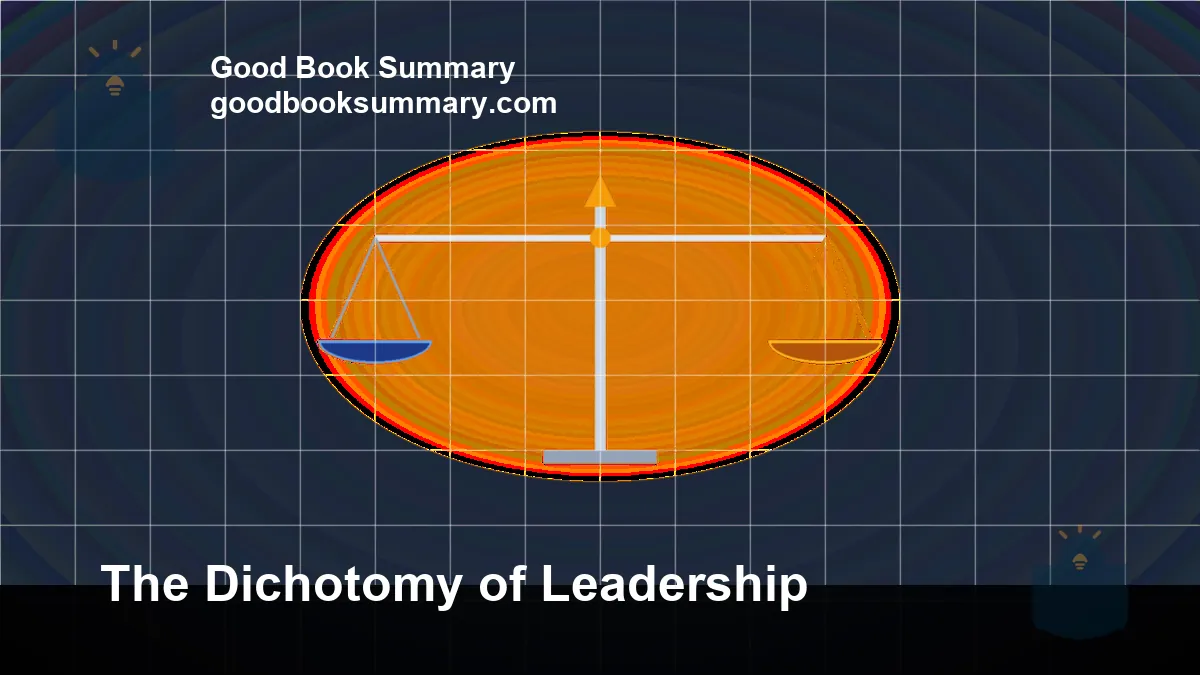
The Dichotomy of Leadership by Jocko Willink and Leif Babin presents leadership as a continuous balancing process in which effective leaders manage opposing demands without allowing any single leadership quality to become destructive. The book extends the principles of Extreme Ownership and Decentralized Command into a practical framework covering 12 chapters, with the first 6 chapters focused on balancing people, mission, standards, training, and action, and the final 6 focused on personal judgment and strategic execution.
The central principle is simple: a leadership strength becomes a weakness when applied without judgment. Discipline can become rigidity. Accountability can become micromanagement. Humility can become passivity. Aggression can become recklessness. Detachment can become disengagement. The leader's task is to recognize where the current behavior sits on that spectrum and move it toward the level required by the mission.
| Leadership principle | Extreme application that creates failure | Balanced execution |
|---|---|---|
| Ownership | Micromanagement and dependency | Take responsibility while empowering others |
| Discipline | Rigid compliance with procedures | Follow standards while adapting to reality |
| Accountability | Constant inspections and hand-holding | Teach the "why" and build self-accountability |
| Training | Crushing difficulty or excessive comfort | Realistic pressure at a productive intensity |
| Aggression | Reckless action without risk analysis | Proactive action with risk mitigation |
| Planning | No preparation or excessive contingency planning | Simple plans for likely threats |
| Humility | Passive acceptance of bad decisions | Accept feedback while pushing back when necessary |
| Focus | Obsession with tactical details | Stay close enough to understand while retaining perspective |
What does the book add to Extreme Ownership?
The Dichotomy of Leadership explains leadership as a balance between opposing demands. Across 12 chapters, Jocko Willink and Leif Babin show how leaders can combine ownership with empowerment, discipline with adaptability, accountability with trust, planning with flexibility, humility with courage, and tactical focus with strategic detachment. The book uses combat experiences and business consulting cases to show how extremes damage performance.
The book builds on the authors' earlier work in Extreme Ownership. The leadership problem examined here is more subtle. A leader can understand ownership and still fail by taking responsibility for every decision personally. A leader can value discipline and still damage a team through rigid enforcement. A leader can care deeply about employees and still harm the organization by refusing to remove a persistent underperformer.
The first 6 chapters establish the human and operational side of the dichotomy. The final 6 chapters move toward judgment, adaptability, and strategic perspective. Together, the 12 chapters describe leadership as a system of controlled adjustments.
The framework applies to military units, companies, managers, executives, and individual decision-making. The underlying question remains the same: what does the situation require now, and where has the leader moved too far toward one extreme?
The following video analysis provides an animated breakdown of Jocko Willink and Leif Babin's core dichotomy framework, which demonstrates how extreme leadership behaviors can be rebalanced into sustainable tactical strengths:
How does the dichotomy of leadership balance ownership and empowerment?
The first balance is responsibility versus delegation. A leader remains accountable for the team's results while allowing subordinate leaders to make decisions within clear boundaries. Willink and Babin describe Decentralized Command as the mechanism that prevents ownership from turning into micromanagement and delegation from turning into abandonment.
The second chapter, "Own It All, but enable Others," addresses one of the most common leadership failures. Leaders who become the solution to every problem create an organizational bottleneck. Employees stop solving problems because they learn that the safest action is to escalate every decision.
The source material calls this the "Easy Button" symptom. The leader answers every question, makes every decision, and eventually becomes saturated with tactical issues. The organization becomes dependent on one person.
The opposite extreme creates a different problem. Jocko's own pre-deployment maritime experience showed how excessive decentralization can allow standards to deteriorate. A leader who gives complete freedom without direction can create confusion, missed responsibilities, and poor execution.
The equilibrium requires three conditions:
- The leader accepts responsibility for the overall result.
- Junior leaders understand the commander's intent.
- Junior leaders retain authority over execution within defined boundaries.
The third chapter adds another dimension: leadership capital. Authority is finite. A leader can spend influence on critical standards, or waste it enforcing trivial preferences.
The radio-programming example illustrates the difference. Tactical radio competence directly affects communication and mission safety, so Jocko treated the standard as strategically important. Custom platoon patches had a different effect. Although they technically violated a rule, they strengthened unit cohesion and therefore had a different strategic value.
The contrast is useful in business. An executive who spends authority enforcing every minor administrative preference may have little influence left when a critical operational change becomes necessary. A leader should therefore rank standards according to consequences.
Leadership balance does not mean lowering standards. It means identifying which standards require absolute consistency and which allow reasonable discretion.
The practical test is straightforward: if breaking the rule creates a serious threat to the mission, safety, customer, or team, the leader should apply firm standards. If the consequence is minor and the rule exists mainly for uniformity, flexibility may preserve more leadership capital than strict enforcement.
How should leaders balance accountability and empowerment?
Accountability works best when team members understand why a standard exists and enforce it without constant supervision. The Dichotomy of Leadership distinguishes useful accountability from accountability saturation, where inspections consume the leader's time and prevent strategic work. The goal is self-policing behavior supported by clear standards, education, and trust.
Chapter 8 develops the principle through the idea of intrinsic accountability. In a high-performing team, employees understand that their individual behavior affects everyone else. That understanding creates peer pressure and self-correction.
Jocko's ballistic back-plate example illustrates the mechanism. After discovering that a SEAL operator lacked required protection, Jocko recognized that inspecting every individual's equipment before every operation would create an unsustainable leadership burden. The more durable solution was to explain why the equipment mattered. The team members then became responsible for maintaining the standard themselves.
The same mechanism appears in the business case involving technicians and CRM data. Management initially attempted to enforce detailed data entry through incentives and a 10% penalty. The penalty failed to create the desired behavior because technicians calculated that completing the forms could reduce installation volume and therefore their earnings.
The lesson is deeper than "explain the why." A standard must make operational sense to the person expected to follow it.
Accountability has three levels:
- External accountability: The leader checks the work.
- Internal accountability: The employee understands the reason and self-corrects.
- Peer accountability: Team members protect the standard collectively.
A leader who remains permanently at the first level creates dependency.
The accountability saturation point appears when inspections, reviews, approvals, and corrections consume most of the leader's working time. The leader then loses the capacity to work with senior leadership, anticipate future problems, develop people, and evaluate strategy.
The practical implication is significant for managers. A team with 20 employees cannot scale if every small decision requires executive approval. A manager who checks every data field may achieve short-term compliance while creating long-term dependency.
The better sequence is to establish the standard, explain its strategic purpose, train the team, verify performance, and then reduce unnecessary supervision as competence increases.
Accountability therefore becomes a developmental process. The leader starts with more oversight when the standard is unfamiliar or performance is unreliable. As the team demonstrates competence, the leader can shift from direct inspection toward outcome monitoring.
When should a leader lead, follow, or push back?
Effective leaders change positions according to the needs of the mission. They lead when their responsibility requires direction, follow when another person has superior knowledge or position, and push back when a higher-level decision creates serious strategic risk. Rank alone is an inadequate substitute for judgment, expertise, and trust.
Chapter 9 introduces the balance between leadership and followership. Willink and Babin describe "Rock, Scissors, Rank" as the weakest form of leadership because authority replaces reasoning.
A leader who says, "We are doing it my way because I outrank you," may win the immediate argument while damaging trust and suppressing useful information.
The South-Central canal patrol demonstrates the opposite behavior. Leif deferred to Chris, an experienced point man and sniper with significant combat experience, because Chris was in the best position to understand the tactical situation. Leif's willingness to follow did not reduce his leadership authority. It improved the platoon's decision.
The same principle applies to business. A CEO does not necessarily have the best answer about software architecture. A sales executive may not understand a technical implementation as well as an experienced engineer. A department head may know the broader strategy while a frontline employee understands the customer problem more accurately.
The hierarchy can therefore remain intact while decision-making moves toward the person with the most relevant knowledge.
Chapter 11 adds the other side of the equation: leading upward. Humility requires a leader to accept criticism, follow legitimate direction, and control ego. Passivity becomes dangerous when the leader recognizes a serious problem and remains silent.
The book's technology-company example involved approximately 30 department heads and leaders who believed a proposed software system would fail. Their failure was not simply disagreement with the CEO. Their failure was remaining passive instead of presenting a structured argument.
The military cases make the stakes more severe. Jocko describes pushing back against a directive involving the ratio of Iraqi soldiers to SEALs when he believed the requirement could put his team in unacceptable danger.
The principle is proportionality. A leader should not challenge every decision. Leadership capital is limited, and constant opposition reduces credibility. Pushback becomes necessary when the consequences involve mission failure, serious safety risks, or major strategic damage.
A strong follower executes legitimate decisions with commitment. A strong leader also recognizes when silence would make them responsible for a foreseeable failure.
How should leaders balance hard training with smart training?
The Dichotomy of Leadership argues that training must expose people to meaningful stress while preserving their ability to learn. Comfortable training leaves teams unprepared for pressure, while excessive difficulty can destroy morale and cognitive performance. Effective training increases difficulty progressively and tests whether junior leaders can operate when familiar support disappears.
Chapter 5, "Train Hard, but Train Smart," rejects two common training failures.
The first is comfort. A team that trains only under predictable conditions develops confidence without sufficient evidence that it can perform under pressure.
The second is destructive intensity. If training becomes so difficult that participants stop processing information, the exercise becomes a demonstration of suffering instead of a learning environment.
The "Big Walt is Dead" scenario illustrates the value of controlled disruption. During an urban training exercise, Jocko simulated the loss of Big Walt, an experienced platoon chief. The platoon struggled because junior leaders had become dependent on his presence.
The training exposed a structural weakness before the same weakness could emerge in an actual mission.
The concept can be applied to organizations through realistic role-play. A company that wants junior managers to handle difficult clients can simulate escalations, resource shortages, deadlines, customer complaints, and unexpected operational failures.
A useful training progression contains several levels:
- Teach the basic procedure.
- Repeat the procedure until the fundamentals become reliable.
- Add realistic stress.
- Remove expected support.
- Introduce unexpected changes.
- Debrief performance and identify specific weaknesses.
The objective is not maximum difficulty. The objective is maximum useful learning.
This distinction matters because training quality is difficult to measure through difficulty alone. A 60-minute exercise that overwhelms participants may produce less development than a controlled 30-minute scenario followed by a detailed debrief.
Chapter 6 applies a similar principle to operational aggression. "Aggressive" means proactive, not emotional or reckless. A leader should identify problems and act without waiting for permission when the commander's intent gives sufficient authority.
The Seth Stone flanking example represents controlled aggression. The action was decisive, but the decision remained connected to tactical risk.
The opposite example is the "Victory Disease," where repeated success creates excessive confidence. A company that succeeds in one market may assume that the same approach will automatically work in another market. Expansion then becomes a substitute for analysis.
Aggression is productive when paired with risk mitigation. It becomes destructive when confidence replaces judgment.
How should leaders plan without becoming trapped by their plans?
Planning should prepare a team for probable problems while preserving enough simplicity to adapt when reality changes. The Dichotomy of Leadership recommends concentrating contingency planning on roughly 3 or 4 likely scenarios plus the worst case, instead of designing microscopic responses to every imaginable event.
Chapter 10, "Plan, but Don't Overplan," identifies contingency overburden as a major leadership problem.
Leif's experience in downtown Ramadi provides the clearest example. He packed excessive equipment because he wanted to prepare for every possible problem. The additional weight exhausted him during an urban movement and reduced his situational awareness.
The planning problem was therefore paradoxical. Preparation intended to increase resilience created a new operational weakness.
The same issue appeared when SEAL teams spent excessive time designing detailed room-by-room clearance plans. Real operations changed as soon as unexpected conditions appeared. A plan that depended on exact sequences became difficult to adapt.
A useful plan therefore needs a hierarchy:
- Mission objective
- Commander's intent
- Primary approach
- 3 or 4 probable contingencies
- Worst-case response
- Decision boundaries for frontline leaders
This structure gives people enough information to act without requiring them to wait for headquarters when circumstances change.
The business example involving a rapidly expanding technology company follows the same logic. The company was pursuing several expansion initiatives at once, including new subsidiaries and significant overhead commitments. The COO needed a way to address the risks without becoming paralyzed by them.
The recommended approach was to identify the most probable threats and develop responses that management could control.
The number 3 or 4 matters because contingency planning has a cognitive cost. Every additional branch creates more information to remember, communicate, rehearse, and update.
Planning therefore should reduce uncertainty where possible without pretending uncertainty can be eliminated.
The same principle applies to personal productivity. A manager who plans every minute of a day may have a detailed schedule but no flexibility for unexpected customer issues, employee problems, or strategic opportunities. A simpler plan can preserve room for judgment.
The best plan is a framework for action, not a prediction that reality will behave exactly as expected.
How can leaders stay focused while maintaining strategic detachment?
Focused leadership requires attention to critical details without becoming trapped inside them. Willink and Babin describe mental detachment as the ability to step back, assess the larger situation, and make decisions from a broader perspective. The effective leader remains close enough to understand reality while far enough away to retain command.
Chapter 12, "Focused, but Detached," completes the six dichotomies from the book's second half.
The problem has two extremes. A leader who is too detached can become unaware of frontline reality. The source material calls this "battlefield aloofness." A leader who becomes too focused on details can lose the ability to understand the wider situation.
The kill-house example captures the balance. Leif initially positioned himself at the back of the train during room-clearance training. He could maintain perspective but could not see enough of the action to lead effectively. Moving too far forward created the opposite danger because he could become absorbed in tactical activity.
The useful position was the middle.
This principle also appears in the paintball exercise. A task-unit commander remained inside a Humvee, focused on a map while his simulated platoon was pinned down and suffering casualties. His physical separation became operational detachment.
Detachment therefore does not mean distance for its own sake. It means changing perspective when the current perspective is preventing good decisions.
A leader can use a simple cycle:
- Observe the immediate problem.
- Identify the larger mission.
- Separate urgent issues from important issues.
- Decide what must be personally handled.
- Delegate execution where possible.
- Reassess after the immediate crisis changes.
The "10,000 feet" metaphor in the source material represents this mental movement from tactical immersion toward strategic perspective.
This principle is especially relevant to executives. A leader who spends all day answering operational messages may feel highly productive while ignoring strategic work. The opposite leader who never examines operational details may make decisions based on inaccurate assumptions.
The answer is deliberate oscillation between detail and distance.
The authors' six later chapters can therefore be understood as a connected system. Discipline provides repeatability. Accountability creates standards. Followership keeps ego under control. Planning reduces avoidable risk. Humility permits correction. Detachment preserves strategic perspective.
Each principle becomes weaker when applied without its counterweight.
Which balance runs through all 12 chapters?
The key lesson is that leadership quality depends on balance. Across 12 chapters, Willink and Babin show that ownership needs empowerment, discipline needs adaptability, accountability needs trust, training needs judgment, aggression needs risk control, planning needs flexibility, humility needs courage, and focus needs detachment.
The first foundational insight is that leadership is situational. A single behavior cannot be applied at maximum intensity in every circumstance.
Second, leadership responsibility extends beyond personal performance. A leader must develop team members who operate independently without constant executive intervention.
Third, procedural standards require strategic explanation. Articulating the underlying "why" gives rules operational context and helps employees make better choices under shifting conditions.
Fourth, leadership capital is finite. Authority and trust accumulate slowly and deplete rapidly; leaders should reserve firm interventions for issues that materially dictate mission success.
Fifth, underperformance requires structured coaching. Struggling team members need clear expectations, feedback, and developmental support prior to dismissal. When structured intervention fails, however, loyalty to one individual cannot compromise the safety and mission of the broader organization.
Sixth, operational training must expose weaknesses prior to live execution. Teams should encounter simulated stress, support loss, and leadership vacuums in safe environments where failure yields lasting competence.
Seventh, aggression reflects proactive initiative rather than emotion. Decisive leaders identify emerging risks, establish the desired end-state, assess exposure, and act without hesitation.
Eighth, contingency planning exhibits diminishing returns. Preparing for three or four probable threats builds resilience, whereas designing microscopic responses for infinite edge cases produces cognitive overload.
Ninth, genuine humility reinforces authority. Strong commanders accept feedback and defer to front-line expertise without relinquishing ultimate responsibility.
Tenth, passive compliance constitutes command failure. When a subordinate leader foresees grave operational danger, responsible followership mandates articulate, respectful pushback.
The final lesson is mental perspective. Leaders must move between tactical detail and strategic distance. Neither position is sufficient on its own.
Detach, prioritize, explain why: putting the dichotomies to work
Applying the book begins by identifying the two competing behaviors in a situation, locating the current behavior on the spectrum, and deliberately moving toward the appropriate balance. Use daily detachment, strategic prioritization, clear explanations of "why," delegated execution, and regular review to prevent leadership extremes from becoming habits.
A practical daily routine converts the book's principles into observable operational behaviors:
1. Pull back and detach. Start the day by separating strategic priorities from tactical noise. Ask which decisions materially affect the organization and which problems require delegation.
2. Identify the strategic priority. Choose the single most consequential outcome before reacting to incoming communication. Willink and Babin connect this step directly to the Prioritize and Execute framework.
3. Explain the "why." When assigning critical objectives, articulate the tactical purpose behind the task. Team members who comprehend the broader intent make superior autonomous decisions when operating conditions change.
4. enable junior leaders. Define the clear operational intent, boundary lines, and decision thresholds. Allow frontline leaders full autonomy over tactical execution.
5. Monitor results and adjust. Delegation does not mean abandonment. Track objective milestones and adjust leadership presence according to demonstrated competence.
6. Audit leadership capital. Prior to enforcing a regulation, evaluate whether the issue possesses enough strategic gravity to justify expending finite authority.
7. Test your training. Provide team members structured opportunities to resolve escalations without immediate rescue from executive leadership.
8. Plan probable failures. Formulate clear response trees for the three most probable operational bottlenecks while preserving procedural simplicity.
9. Check for passivity. Interrogate whether team consensus reflects genuine alignment or passive avoidance of constructive friction.
10. Detach and debrief. Conclude each operational cycle by auditing where tactical behavior drifted into micromanagement or disengagement.
Daily dichotomy diagnostic checklist
- [ ] Detached from immediate operational chaos before issuing directives
- [ ] Confirmed that junior leaders understand the strategic commander intent
- [ ] Delegated execution authority within clearly established operational boundaries
- [ ] Preserved leadership capital by avoiding micromanagement on trivial preferences
- [ ] Conducted an objective debrief to calibrate tactical balance
The routine creates an iterative feedback cycle:
Observe operational reality
   |
Identify the competing extremes
   |
Determine the primary strategic priority
   |
Select the balanced counterweight
   |
Delegate execution within clear boundaries
   |
Monitor objective metrics
   |
Detach, debrief, and adjust
The objective is continuous calibrated adjustment rather than a fixed static midpoint.
A leader facing an acute safety crisis must adopt directive command. The same leader must step back entirely when a seasoned operator possesses superior tactical information. A struggling team member requires close coaching for three weeks. A proven executive requires outcome-level oversight.
Four questions for locating a leadership extreme
Jocko Willink and Leif Babin map every leadership challenge between two opposing failure extremes to identify the optimal equilibrium. This model integrates Extreme Ownership, Decentralized Command, commander intent, empirical debriefs, and calibrated delegation.
Leaders diagnose operational imbalances through four diagnostic questions:
1. What are the two opposing failure extremes?
An organizational performance issue typically lies between neglectful disengagement and suffocating micromanagement. A planning challenge sits between reckless improvisation and paralyzing contingency design.
2. Which extreme is currently compromising mission success?
A team that halts operations while awaiting executive approval has succumbed to excessive control. A unit that repeatedly breaches safety standards has suffered from excessive delegation.
3. What operational context does the team require?
The commander must communicate the underlying strategic rationale and desired end-state, equipping subordinate leaders with the conceptual tools needed for independent judgment.
4. What non-essential behavior should the leader eliminate?
Leadership refinement frequently involves removing friction. Executives must cease answering every trivial escalation, managers must stop inspecting routine data entries, and team leads must refrain from policing minor administrative preferences.
The core dichotomy spectrum is structured as follows:
Deficiency Extreme ------------ Calibrated Equilibrium ------------ Excess Extreme

Hands-off neglect               Context + decentralized trust       Micromanagement
Operational chaos               Disciplined standards               Rigid dogmatism
Passive compliance              Courageous humility                 Overbearing ego
Inadequate planning             Focused risk preparation            Paralyzing overplanning
Hesitant caution                Risk-managed aggression             Reckless haste
Tactical tunnel vision          Mental detachment                   Battlefield aloofness
Applying this diagnostic framework systematically transforms leadership from subjective instinct into a measurable discipline.
Detachment, commander's intent and the debrief
Willink and Babin translate operational balance into repeated practices centered around detachment, prioritization, and decentralized execution. By institutionalizing structured habits of reflection, communication, and delegation, leaders consistently avoid the behavioral drift that turns tactical strengths into destructive liabilities.
Building balanced leadership habits requires three core structural disciplines:
1. The daily detachment reflex. When emotional tension or operational chaos surges, the leader takes a physical step back, breathes, looks around, and assesses the broader battlefield before issuing directives.
2. The commander intent briefing habit. Prior to launching any strategic initiative, the leader clearly defines the broader objective, parameters, and success criteria so that team members execute with complete autonomy.
3. The post-action debrief protocol. Following every major project or operational milestone, the team conducts an ego-free analysis of what occurred, what succeeded, what failed, and how to calibrate future execution.
Critical perspective on the dichotomy of leadership
The Dichotomy of Leadership is strongest as a practical decision framework because it acknowledges that leadership behaviors can produce opposite outcomes at different intensities. Its combat examples provide memorable illustrations, while its business cases translate the same principles into organizational problems involving delegation, performance, planning, and executive decision-making.
The framework's major strength is its rejection of one-dimensional leadership formulas. A manager cannot simply become "more disciplined," "more humble," or "more aggressive" and assume performance will continuously improve.
The book also recognizes a difficult organizational reality: leaders must sometimes make decisions that hurt individuals to protect the larger organization. The mining case illustrates this tension. A manager facing an unprofitable operation initially resisted layoffs because employees felt like family. The proposed restructuring involved 80 layoffs to protect approximately 520 remaining livelihoods and return the operation to profitability.
The example creates a useful distinction between compassion and avoidance. Caring about employees does not remove the responsibility to make difficult decisions.
The same tension appears in performance management. A leader can mentor an underperformer for too long and shift the cost of that person's deficiencies onto high-performing colleagues.
The book's balance framework does not eliminate difficult choices. It gives leaders a method for recognizing which responsibility has priority.
There is also a practical limitation. The source material relies heavily on military command experiences, where hierarchy, mission clarity, and life-or-death consequences can differ sharply from ordinary workplaces. Business leaders must therefore translate the principles rather than copy military behavior literally.
For example, "aggressive" behavior in a sales organization should mean proactive problem-solving, not intimidation. "Discipline" should mean reliable processes, not blind compliance. "Pushback" should mean structured disagreement on strategically important issues, not constant confrontation.
The strongest interpretation of the book is therefore conceptual. The dichotomies provide categories for diagnosing leadership problems. The correct behavior still depends on context.
Related book summaries
The principles in The Dichotomy of Leadership connect directly with several books about personal discipline, leadership, decision-making, and effectiveness.
- Leadership Strategy and Tactics
- The 7 Habits of Highly Effective People
- First Things First
- Getting Things Done
The strongest conceptual connection is Leadership Strategy and Tactics, because The Dichotomy of Leadership extends the responsibility principle into a more careful discussion of delegation and balance. A leader can own the outcome without personally controlling every action.
The broader connection across these books is the movement from personal discipline toward deliberate action. The Dichotomy of Leadership adds a specific warning: almost every strength becomes dangerous when its application exceeds what the situation requires.