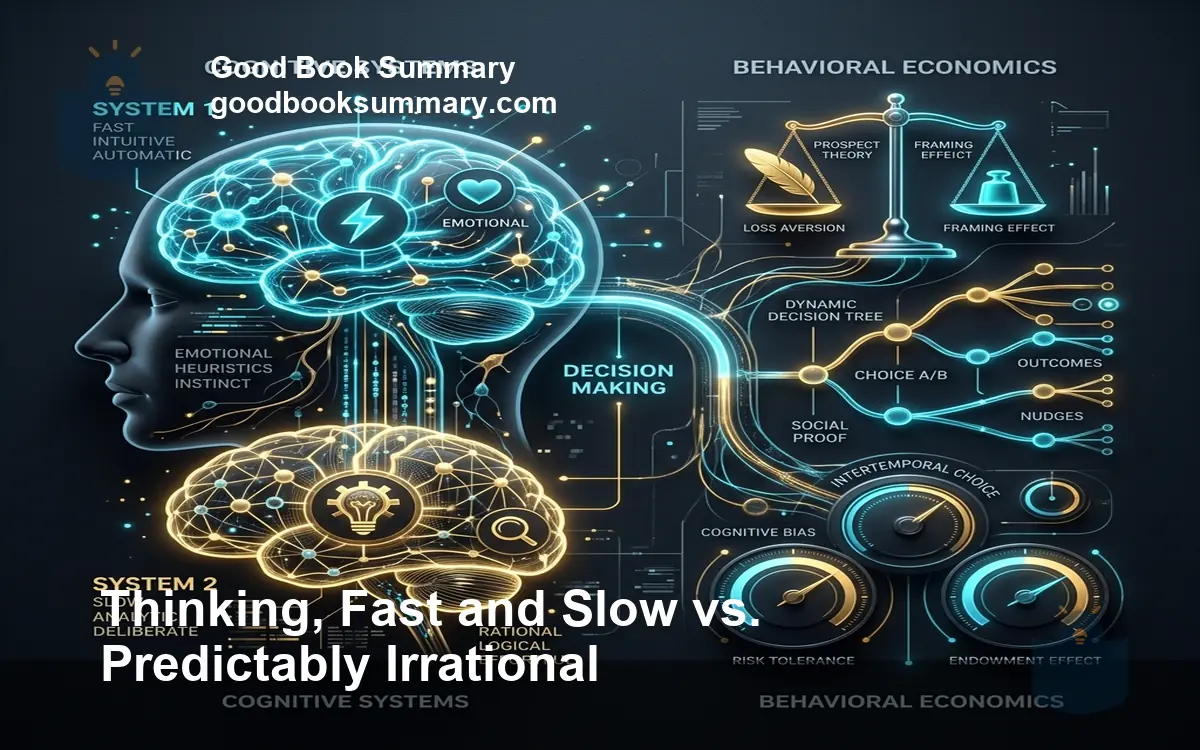
Comparison table: Kahneman's dual-process model against Ariely's behavioral triggers
| Dimension | Daniel Kahneman (Thinking, Fast and Slow) | Dan Ariely (Predictably Irrational) |
|---|---|---|
| Core processing mechanism | System 1 operates automatically and System 2 operates through slow, effortful analysis. System 2 activates under surprise, detected conflict, or deliberate attention allocation. | Choices split along social norms versus market norms, and along a calm cold state versus an aroused hot state. |
| Source of bias | Bias comes from the built-in limitations of the cognitive machinery itself, including associative activation and the WYSIATI shortcut. | Bias comes from specific, repeatable emotional triggers such as free pricing, relative comparison, and arousal-driven shifts in moral boundaries. |
| View of rationality | Humans are not fully rational, they are reasonable within the limits of a finite mind that cannot sustain strict logical coherence. | Humans depart from classical utility theory in ways that are systematic, repeated, and calculable in advance. |
Before moving into the core sections, both authors built their arguments on decades of controlled laboratory experiments rather than armchair speculation, and the sections below trace those experiments chapter by chapter.
How System 1 and System 2 divide the work of thinking
Kahneman opens his book by naming two agents inside a single mind. System 1, defined specifically as the automatic and intuitive mode of cognition, generates impressions and quick judgments with no sense of voluntary control. System 2, defined as the slow and effortful mode of cognition associated with concentration and agency, handles complex computation and monitors System 1 for errors. The two systems produce a measurable division of labor: System 1 reads a billboard or detects hostility in a voice in a fraction of a second, while System 2 is required for a task such as multiplying 17 by 24.
The short video lecture below illustrates the operational differences between fast, intuitive System 1 responses and deliberate System 2 cognitive processing:
The clearest demonstration of this split comes from the selective attention research built by Christopher Chabris and Daniel Simons. Viewers instructed to count basketball passes among a white-shirted team become so absorbed in the counting task that roughly half of them fail to notice a person in a gorilla suit crossing the court for 9 full seconds. The experiment demonstrates that intense engagement of System 2 on a narrow task produces a form of blindness to events that would otherwise be obvious, a pattern Kahneman terms inattentional blindness.
Mental effort is not free in this model. Kahneman and Jackson Beatty measured pupil dilation while participants transformed digit strings under a metronome beat, and pupil area expanded by roughly 50 percent alongside a heart rate increase of about 7 beats per minute during the hardest phase of the task. This pupillometry data supports what Kahneman calls the law of least effort, a principle stating that when several paths lead to the same goal, people gravitate toward the path that costs the least cognitive energy.
System 1  ---->  fast, automatic, associative, always on
                    |
                    v (monitored by)
System 2  ---->  slow, effortful, statistical, easily depleted
Why self-control runs out and how ego depletion shapes decisions
Self-control and analytical effort draw from a shared, limited pool of mental energy in Kahneman's account, and depleting that pool through one task leaves less capacity available for the next. This state, called ego depletion, is distinct from simple busyness, since it specifically weakens the willingness to exert further self-control rather than the ability to process information.
The bat-and-ball puzzle illustrates how quickly System 2 gives up on checking an intuitive answer. A bat and a ball together cost $1.10, and the bat costs $1.00 more than the ball, yet more than 50 percent of students at Harvard, MIT, and Princeton, along with over 80 percent of students at other universities, submit the incorrect intuitive answer of 10 cents without verifying it. A separate field study of eight Israeli parole judges found approval rates climbing to about 65 percent right after a food break and dropping toward zero right before the next meal, a pattern that tracks glucose depletion rather than case merit. Walter Mischel's marshmallow experiment adds a developmental angle: four-year-olds who resisted an immediate reward in favor of a larger delayed one went on to show measurably higher executive control and higher SAT scores as young adults.
Ego depletion: a temporary reduction in the capacity for self-control caused by a preceding act of willpower, distinct from ordinary fatigue.
Mental Model: Dual-System Cognitive Trade-off Formula
System 1 speed and System 2 accuracy follow a fundamental cognitive energy constraint:
What triggers the associative machine inside System 1
System 1 builds a coherent model of the world through associative activation, where one idea spreads automatically into related concepts, emotions, and bodily responses. Reading the words banana and vomit together, for example, produces a brief physical aversion to fruit even though no real threat is present. This machinery also drives priming, a phenomenon in which an unconscious stimulus shapes a later behavior.
John Bargh's sentence-scrambling study at NYU exposed one clear case. Students who assembled sentences from words associated with old age, such as forgetful, bald, and wrinkle, walked measurably slower down a hallway afterward, and none of them reported noticing any influence on their pace. A separate honesty-box study in a British university kitchen alternated a poster of eyes with a poster of flowers above the same coffee price list over 10 weeks, and contributions during eyes weeks ran close to three times higher than during flowers weeks. Neither experiment required the subjects to be aware of the manipulation for it to work.
How cognitive ease produces the illusion of truth
Kahneman describes a continuous monitoring dial running from cognitive ease to cognitive strain. When processing feels easy, System 1 concludes that the situation is safe and no extra vigilance is required, which opens the door to the illusion of truth, a bias in which repeated exposure to a statement makes it feel truer regardless of its actual accuracy.
Robert Zajonc demonstrated the underlying mechanism with Turkish nonsense words such as kadirga and saricik, placed at varying frequencies inside ad-like boxes in student newspapers at Michigan universities. Words that had appeared more often were rated as more likely to mean something good, a result driven entirely by repetition rather than content. A related experiment with 40 Princeton students administering the Cognitive Reflection Test found that 90 percent of students reading the test in a clear font made at least one mistake, compared to only 35 percent of students reading a deliberately faded, harder-to-read font. Strain, in that case, recruited System 2 and improved accuracy.
Norms, causes, and why the mind resists statistics
System 1 continuously checks incoming events against an internal sense of normality and reaches instantly for causal explanations, a tendency Kahneman calls intentional causality. This wiring is efficient for detecting agents and danger, but it performs poorly whenever a question calls for statistical reasoning about categories rather than individuals.
Fritz Heider and Mary-Ann Simmel's 1944 film of two triangles and a circle moving around a box shows how automatic this causal instinct is. Viewers shown the 100-second film reliably narrate a bullying large triangle, a frightened circle, and a rescue, despite watching nothing but simple geometric shapes with no actual agency. The same wiring later shows up in statistical settings where causal stories overwhelm base rates, a pattern examined in detail below.
The law of small numbers and why sample size gets ignored
Kahneman labels the tendency to trust small samples as strongly as large ones the law of small numbers. A small sample allows extreme results to occur purely by chance, yet System 1 tends to read those extremes as evidence of a real underlying pattern. Rural counties with small populations, for example, appear at both the highest and lowest ends of kidney cancer rate rankings for the same reason, small sample variance rather than any environmental cause.
The Gates Foundation invested $1.7 billion in restructuring schools into smaller units after noting that small schools were overrepresented among the highest-performing schools nationally. The initiative under-weighted the fact that small schools were equally overrepresented among the worst-performing schools, a direct consequence of sampling variance rather than school size itself.
The zero-price effect and why free changes everything
A price of zero removes the perceived downside of a transaction entirely, which is why demand jumps far more than a simple discount would predict. In a side-by-side comparison, Ariely offered Lindt truffles for 15 cents and Hershey's Kisses for 1 cent, and 73 percent of buyers chose the higher-quality Lindt truffle. Dropping both prices by a single cent, so that Lindt cost 14 cents and the Hershey's Kiss became free, flipped the outcome entirely: 69 percent then chose the free Hershey's Kiss, despite the Lindt truffle remaining the better value at any price above zero.
Amazon's European rollout produced an unplanned natural experiment on the same principle. Free shipping on a second book purchase drove strong sales growth across most countries, but a pricing error in France left shipping set at 1 franc, roughly 20 cents, and French sales did not rise until that charge was corrected down to zero.
Social norms, market norms, and the danger of mixing money with relationships
Ariely separates human interaction into two incompatible systems. Social norms govern relationships built on goodwill and mutual obligation, while market norms govern transactions priced in dollars and contracts. Introducing money into a social relationship does not simply add a small cost, it converts the whole interaction into a market transaction, and that shift is difficult to reverse.
An Israeli daycare study by Uri Gneezy and Aldo Rustichini tested this directly by fining parents for late pickups. Late pickups doubled rather than declined, because the fine replaced a social obligation, feeling guilty for keeping teachers late, with a market transaction, paying for extra time. Removing the fine afterward did not restore the original behavior, since the social norm had already been displaced.
| Concept | What it disrupts | Mechanism |
|---|---|---|
| Social norms | Relationship goodwill | Cooperation without expectation of direct payment |
| Market norms | Transactional exchange | Cost-benefit calculation tied to explicit price |
| Collision effect | Both, once mixed | Market pricing permanently displaces the social frame |
Arousal, procrastination, and the hot-cold empathy gap
People in a calm, analytical state consistently underestimate how much an aroused emotional or physical state will change their own judgment later, a pattern Ariely and George Loewenstein call the hot-cold empathy gap. In their study, male students at UC Berkeley reported their moral boundaries and safe-sex intentions once in a calm state and once while sexually aroused, and reported willingness toward risky or aggressive behavior increased by as much as 100 percent in the aroused condition.
Procrastination follows a related logic of short-term gratification overriding long-term benefit. Ariely divided three university classes for a term paper assignment. One class had complete freedom over the submission date, one class had no fixed deadlines beyond a single final date, and one class was assigned rigid, evenly spaced deadlines by the instructor. The class with externally imposed deadlines earned the highest grades, evidence that pre-commitment devices work better than relying on willpower alone.
Ownership, expectation, and the price-driven placebo effect
Owning an object raises its subjective value well beyond what a non-owner would pay for the same item, a pattern known as the endowment effect. In a coffee mug study modeled on university ticket-lottery research, students given a mug set a median selling price of $7.12, while students without a mug set a median buying price of only $2.87, a gap explained by loss aversion rather than any real difference in the mug's value.
Expectation shapes perception at a sensory level as well. MIT students who tasted a beer mixed with a small amount of balsamic vinegar without being told about the vinegar preferred it to regular beer, while a separate group told about the vinegar before tasting it rejected it outright, even though the two groups tasted an identical drink. Price produces a similar effect on physical outcomes: in a fake painkiller study, participants told a pill cost $2.50 reported significant pain relief 100 percent of the time, while participants told an identical pill cost 10 cents reported relief only 50 percent of the time.
How cold-state pre-commitments and System 2 checks counter bias
Apply these concepts by setting cold-state pre-commitments, such as automatic savings transfers or blocking software, before a hot state can override them. When facing a high-stakes choice, force System 2 engagement through checklists or a deliberately harder-to-read format, name any price anchor or decoy option out loud before deciding, and keep cash transactions separate from token or credit systems where dishonesty becomes easier. Finally, keep social relationships free of market pricing, since a single cash offer for a favor can permanently damage the goodwill that made the favor possible.
Practical routine for countering everyday cognitive bias
1. Diagnose the cognitive minefield. Notice situations built around a free offer, a first-seen price, or a strong emotional state, since each one predictably distorts judgment.
2. Force cognitive strain deliberately. Slow down System 2 by writing out alternatives by hand or asking what the actual base rate is before trusting a vivid story.
3. Set pre-commitment devices in a cold state. Lock in deadlines, spending limits, or automatic transfers before willpower is needed to enforce them.
4. Collect independent judgments first. Ask colleagues for separate, private opinions before a group discussion begins, since open discussion invites herding around the first opinion spoken.
5. Keep social and market norms apart. Avoid attaching a price to a favor, a gift, or a family gathering, since the market frame is difficult to undo once introduced.
Synthesis: two compatible accounts of the same irrational mind
Kahneman's dual-process model explains the architecture behind human error, showing how a fast associative system and a slow analytical system trade off under time pressure and fatigue. Ariely's experiments explain the specific levers, including price, ownership, and social framing, that pull on that architecture in predictable directions. The System 1 and System 2 framework gives a reader the mechanism, and the behavioral economics experiments give the reader concrete situations in which that mechanism misfires at measurable, repeatable rates. A fair critical note is that both books draw heavily on laboratory settings with student populations, and some of the original effect sizes, including several social priming results from the era, have faced replication challenges in later research. That caveat does not erase the core claim shared by both authors, that departures from rational choice follow patterns stable enough to anticipate and, in many cases, to design around.