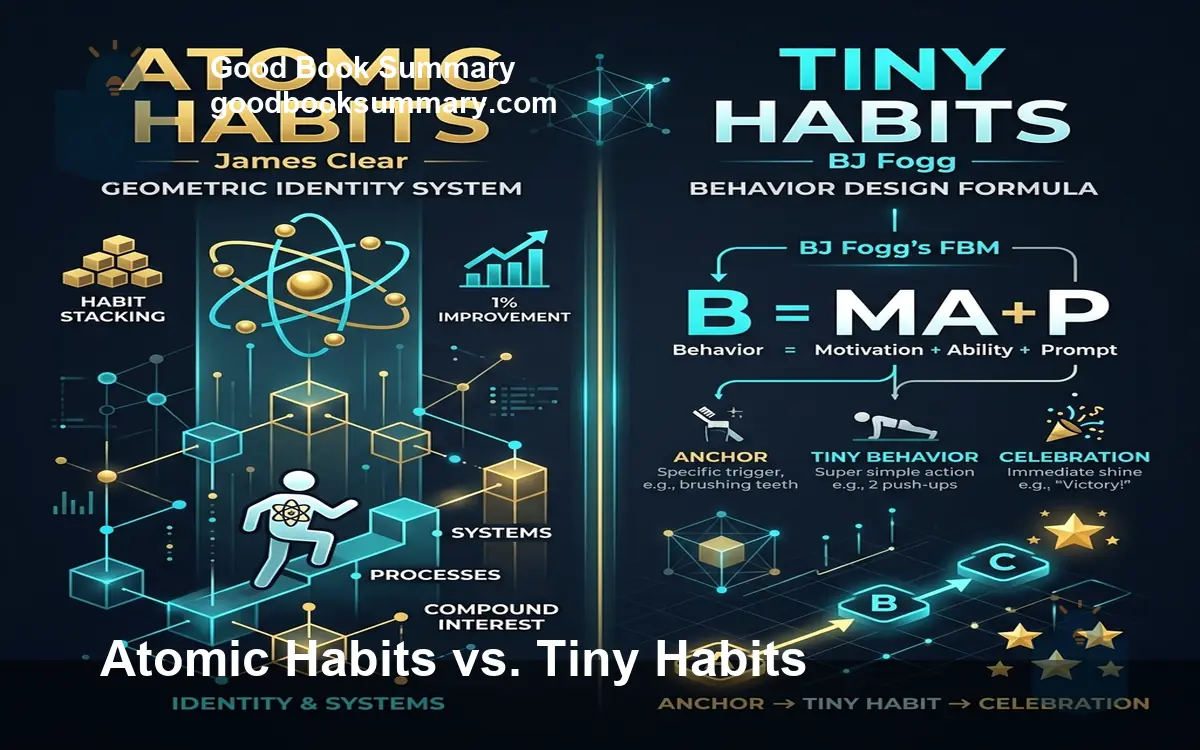
This comparison works through both frameworks chapter by chapter, then places them side by side so you can see exactly where they overlap and where they diverge.
Atomic Habits vs. Tiny Habits at a Glance
Before going deeper, it helps to see the core dimensions laid out next to each other. The table below draws directly from each author's central mechanisms rather than surface-level summaries.
| Dimension | Atomic Habits (James Clear) | Tiny Habits (BJ Fogg) |
|---|---|---|
| Core Formula | Four Laws of Behavior Change | B=MAP (Behavior = Motivation x Ability x Prompt) |
| Starting Point | Identity ("who do you want to become") | Aspiration matched to a specific Golden Behavior |
| Habit Trigger | Habit Stacking (pairing with a current habit) | Anchor Moments, especially the Trailing Edge |
| Sizing Method | The Two-Minute Rule | Scaling Back and Starter Steps |
| Reinforcement | Immediate satisfaction, habit tracking | Shine, immediate emotional celebration |
| Underlying Discipline | Systems design and environment | Behavioral science and psychology |
The table shows a pattern that holds throughout both books: Clear tends to describe habits as identity statements wrapped in systems, while BJ Fogg treats habits as engineering problems solved with a formula. Neither approach is purely theoretical. Both authors ground their arguments in specific, named case studies, which the sections below unpack in detail.
What Is the Main Summary of Atomic Habits vs. Tiny Habits?
Both books argue that lasting transformation comes from compounding minuscule daily changes rather than one large effort. Tiny Habits supplies a scientific "Behavior Design" method built on starter steps and Anchor Moments, while Atomic Habits complements it with systems-oriented, identity-driven routines designed to bypass reliance on willpower.
That single paragraph captures the thesis, but it compresses a lot of mechanism. James Clear spends much of "Atomic Habits" arguing that people do not rise to the level of their goals, they fall to the level of their systems. BJ Fogg, a behavior scientist who founded the Behavior Design Lab at Stanford University, approaches the same problem from a laboratory angle: he wants a formula precise enough to predict when a behavior will and will not occur. Read together, the two books function almost like a manual and a philosophy sitting on the same shelf.
The Anatomy of Behavior: B=MAP, Motivation, and Golden Behaviors
BJ Fogg opens "Tiny Habits" with a claim that sounds almost too simple: every human behavior, good or bad, happens when three elements converge at the same moment.
The Fogg Behavior Model
Fogg Behavior Model: a formula stating that behavior (B) occurs only when Motivation (M), Ability (A), and a Prompt (P) arrive together, represented as B=MAP. Below a certain threshold, which Fogg calls the "Action Line," a prompt simply fails to trigger action. Fogg puts it simply: no behavior happens without a prompt. The model applies equally to flossing and to compulsively checking a phone; only the weighting of the three elements changes.
"The B=MAP model is not a metaphor. Fogg designed it as a diagnostic tool: if a habit is not sticking, exactly one of the three elements is missing, and the fix depends on identifying which one."
The case of Katie, a successful executive profiled in the book, illustrates the model cleanly. Katie kept a spotless desk without effort but repeatedly failed at her morning exercise plan. The difference was not discipline. Her scrolling habit sat comfortably above the Action Line because it required almost no ability, while her exercise routine was designed at a difficulty level that consistently pushed it below the line.
Motivation Is a Wave, Not a Foundation
James Clear and BJ Fogg agree on one uncomfortable point: motivation cannot be trusted as the engine of a habit. Fogg compares it to a party-animal friend, great for a night out, but not someone you'd want picking you up from the airport at dawn. His answer is Behavior Matching, a process of finding "Golden Behaviors," meaning actions that are effective, wanted, and doable all at once.
Focus Mapping: a two-round sorting exercise that plots candidate habits on an impact axis and a feasibility axis to surface the few behaviors worth pursuing first. Mark, one of the book's recurring case studies, used Focus Mapping to discover that a ten-minute guitar session beat a grueling thirty-minute practice block, simply because the shorter version actually got done.
" Sandra and Adrian bought a home with an overgrown backyard, assuming their initial excitement would carry them through the hard landscaping work. It didn't. Their story is Fogg's cautionary tale about what he calls the Motivation Wave trap: relying on a temporary emotional spike to sustain a long, effortful project almost always ends in stalled progress."
Ability, Prompts, and the Architecture of Ease
Where Chapter 1 of "Tiny Habits" diagnoses behavior, the next two chapters prescribe a fix built around simplicity and cueing.
The Ability Chain and Starter Steps
Ability Chain: a five-link model (Time, Money, Physical Effort, Mental Effort, and Routine) representing everything that makes a behavior harder or easier to perform, where the chain is only as strong as its weakest link. A seven-minute workout can fail not because of laziness but because physical effort alone is too demanding a link.
Fogg's fix is radical shrinkage. A Starter Step is one small physical movement toward a larger behavior, designed to sidestep resistance entirely. Scaling Back takes that logic further, reducing a habit to its smallest defensible version. Fogg's own dental routine, reduced to flossing a single tooth, is the book's most quoted example of this principle in action. Sarika, a project manager managing bipolar disorder, used the same scaling logic across breakfast, meditation, and exercise, building consistency from starter steps rather than ambitious targets.
Anchor Moments and the Trailing Edge
No habit begins without a cue, and Fogg's preferred cue is an existing routine rather than a calendar reminder or an app notification.
Anchor Moment: an established daily routine that acts as the trigger for a new, tiny behavior placed immediately after it. Fogg pushes this idea one step further with the Trailing Edge, the exact final sensory point of an anchor behavior, such as the click of a faucet shutting off, which he argues makes for a sharper and more reliable prompt than a vague reference to "after breakfast."
Pearl Habits: habits that convert an irritant or negative prompt into a trigger for a positive action, effectively turning friction into a resource. Amy, a freelance writer, used her ex-husband's criticism as an unlikely Pearl Habit anchor, redirecting the sting into an immediate act of self-care.
"If a habit keeps slipping, the problem is often the anchor, not the willpower. Choose the most specific physical sensation in an existing routine, not just the routine's general name."
Emotion, Shine, and the Growth of Habits
BJ Fogg's most distinctive argument, and arguably his biggest departure from conventional habit advice, is that repetition is not what encodes a habit into the brain. Emotion is.
Shine: The Chemistry of Celebration
Shine: the immediate, self-generated feeling of success experienced right after performing a behavior, which chemically reinforces the neural pathway associated with that action. Fogg is blunt about the mechanism: people change best by feeling good, not by feeling bad. Mike, a creative director in the book, celebrates rolling out his yoga mat by pacing the room with his arms raised, mimicking a boxer after a win. The gesture looks silly, and that is partly the point: intensity of feeling matters more than dignity.
This connects to what Fogg calls the Spectrum of Automaticity, a model tracking how a behavior moves from a conscious decision on one end to an unthinking habit on the other. Hailing a rideshare, once a deliberate choice full of friction, becomes automatic after just one strongly positive experience.
Success Momentum and the Growth of Habits
Once a tiny habit is rooted through Shine, it tends to expand on its own timeline rather than a forced schedule. Fogg calls this Success Momentum, the psychological lift produced by the frequency of small wins rather than their size. Sukumar, a Chennai resident who had struggled with his weight for seventeen years, began with two push-ups and a five-second plank. He eventually built a full hour-long routine, not by willing himself into intensity but by letting one small success generate the next.
"Fogg's data suggests the size of a success barely matters for building momentum. What matters is that it happens often enough to register emotionally."
Breaking Bad Habits and Changing Together
The later chapters of "Tiny Habits" shift from building new behaviors to dismantling old ones, and from individual change to group change.
Untangling, Not Breaking, Bad Habits
Fogg objects to the phrase "break a bad habit" on principle, arguing it misleads people into expecting a single decisive moment. His alternative is the Behavior Change Masterplan, a three-phase sequence: build unrelated positive habits first, then design against the old behavior, then swap in a replacement. Juni Felix, a radio host, used this sequence to untangle a sugar habit by mapping the emotional prompts, fatigue and grief in particular, that triggered it, rather than attacking the sugar itself.
Fogg also separates habits into three categories worth knowing before attempting to change anything:
- Uphill habits: require conscious effort to maintain, but are correspondingly easy to stop (a daily workout, for instance).
- Downhill habits: effortless to maintain and hard to stop (hitting snooze).
- Freefall habits: deep addictions that typically require professional support rather than a Behavior Design fix.
For habits that resist removal through prompt elimination, Fogg recommends the Password Friction Technique, deliberately increasing the mental effort required to perform the behavior, such as resetting a social app's password to a long, awkward string with autosave disabled.
Group Behavior Design
Chapter 8 widens the lens to teams and families. Fogg distinguishes between the Ringleader, who leads change openly and teaches the tools directly, and the Ninja, who quietly redesigns an environment or a prompt without announcing it. Mike Coulter used Ninja tactics to get his son Chris to clean a coffee filter, sidestepping what could have become a recurring argument.
For sorting group members, Fogg proposes a matrix of Dolphins (motivated and able), Turtles (motivated but struggling), Crabs (able but unmotivated), and Clams (neither), suggesting that facilitators get the most return by focusing energy on Dolphins and Turtles rather than trying to convert Clams first. A related idea, the Queen B Solution, reframes a mandatory task around something a person already wants; a nurse team at a research hospital used a version of this, paired with Recipe Maker worksheets, to attach quick stress-reduction habits to existing workplace anchors.
The Cardinal Rule: Make It Immediately Satisfying
James Clear's fourth law of behavior change, covered in his book's later chapters, converges almost exactly with Fogg's Shine concept, though Clear arrives there through evolutionary psychology rather than lab experiments.
Immediate-Return Environment: the evolutionary mismatch between brains wired for instant feedback and a modern world structured around delayed rewards, such as retirement savings or long-term fitness gains. Clear's own framing is direct: what is immediately rewarded gets repeated, and what is punished gets avoided. A donut wins over a salad in the moment because its reward arrives instantly, while the cost of the choice is deferred by years.
Clear's practical tool for this problem is the Habit Tracker Visual, a simple mechanism, often nothing more than an X on a calendar, that converts a slow-moving reward into an immediate visual win. The book's paperclip strategy captures this well: a young stockbroker moved 120 paperclips between two jars, one per sales call, turning an otherwise invisible grind into a satisfying, countable ritual.
Atomic Habits vs. Tiny Habits Framework Explained
With both mechanisms on the table, it is worth mapping where the two frameworks line up term for term.
James Clear vs. BJ Fogg Habit Framework
1. Identity-Based Systems vs. Behavior Design. Atomic Habits starts with identity, arguing that lasting change happens when a person first decides who they want to become and lets systems follow from that decision. Tiny Habits starts with the behavior itself; identity shift, in Fogg's model, arrives as a side effect of repeated tiny successes and Shine, not as a precondition for them.
2. Habit Stacking vs. Anchor Moments. Clear's Habit Stacking pairs a new habit with an existing one in a general sense ("after I pour my coffee, I will..."). Fogg's Anchoring is more surgical, targeting the Trailing Edge of the existing routine for a sharper, higher-definition cue.
3. Two-Minute Rule vs. Scaling Back. Clear's Two-Minute Rule shrinks any new habit down to something completable in under two minutes. Fogg's Scaling Back and Starter Steps pursue a similar goal through a slightly different route, reducing the behavior to its smallest defensible unit, such as flossing one tooth or putting on running shoes without necessarily going for a run.
Routine vs Technique
Before comparing execution details, it helps to separate two terms that both books use loosely but that carry distinct meanings once placed side by side.
| Concept | Routine Definition | Technique Definition |
|---|---|---|
| Routine vs Technique | An identity-based daily system, such as Fogg's morning "Maui Habit" or Clear's automated daily writing practice, that reshapes a person's fundamental relationship with habits over time. | A specific, task-level mechanism, such as the Rocky-style celebration, pre-washing vegetables for easier meal prep, or a password friction reset, used to solve one isolated problem. |
Routines are the long arc; techniques are the individual tools that keep the arc on course. A reader who confuses the two often abandons a good technique too early, expecting it to function like a full routine on its own.
How to Apply Atomic Habits vs. Tiny Habits Routine in Daily Life
To apply these concepts, identify a clear aspiration, break it into a starter step under two minutes, anchor it to the trailing edge of an existing daily routine, and celebrate immediately afterward to trigger the emotional response that wires the habit into memory.
That answer compresses into a repeatable three-step routine that borrows equally from both books.
- Anchor Definition: locate a routine that already happens reliably every day, such as brushing your teeth or starting the coffee maker.
- Tiny Action: attach a scaled-back version of the target habit, or a Starter Step, directly after that anchor. Two push-ups, one paragraph, one deep breath.
- Shine Celebration: mark the moment with a genuine, immediate positive reaction rather than waiting for a delayed sense of accomplishment.
3. Shine Celebration
Of the three steps, this is the one most people skip, and it is also the one both authors treat as non-negotiable. A silent nod of approval rarely produces enough dopamine to matter; Fogg's research points toward a physical, even slightly exaggerated reaction, arms raised, a small fist pump, a spoken "yes." Clear's habit tracker functions the same way in visual form, giving the brain a small, immediate hit of satisfaction that outcompetes the pull of an old, more rewarding habit.
The formula above is not a literal equation either author publishes, but it is a useful shorthand for what both books argue in practice: a habit's strength over time is the accumulation of correctly matched Motivation, Ability, and Prompt, amplified by the emotional charge of Shine at each repetition.
What Are the Key Takeaways from Atomic Habits vs. Tiny Habits by James Clear vs. BJ Fogg?
The key takeaways are that behavior depends on Motivation, Ability, and a Prompt converging at once; motivation itself is unreliable; simplicity and environment design outperform willpower; and habits get wired into the brain by positive emotion, generated through immediate celebration, rather than by sheer repetition.
Whether Shine holds up as a mechanism outside the specific coaching contexts Fogg studied is still an open question; most of his published case evidence comes from workshop participants rather than long-term controlled trials.
A Starter Routine Combining Both Books
For readers who want a single entry point rather than two competing systems, the following sequence draws numbered steps directly from both frameworks.
1. Pick One Aspiration. Choose a broad outcome (better sleep, less stress, more writing) rather than a specific behavior at this stage.
2. Focus Map the Behaviors. List several candidate actions and sort them by impact and ease, keeping only the ones that land in the high-impact, high-feasibility zone.
3. Apply the Two-Minute Rule. Shrink the chosen behavior until it fits inside two minutes, then shrink it again if it still feels effortful.
4. Set the Anchor at the Trailing Edge. Attach the tiny behavior to the exact final sensory moment of an existing routine, not a vague time of day.
5. Celebrate Within Three Seconds. Use a genuine physical or verbal cue for Shine immediately after the behavior, every single time, for at least the first two weeks.
"Track the habit visually, even with something as simple as a checkmark. The Habit Tracker Visual and Shine work through the same channel: both give the brain an instant, undeniable signal of progress."
Synthesis: Two Vocabularies, One Underlying System
Read closely, "Atomic Habits" and "Tiny Habits" are not rival theories so much as two dialects describing the same underlying system. Clear's four laws (make it obvious, attractive, easy, and satisfying) map almost directly onto Fogg's B=MAP plus Shine: obvious and attractive map to prompt and motivation, easy maps to ability, and satisfying maps to Shine. The real difference sits in vantage point. Clear writes as a systems thinker concerned with identity and long-run automation. Fogg writes as a behavior scientist concerned with the precise moment a behavior does or does not fire. Readers who need a philosophy of change may lean toward Clear first. Readers who need a diagnostic toolkit for a habit that keeps failing may get more immediate traction from Fogg's model.
Reader Perspective: Positive and Critical Interpretations
Positive interpretation. Both books succeed at making habit change feel achievable rather than aspirational. The emphasis on starting absurdly small, whether through the Two-Minute Rule or a Starter Step, removes the all-or-nothing thinking that derails most New Year's resolutions. Our editorial team found Fogg's Trailing Edge concept especially practical, since it solves a specific, common failure point: vague cues that quietly disappear once the initial motivation fades.
Critical interpretation. Neither book fully accounts for structural barriers, chronic illness, poverty, caregiving demands, that can make even a two-minute habit genuinely hard to sustain. Fogg's case studies also skew toward relatively resourced professionals (executives, project managers, radio hosts), which raises a fair question about how well Behavior Design generalizes to more constrained circumstances. Long-term data on the Shine mechanism beyond a few years of follow-up remains limited, so claims about permanent rewiring should be read as promising rather than settled.
Related Book Summaries
For readers building out a personal systems library, a few adjacent titles extend the themes covered here. Our breakdown of Atomic Habits goes deeper into Clear's four laws on their own, while our summary of Deep Work applies similar focus principles to concentrated professional output. Readers interested in the discipline side of habit formation may also want our The Monk Who Sold His Ferrari guide, which pairs identity-based routines with a more spiritually framed approach to daily structure.