| Dimension | Traditional productivity approach | Free to Focus approach |
|---|---|---|
| Core philosophy | Increase efficiency and fit more work into the day | Increase contribution by concentrating on high-value work |
| Primary goal | More output and greater efficiency | Freedom to focus, be present, be spontaneous, and do nothing |
| Task management | Large reactive task lists | Freedom Compass and selective commitment |
| Main resource | Time | Renewable personal energy |
| Commitment filter | Accepting requests and managing the resulting workload | Eliminating, automating, and delegating low-value commitments |
| Daily execution | Responding to whatever appears | Big 3 priorities and protected focus blocks |
Stop, Cut and Act: the Free to Focus method
Free to Focus is Michael Hyatt's productivity framework for achieving greater results through selective focus, energy management, and systematic removal of low-value work. The method moves through Stop, Cut, and Act: formulate a productivity vision, evaluate commitments, rejuvenate energy, eliminate unnecessary work, automate repetitive tasks, delegate suitable responsibilities, plan an Ideal Week, prioritize the Big 3, and defend concentration.
Hyatt begins with a challenge to the "more myth": the belief that productivity improves when a person increases activity, speeds up execution, and fills available time with additional commitments. Free to Focus defines productivity through contribution. The central question becomes whether a person's work produces the outcomes that matter most.
The distinction affects how a professional evaluates a full calendar. A calendar containing 60 working hours can represent poor productivity if much of that time sits outside the person's strongest contribution. Hyatt's framework asks the reader to identify the work that combines high passion and high proficiency, then create conditions that allow more time in that area.
Three movements and nine actions
The Free to Focus framework explained in the book organizes execution across three structured movements and nine specific actions:
| Movement | Main actions | Purpose |
|---|---|---|
| Stop | Formulate, Evaluate, Rejuvenate | Establish direction and capacity |
| Cut | Eliminate, Automate, Delegate | Remove low-value demands |
| Act | Consolidate, Designate, Activate | Execute high-value work |
The framework therefore treats productivity as a design problem. A professional first defines the desired life and work pattern. The person then examines current commitments, protects physical and mental energy, removes unnecessary responsibilities, and builds systems around the remaining work.
The book also gives the idea of freedom a specific meaning. Freedom includes the ability to focus on demanding work, remain present with other people, respond spontaneously when appropriate, and deliberately do nothing. These four forms of freedom connect professional productivity with personal life.
Hyatt's experience at Thomas Nelson illustrates the importance of formulation. When he became general manager of Nelson Books in July 2000, he used a private retreat to understand the division's position and formulate a vision before attempting operational changes. The example establishes a recurring principle throughout the book: execution improves when the desired destination is explicit.
The practical consequence is straightforward. Productivity begins before the task list. It begins with deciding what deserves attention.
How does the freedom compass identify your highest-value work?
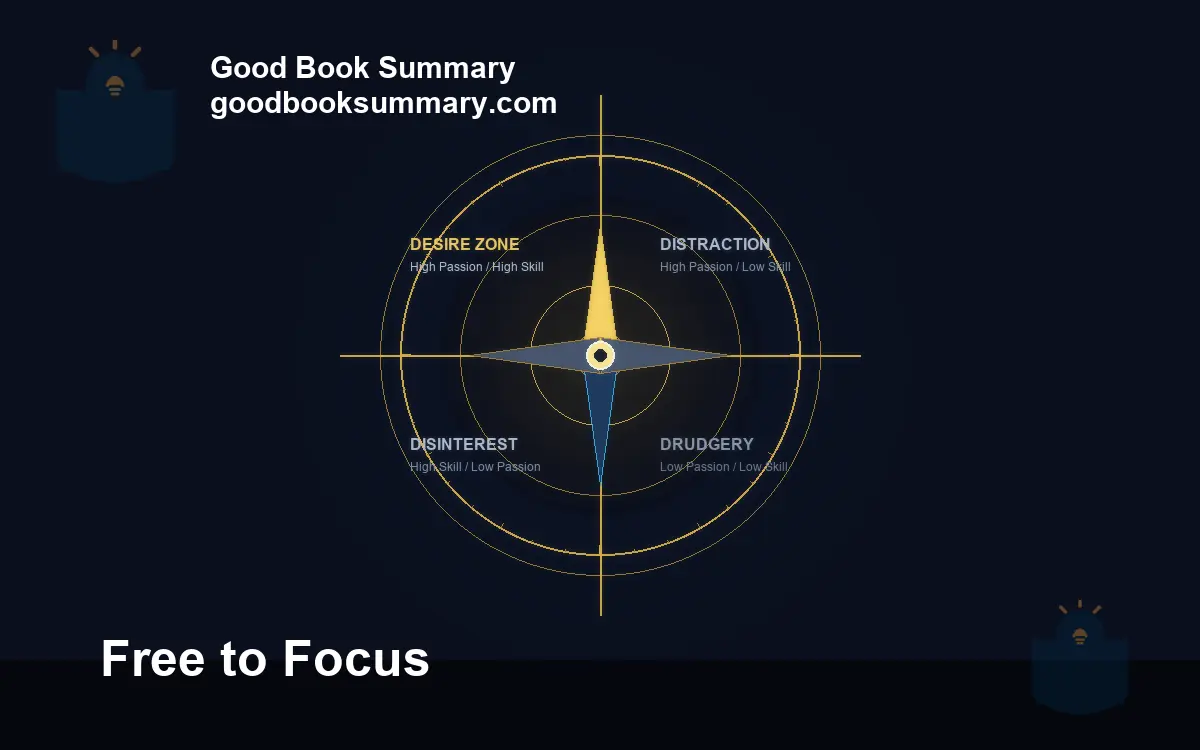
The Freedom Compass evaluates work through two dimensions, passion and proficiency, and produces four zones: Desire, Distraction, Disinterest, and Drudgery. The Desire Zone combines high passion with high proficiency. Free to Focus uses that zone as the primary destination for professional effort and treats the other three zones as candidates for development, elimination, automation, or delegation.
The Freedom Compass provides the central diagnostic tool in Free to Focus. Passion describes how strongly a person enjoys or feels energized by an activity. Proficiency describes the person's ability to produce strong results in that activity. Crossing the two dimensions creates four zones.
| High proficiency | Low proficiency | |
|---|---|---|
| High passion | Desire Zone | Distraction Zone |
| Low passion | Disinterest Zone | Drudgery Zone |
The Desire Zone contains work that a person enjoys and performs well. Hyatt positions this area as "true north" because it combines personal energy with competence. The brief gives Hyatt's own example of spending roughly 90% of his week writing and creating content because that work fits his strengths and interests.
The Distraction Zone creates a subtle problem. A person may enjoy an activity and therefore assume that the activity deserves more time. Passion alone does not establish contribution. A sales manager who enjoys graphic design but produces weaker designs than a professional designer can spend several hours on a task that someone else could complete more effectively.
The Disinterest Zone contains work that a person performs competently but does not enjoy. Financial analysis and budgeting provide Hyatt's example. Competence can keep a person trapped in this zone because other people recognize that the person performs the work well.
The Drudgery Zone contains activities with low passion and low proficiency. Printer repairs, expense reports, travel arrangements, and similar administrative chores belong here when the individual lacks both interest and skill. These activities often provide the clearest candidates for removal.
Hyatt also introduces the idea that zones can change. Megan Hyatt Miller initially had little passion or proficiency for financial analysis. Through development, proficiency increased, and greater competence changed her relationship with the activity. This creates an important qualification: the Freedom Compass is a diagnostic model, not a permanent identity classification.
Rene's case illustrates the possible effect of systematic pruning. She had been working approximately 60 hours per week in reactive mode. After sorting her commitments through the Freedom Compass, she reduced her workload to approximately 30 hours while concentrating more closely on her highest-value contribution.
Hyatt's focus principle can be formalized through the Productivity Yield ratio:
The model therefore asks four practical questions for every recurring responsibility:
- Do I perform this activity well?
- Does this activity give me energy?
- Could someone else perform it better?
- Does the activity belong in the work I am uniquely positioned to do?
The answer determines the next action. Desire Zone work receives protection. Distraction Zone work receives scrutiny. Disinterest Zone work becomes a delegation or automation candidate. Drudgery becomes a removal candidate.
How does free to focus use energy and rejuvenation to improve productivity?
Free to Focus treats time as fixed and personal energy as renewable. Hyatt organizes rejuvenation around seven practices: Sleep, Eat, Move, Connect, Play, Reflect, and Unplug. The productivity implication is that scheduling recovery becomes part of performance management, with high-energy periods reserved for demanding work and lower-energy periods assigned to less demanding activities.
Time management alone cannot explain sustainable productivity because every person receives the same basic 24-hour daily boundary. Hyatt shifts attention toward energy. Energy changes across the day and can be influenced by sleep, food, movement, relationships, recreation, reflection, and deliberate disengagement.
The seven rejuvenation practices form the recovery structure:
| Practice | Productivity function |
|---|---|
| Sleep | Restores physical and cognitive capacity |
| Eat | Supplies energy for sustained activity |
| Move | Supports physical and mental stamina |
| Connect | Maintains important relationships |
| Play | Creates space for enjoyment and recovery |
| Reflect | Creates mental space for review and thought |
| Unplug | Separates work demands from recovery time |
The concept of "energy flexing" follows from this model. High-energy periods should support demanding Desire Zone work. Lower-energy periods can contain meetings, routine administration, calls, or coordination.
The book uses Alexandra Michel's study of investment bankers to illustrate the cost of extreme work patterns. The case connects excessive work and insufficient sleep with physical and cognitive deterioration. The brief also reports a Finnish twin study involving approximately 5,000 male twins followed for 30 years, with regular exercise associated with roughly 14% to 17% higher long-term income. Because these are specific research claims presented in the supplied knowledge graph without independent verification here, the exact study details should be before publication.
Hyatt also uses the Italian expression "la dolce far niente," meaning the sweetness of doing nothing. The concept gives deliberate idleness a legitimate place within a productivity system. A walk, a quiet period, or an hour away from screens can create cognitive distance from the problem that previously occupied attention.
A practical day can therefore contain two 90-minute focus blocks, separated by a 30-minute screen-free break. A one-hour lunch period can provide another recovery interval. The exact schedule depends on the individual's energy pattern.
The deeper point is allocation. A person who spends peak energy answering routine email may reach the afternoon with insufficient capacity for strategic work. A person who reserves peak energy for difficult creative or analytical work changes the relationship between the same 8 or 10 working hours and the resulting output.
Free to Focus therefore treats recovery as a scheduled input into productivity. Sleep, movement, connection, play, reflection, and periods without work devices become part of the operating system.
How do elimination, automation, and delegation create more focus?
Free to Focus removes low-value work through three mechanisms: elimination removes commitments that should disappear, automation places recurring work into repeatable systems, and delegation transfers suitable responsibilities to other people. Hyatt combines these mechanisms with the Not-to-Do List, Positive No, workflow documentation, and a seven-step delegation process.
Elimination is the first filter because some work should simply disappear. Hyatt's Not-to-Do List makes the decision explicit. A person can prohibit recurring behaviors such as accepting meetings without an agenda, mindless internet use, or commitments that conflict with core priorities.
The Positive No provides a structure for protecting those boundaries. The framework begins with a commitment to a personal value, states a clear refusal, and offers an alternative when appropriate. A family commitment can therefore produce a direct response to an evening invitation, followed by an alternative lunch meeting.
Hyatt's own overcommitment case demonstrates the cost of indiscriminate agreement. He describes a period involving board meetings for three companies, five speaking engagements, a book manuscript, and 669 emails. The workload created severe pressure. The lesson is structural: every accepted commitment consumes capacity that cannot be used elsewhere.
Automation handles work that still needs to happen. Hyatt separates automation into four categories:
| Automation type | Example |
|---|---|
| Self-automation | Standard morning and evening rituals |
| Template automation | Prewritten recurring email responses |
| Process automation | Documented standard operating procedures |
| Technology automation | Software filters and blocking tools |
Atul Gawande's use of checklists provides an example of process standardization. Mason Currey's analysis of more than 150 creative figures also appears in the supplied brief as evidence that structured routines can reduce the number of daily decisions.
Delegation handles work that another person can perform effectively. Hyatt's Delegation Hierarchy evaluates tasks beginning with Drudgery, followed by Disinterest and Distraction. Desire Zone work remains closest to the leader because it represents the person's strongest contribution.
The seven-step delegation process is:
1. Decide what to delegate. Identify responsibilities outside the leader's strongest contribution.
2. Select the best person. Match the task with someone who has suitable passion and proficiency.
3. Communicate the workflow. Explain the expected process and result.
4. Provide resources. Give the person the access, information, tools, and authority required.
5. Specify the delegation level. Define how much independent authority the person has.
6. Give room to operate. Allow the person to execute without constant interference.
7. Check in and provide feedback. Review progress and improve the process.
The Five Levels of Delegation make authority explicit. A Level 2 assignment can involve researching and reporting. A Level 4 assignment can involve deciding, executing, and reporting afterward. Clear authority prevents the confusion illustrated by Tom's special-event case, where an employee's initiative exposed an unclear delegation boundary.
The result is a chain of subtraction. Elimination removes unnecessary work. Automation reduces repetitive involvement. Delegation transfers appropriate responsibilities. The remaining workload becomes easier to organize around high-value contribution.
How does the ideal week reduce task switching?
The Ideal Week treats the 168 hours of a week as a planning budget and assigns categories of work before reactive demands consume available capacity. Hyatt combines this structure with MegaBatching, which groups similar activities into dedicated blocks, and separates Front Stage work, Back Stage work, and Off Stage time.
Task switching creates a central problem for knowledge workers. A person who moves from strategic writing to email, then to a meeting, then to a phone call, then back to writing must repeatedly reconstruct the mental context required for each activity.
Free to Focus addresses this problem through consolidation. MegaBatching groups related activities together. Hyatt describes moving podcast production from a weekly episode process that consumed a full day toward recording an entire season over a small number of concentrated days.
The Ideal Week begins with a blank 168-hour canvas. The person then allocates time for sleep, family, work, rejuvenation, rituals, meetings, focus blocks, and other recurring responsibilities.
The structure can be represented as follows:
168-hour week
|
+-- Off Stage
|   +-- Sleep
|   +-- Family
|   +-- Recreation
|   +-- Rejuvenation
|
+-- Front Stage
|   +-- Core deliverables
|   +-- Customer work
|   +-- Sales
|   +-- Creative production
|
+-- Back Stage
    +-- Meetings
    +-- Preparation
    +-- Administration
    +-- Coordination
Front Stage work represents the visible, high-value contribution for which the person is hired. Back Stage work supports that contribution through preparation, maintenance, coordination, and administration. Off Stage time protects recovery and personal life.
The Ideal Week also changes the relationship between planning and interruption. A blank calendar creates an opportunity to decide where work belongs before requests arrive. A meeting request can then be evaluated against an existing structure.
Intel's "Think Time" program appears in the brief as an example of protected cognitive space. The program reserved blocks during which employees were not expected to answer email or attend meetings. The case illustrates a simple principle: deep thinking requires a calendar that permits uninterrupted thought.
John Naish's plate-spinner metaphor describes the opposite pattern. Constant switching creates frantic movement between tasks and makes lost attention difficult to recover.
A practical schedule can therefore use two 90-minute focus blocks in the morning, a 30-minute recovery break, a one-hour lunch period, and a defined afternoon block for collaborative and administrative work. The precise clock times are examples from the supplied routine, not universal requirements.
The Ideal Week also protects weekends and other Off Stage periods. Hyatt's framework treats personal recovery as a calendar category with real boundaries. Work that expands into every available hour removes the margin that the productivity system is designed to create.
How do the weekly big 3 and daily big 3 determine priorities?
Free to Focus narrows weekly and daily priorities to three major outcomes through the Weekly Big 3 and Daily Big 3. The Weekly Preview reviews the previous week, triages commitments, checks goals and deadlines, selects three outcomes, and schedules rejuvenation. The Daily Big 3 then translates those priorities into a manageable daily focus.
The Weekly Preview provides the planning rhythm. Hyatt's framework describes six actions:
- Review the biggest wins from the previous week.
- Review progress and lessons.
- Triage the task list.
- Review goals, projects, meetings, events, and deadlines.
- Designate the Weekly Big 3.
- Schedule rejuvenation.
The Weekly Big 3 are three outcomes that matter most during the coming week. The Daily Big 3 translate that same constraint into daily execution.
The numerical limit matters because an unlimited task list encourages attention to migrate toward easy activities. Three priorities create a smaller decision field. J.D. Meier's Rule of 3 appears in the brief as an influence on Hyatt's Weekly and Daily Big 3 system.
Jim Koch provides another example. The Boston Beer Company founder reportedly uses a short list of three to five must-do items to keep daily attention away from low-value reactive work. Ratmir Timashev, cofounder of Veeam Software, is described as limiting his daily list to three high-priority items and completing them before noon.
The Eisenhower Priority Matrix adds a second filter:
| Quadrant | Meaning | Free to Focus response |
|---|---|---|
| Q1 | Important and urgent | Act |
| Q2 | Important and not urgent | Protect |
| Q3 | Urgent and not important | Delegate, defer, or reduce |
| Q4 | Neither important nor urgent | Remove |
Quadrant 2 receives special attention because strategic planning, system building, relationships, and rejuvenation often lack immediate urgency. These activities can therefore disappear from a reactive schedule even when they determine long-term results.
The supplied brief states that Hyatt's matrix recommends spending 95% of time in Quadrants 1 and 2. The exact percentage should be against the published edition before using it as a factual benchmark.
The distinction between urgency and importance also protects the Daily Big 3. A task can arrive with an urgent label because another person wants a response. That urgency does not automatically make the task important to the individual's goals.
Rene's case demonstrates the shift. Her work had become driven by the email inbox. The Daily Big 3 gave her a competing structure, which allows major outcomes to receive attention before the inbox dictated the day.
The system therefore uses three levels of priority: weekly outcomes, daily outcomes, and protected execution blocks. The hierarchy limits the number of priorities while increasing the amount of calendar protection around them.
How does free to focus protect attention from interruptions and distractions?
Free to Focus separates interruptions from distractions and treats each as a distinct threat to concentration. Interruptions originate outside the worker, such as messages or drop-in conversations. Distractions arise internally as the desire to escape difficult work. Hyatt's response combines environmental boundaries, technology controls, and deliberate focus blocks into a "Virtual Isolator."
The distinction matters because the solution differs. External interruptions require environmental or communication boundaries. Internal distractions require a person to tolerate the discomfort associated with demanding work.
Downhill work creates a strong temptation because easy activities feel immediately manageable. Email, Slack, routine administration, and similar tasks can provide quick completion signals while displacing cognitively demanding work.
The opposite category is uphill work. Writing a strategy, analyzing a complex problem, developing a product, or creating original content requires sustained attention. The discomfort of these tasks can make downhill work attractive.
Hyatt uses Hugo Gernsback's 1925 "Isolator" invention to show that workplace distraction predates smartphones and social media. The device attempted to block office noise and conversation. The underlying problem is therefore older than current technology.
The brief reports a Wall Street Journal account by Rachel Emma Silverman that described employees facing a distraction or interruption roughly every three minutes. It also reports a Stanford screenshot study in which screen attention lasted approximately one minute on average, with half of screen switches occurring after only 19 seconds. These precise research claims should be before publication.
Edward Hallowell's "Attention Deficit Trait" provides another concept in the supplied material. The term describes a learned pattern associated with constant switching and environmental interruption. The model explains why attention can weaken through repeated exposure to fragmented work.
3. focus block execution
A Virtual Isolator combines several defensive mechanisms:
High-value task
     |
     v
90-minute focus block
     |
     +-- Phone away
     +-- Notifications off
     +-- Email closed
     +-- Blocking software active
     +-- Physical boundary established
     |
     v
Protected attention
Technology can therefore be used to control technology. The supplied framework names Freedom as an example of software that can block distracting websites during focus periods. A physical "Do Not Disturb" signal can handle workplace interruptions.
The internal side requires a different discipline. When a difficult task creates frustration, the worker may generate an impulse to check email, browse the web, or handle a simpler responsibility. Recognizing the impulse as a distraction makes the choice visible.
The goal is not permanent isolation. Communication, collaboration, and reactive work still have a place in the Ideal Week. The goal is to prevent those activities from consuming every high-energy period.
Focus becomes a calendar condition and an environmental condition. A 90-minute block is useful only when the surrounding environment supports the intended attention.
Running the nine Free to Focus steps
Learning how to apply Free to Focus routine in daily life requires a structured nine-step operating sequence: establish a productivity vision, audit work with the Freedom Compass, schedule rejuvenation, eliminate low-value commitments, automate recurring tasks, delegate suitable responsibilities, build an Ideal Week, choose the Weekly and Daily Big 3, and defend 90-minute focus blocks from interruption and distraction.
1. Complete a productivity assessment. Establish a baseline before changing the system. Hyatt's framework includes a Productivity Assessment at FreeToFocus.com/assessment.
2. Define the productivity vision. Write the desired relationship between work, family, personal time, energy, and contribution. Include concrete boundaries such as preferred working hours and protected personal periods.
3. Audit every recurring responsibility. List regular tasks and place each one on the Freedom Compass. Identify Desire, Distraction, Disinterest, and Drudgery activities.
Hyatt's four daily rituals
The Michael Hyatt habit framework anchors daily momentum through four non-negotiable rituals:
4. Build four recurring rituals. Create Morning, Evening, Workday Startup, and Workday Shutdown routines. The supplied framework gives the Workday Startup a 30-minute window and the focus blocks a 90-minute structure.
5. Schedule rejuvenation. Select practices from Sleep, Eat, Move, Connect, Play, Reflect, and Unplug. Put recovery on the calendar before lower-value commitments fill the available space.
6. Create a Not-to-Do List. Write explicit boundaries. Include behaviors that repeatedly consume attention without contributing to important outcomes.
7. Automate repetitive work. Use templates for recurring messages, documented processes for repeatable workflows, personal routines for repeated decisions, and technology for filtering or blocking.
8. Delegate outside your strongest contribution. Use the Delegation Hierarchy and the seven-step process. Define the authority level before transferring responsibility.
9. Construct the Ideal Week and defend the Big 3. Allocate Front Stage, Back Stage, and Off Stage time. Select three weekly outcomes and three daily outcomes. Reserve 90-minute focus blocks for the highest-value work.
A sample day can follow this structure:
| Time | Activity |
|---|---|
| Morning | Morning ritual |
| 9:00 to 9:30 | Workday Startup |
| 9:30 to 11:00 | First 90-minute focus block |
| 11:00 to 11:30 | Active rest |
| 11:30 to 1:00 | Second focus block |
| 1:00 to 2:00 | Lunch and recovery |
| 2:00 to 5:00 | Meetings, calls, coordination, Back Stage work |
| 5:00 to 5:30 | Shutdown ritual |
| Evening | Unplug, connect, play, and rest |
The schedule is a template, not a requirement. The important elements are protected concentration, deliberate recovery, defined administrative periods, and a clear endpoint for work.
The operating principles behind Free to Focus
Free to Focus reduces productivity to a small number of operating principles: define the work that matters, identify the activities that fit your strengths, protect renewable energy, remove low-value commitments, automate repetition, delegate appropriate responsibilities, consolidate similar work, choose three major outcomes, and defend attention. The system measures productivity through contribution and freedom.
The first principle is direction. A productivity system cannot determine what deserves attention until the individual defines what success means.
The second principle is fit. The Freedom Compass places passion and proficiency at the center of task selection. High passion without proficiency can become distraction. High proficiency without passion can become draining. Low passion and low proficiency create strong candidates for removal.
The third principle is energy. Time cannot be replenished after a day passes. Energy can be restored through sleep, movement, connection, play, reflection, food, and periods away from work.
The fourth principle is subtraction. Elimination, automation, and delegation reduce the number of tasks that require personal attention. Hyatt's 669-email overcommitment example shows how quickly accepted commitments can overwhelm available capacity.
The fifth principle is structure. The Ideal Week turns time into a deliberate budget. MegaBatching reduces unnecessary switching. Front Stage, Back Stage, and Off Stage categories create boundaries around different kinds of activity.
The sixth principle is prioritization. Three weekly outcomes and three daily outcomes create a compact decision structure. The Eisenhower Matrix then separates important work from tasks that are merely urgent.
The seventh principle is attention defense. A 90-minute focus block requires protection from both external interruption and internal distraction. Technology, communication rules, physical signals, and environmental design can support the boundary.
The eighth principle is freedom itself. Hyatt defines productivity as creating room for focus, presence, spontaneity, and deliberate rest. A system that produces more output while eliminating personal margin fails the broader purpose of the framework.
The book's strongest practical contribution is the connection between these principles. A person cannot solve an overloaded calendar solely through focus techniques. If low-value work remains, focus becomes a way to process the wrong workload more efficiently. If energy remains depleted, a better calendar may still produce poor execution. If priorities remain unclear, automation can simply make irrelevant work faster.
Free to Focus therefore creates a sequence:
Formulate
    |
    v
Evaluate
    |
    v
Rejuvenate
    |
    v
Eliminate
    |
    v
Automate
    |
    v
Delegate
    |
    v
Consolidate
    |
    v
Designate
    |
    v
Activate
The sequence moves from direction to capacity, from capacity to subtraction, and from subtraction to execution.
How does free to focus compare with conventional productivity advice?
Free to Focus differs from conventional productivity systems through its emphasis on freedom, task fit, renewable energy, and subtraction. Conventional systems often begin with lists, calendars, or efficiency. Hyatt begins with the desired life and contribution, then designs the workload around those objectives through nine actions organized under Stop, Cut, and Act.
The distinction becomes clearer when the systems are compared at the level of daily behavior.
A conventional task-list approach asks what needs to be completed. Free to Focus asks which commitments deserve to exist. A conventional time-management approach asks where available hours can be placed. Free to Focus asks how energy should be allocated across the day.
A conventional productivity system can produce a longer completed-task list. Free to Focus measures progress through high-impact contribution and recovered margin.
The framework also gives personal preference a formal role. Passion is not treated as a vague lifestyle consideration. It becomes one axis of the Freedom Compass. Proficiency supplies the second axis. The intersection determines whether an activity belongs close to the individual's core contribution.
The approach also accepts that some work must remain. Back Stage activities still support Front Stage performance. The goal is to classify these activities accurately and determine whether another person, a system, or a scheduled block can handle them.
The distinction can be summarized as follows:
| Question | Conventional productivity | Free to Focus |
|---|---|---|
| What should I do? | Check the task list | Check the highest-value outcome |
| What should I remove? | Overdue or low-priority tasks | Commitments outside the desired contribution |
| How should I schedule? | Fill available time | Design the Ideal Week first |
| How should I handle repetition? | Repeat efficiently | Automate the process |
| How should I handle other people's requests? | Fit them into the calendar | Apply the Positive No and priority filters |
| How should I handle excess work? | Work longer or faster | Eliminate, automate, or delegate |
| What protects focus? | Personal discipline | Calendar blocks plus environmental defenses |
The framework has limits. Its usefulness depends on accurate self-assessment. A person can misclassify an activity as Desire Zone work because enjoyment feels like competence. Another person can delegate work too quickly without creating clear authority or adequate resources. The system also requires discipline during the transition because removing familiar commitments can create short-term discomfort.
The supplied knowledge graph presents Free to Focus primarily as a practical productivity framework, with several empirical examples supporting individual ideas. Readers seeking a strictly research-driven productivity model should therefore distinguish Hyatt's recommendations from the research cases used to illustrate them.
The strongest application is practical. Use the Freedom Compass to diagnose work, use rejuvenation to protect capacity, use subtraction to reduce workload, use the Ideal Week to allocate remaining responsibilities, and use the Big 3 and focus blocks to execute.
How can you build a free to focus routine that lasts?
A lasting Free to Focus routine depends on converting individual techniques into recurring systems. The practical sequence is to review priorities weekly, choose three outcomes, protect daily focus blocks, maintain elimination and delegation boundaries, perform shutdown rituals, and schedule rejuvenation. The routine becomes sustainable when the calendar reinforces the desired behavior automatically.
Why repetition turns a technique into a system
The difference between a technique and a routine is repetition. A one-time 90-minute focus session can improve one morning. A recurring focus block changes the structure of the week.
The same principle applies to the other components. A single delegation does not create a delegation system. A recurring delegation review can reveal new opportunities. A one-time Not-to-Do List becomes more useful when it is reviewed during the Weekly Preview. A single Ideal Week becomes a working system when the calendar is adjusted as responsibilities change.
A sustainable weekly cycle can therefore look like this:
Weekly Preview
      |
      v
Weekly Big 3
      |
      v
Ideal Week
      |
      v
Daily Big 3
      |
      v
90-minute Focus Blocks
      |
      v
Shutdown Ritual
      |
      v
Rejuvenation
      |
      +----------> Next Weekly Preview
The Weekly Preview provides the control point. The Daily Big 3 provides the daily filter. The focus block provides execution time. The shutdown ritual closes open loops. Rejuvenation restores capacity for the next cycle.
The routine should also preserve Off Stage time. Hyatt's system is designed to create margin, so every hour recovered from low-value work should not automatically become another hour of work. Some recovered time can become family time, recreation, reflection, or simple inactivity.
That point distinguishes Free to Focus from productivity systems that treat every saved minute as an opportunity for additional output. Hyatt's concept of freedom gives recovered time an independent value.
A practical self-audit can use nine questions:
- Is my productivity vision written clearly?
- Which activities are currently in my Desire Zone?
- Which activities belong in Distraction, Disinterest, or Drudgery?
- Which commitments can I eliminate?
- Which recurring tasks can I automate?
- Which responsibilities should I delegate?
- Does my Ideal Week protect Front Stage and Off Stage time?
- Are my Weekly Big 3 and Daily Big 3 visible?
- Do my focus blocks have genuine protection from interruptions?
The answers reveal where the system is breaking. A weak productivity vision creates poor priorities. Poor task classification leaves low-value work untouched. Weak boundaries create excessive commitments. Weak automation and delegation preserve repetitive workload. Poor scheduling fragments attention. Weak focus defenses expose demanding work to constant interruption.
Weekly Free to Focus Implementation Checklist:
- [ ] Complete Friday afternoon Workday Shutdown ritual and clear open loops
- [ ] Audit previous week wins and designate Weekly Big 3 during Sunday Weekly Preview
- [ ] Lock two daily 90-minute focus blocks into calendar before scheduling reactive calls
- [ ] Activate website blocker and set device to Do Not Disturb during focus windows
- [ ] Protect Off Stage rejuvenation time on evenings and weekends
Free to Focus therefore works best as an operating system for decisions. The objective is a calendar and workload that reflect the contribution, energy, relationships, and freedom the person actually wants.