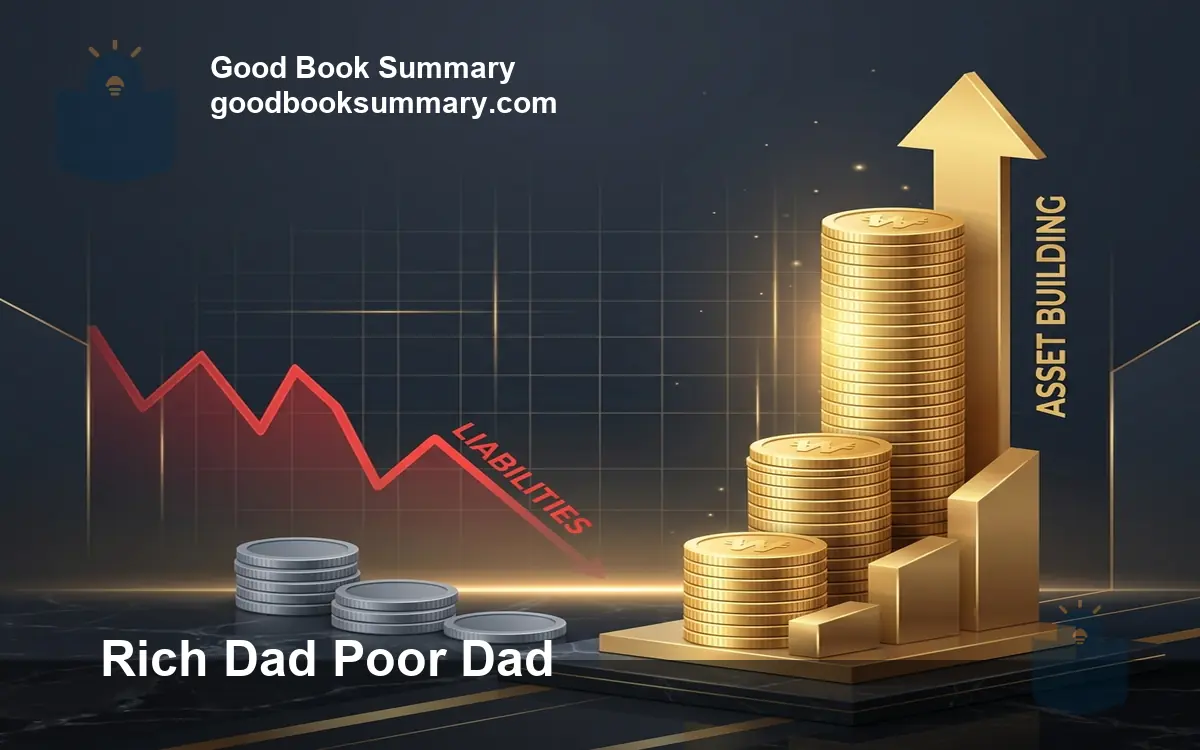
The book reframes wealth not as a salary milestone, but as the ability to survive without active labor by building structured cash- flow systems.
Comparison Table: Rich Dad vs Poor Dad Financial Logic
| Dimension | Rich Dad (Investor Logic) | Poor Dad (Employee Logic) |
|---|---|---|
| Attitude towards money | Money is a tool of power and leverage | Money is morally sensitive and often avoided in discussion |
| Career approach | Work to learn, especially sales and investing skills | Work to earn stability in a secure profession |
| Financial decision framing | “How can I afford it?” to expand thinking | “I can’t afford it” to end the decision process |
| Taxes | Understands systems and structures to optimize legally | Accepts taxation as fixed and unavoidable burden |
| Home ownership | Often a liability unless it produces income | Considered the biggest and safest asset |
This contrast defines the entire intellectual foundation of the book: two different operating systems for interpreting money, risk, and opportunity.
What Is the Main Summary of Rich Dad Poor Dad?
Understanding the underlying philosophy of Robert Kiyosaki requires analyzing the fundamental shift in how one perceives income and wealth. The difference between survival and true independence rests on a core mindset shift regarding assets and labor.
Core financial mindset shift explained
Rich Dad Poor Dad argues that financial success is determined less by income and more by financial intelligence, especially the ability to distinguish between assets and liabilities and consistently accumulate income-generating assets over time.
The “poor” and middle-class mindset focuses on earning wages, while the wealthy mindset focuses on building systems that generate passive income independent of labor.
Key structural idea:
Wealth is not accumulation of money—it is accumulation of income-producing structures.
Why this matters in real economic behavior
In real-world financial behavior, most households increase income and simultaneously increase liabilities. This creates a structural loop where higher income does not translate into freedom.
The book reframes the problem:
- Income alone does not create wealth
- Cash flow direction determines financial destiny
Key Takeaways from Rich Dad Poor Dad by Robert Kiyosaki
Developing financial independence requires mastering a specific set of rules and capabilities. Robert Kiyosaki structures these principles into several actionable insights that redefine traditional views of money.
Financial intelligence is a multi-skill system
Financial intelligence is not a single skill. It is the synergy of:
- Accounting (understanding money flow)
- Investing (deploying capital)
- Market awareness (recognizing opportunities)
- Legal understanding (structuring ownership)
This combination is referred to as Financial IQ in the book.
Why Financial IQ matters
Without financial literacy, individuals remain dependent on employment systems regardless of income level.
Assets vs liabilities is the core filter of wealth
Asset: Something that puts money into your pocket
Liability: Something that takes money out of your pocket
This definition is intentionally cash-flow based, not emotional or status-based.
Practical implication
- A car loan is a liability
- A rental property producing net income is an asset
- A house can be either depending on cash flow structure
Rat race is a structural loop, not a personal failure
The Rat Race describes a repeating financial cycle:
Work → Earn → Pay bills → Repeat
This cycle is reinforced by:
- Fear of instability
- Desire for lifestyle upgrades
- Dependence on salary timing
The system becomes self-sustaining unless asset-building behavior interrupts it.
How to Apply the Key Concepts of Rich Dad Poor Dad in Daily Life?
Direct Answer (Applied Framework):
Applying Rich Dad Poor Dad requires shifting daily decisions from income-focused thinking to asset-building behavior. Instead of optimizing for salary or consumption, individuals must redirect surplus money, time, and skills toward income-producing assets, while continuously improving financial literacy and decision-making systems.
1. Identify cash-flow direction in your life
Track every expense and income source for clarity.
- Does money enter your system from labor or assets?
- Does money leave through liabilities or investments?
2. Reclassify financial decisions
Before any purchase, ask:
- Does this produce cash flow?
- Or does it reduce future cash flow capacity?
3. Build a micro-asset system
Start small but structured:
- Dividend stocks
- Digital products
- Small rental systems
- Skills that generate side income
4. Apply “pay yourself first” behavior
Instead of saving what remains, reverse the logic:
- Allocate investment capital first
- Adjust lifestyle afterward
5. Upgrade financial skills continuously
Focus learning on:
- Negotiation
- Sales communication
- Investment analysis
- Tax and structure awareness
Core Concepts Explained in Depth
Evaluating personal finance requires a deep dive into the structural components of cash flow. Robert Kiyosaki introduces specific definitions to differentiate productive wealth from destructive liabilities.
Assets, Liabilities, and Cash Flow Logic
Analyzing cash flow begins with separating the inflows generated by investments from the outflows caused by financial obligations. The mathematical relationship of household wealth can be modeled using the following cash flow equation:
By maximizing net cash flow, individuals can accelerate the rate of asset growth over time.
Asset Column (Wealth Engine)
The Asset Column represents everything that generates recurring income without direct labor.
Examples:
- Real estate income
- Dividend portfolios
- Intellectual property
Liability Column (Wealth Drain)
Liabilities reduce long-term financial freedom even if they provide short-term comfort.
Examples:
- Consumer debt
- Non-income generating loans
- Depreciating lifestyle purchases
Financial IQ as a compound capability
Financial IQ is not linear—it compounds through exposure and repetition.
Components:
- Accounting literacy: tracking financial reality
- Investment literacy: allocating capital
- Market literacy: reading opportunity patterns
- Legal literacy: structuring ownership efficiently
Wealth as survival horizon
Wealth is defined as:
The number of days a person can survive without working while maintaining lifestyle stability.
This reframes wealth from income level to resilience capacity.
Ten Steps to Awaken Financial Genius (Practical Layer)
Unlocking personal financial potential requires a systematic roadmap of daily actions and psychological adjustments. Robert Kiyosaki details ten specific steps to build financial discipline and locate investment opportunities.
Step 1 — Define emotional motivation
Financial discipline begins with a strong reason that outweighs comfort.
Step 2 — Daily financial choice awareness
Every spending decision becomes a conscious allocation of future freedom.
Step 3 — Environment selection
Surrounding influences shape financial thinking patterns significantly.
Step 4 — Learn repeatable money systems
Focus on frameworks rather than one-time tactics.
Step 5 — Pay yourself first
Paying yourself first forces system creativity instead of passive consumption.
Step 6 — Use professionals strategically
Expert networks amplify financial decisions.
Step 7 — Focus on risk-return structure
Protect downside before chasing upside.
Step 8 — Convert desires into assets
Luxury goals should be financed by income systems.
Step 9 — Study real financial models
Learning from proven investors reduces trial-and-error cost.
Step 10 — Teach what you learn
Teaching reinforces clarity and long-term retention.
Insight Layer: How the System Actually Works
The central mechanism in Rich Dad Poor Dad is behavioral reprogramming. Instead of treating money as a reward for labor, it treats money as a tool for system design.
Once this shift occurs, financial decisions stop being emotional reactions and become structural choices.
The long-term outcome is not simply higher income—it is reduced dependency on time-based earnings.
Reader Perspective: Strengths and Limitations
Analyzing Rich Dad Poor Dad objectively requires weighing its educational benefits against its practical shortcomings. Examining both viewpoints allows readers to apply the core concepts more effectively.
Positive interpretation
- Strong mental model for asset-based thinking
- Clear distinction between income and wealth
- Encourages financial independence mindset early
Critical interpretation
- Oversimplifies some structural economic realities
- Requires financial discipline that not all readers immediately have
- Asset-building assumptions may take time to materialize in real life
Related Book Summaries
The following related book summaries provide complementary perspectives on value investing, structural systems, and habit formation:
- The Intelligent Investor — focuses on structured investing logic and risk control
- The Psychology of Money — examines the behavioral economics and psychological patterns behind wealth creation
- Atomic Habits — complements behavior formation behind financial discipline
Final Synthesis
Rich Dad Poor Dad ultimately reframes wealth as a system design problem rather than a salary problem. Once individuals understand that financial freedom depends on asset creation and cash-flow structure, the entire logic of work, education, and spending begins to shift.
The book’s long-term value lies not in specific tactics, but in the cognitive separation between earning money and building systems that generate money independently.