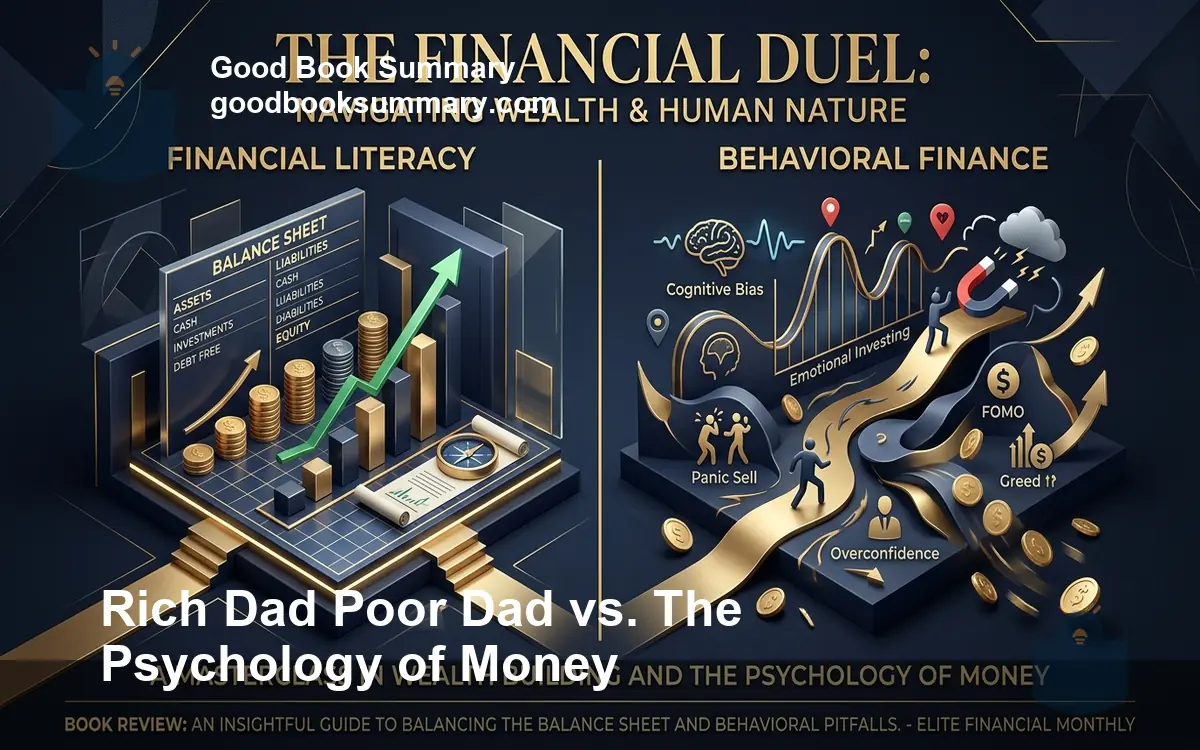
The Psychology of Money explores why people with modest incomes sometimes build extraordinary wealth while highly educated professionals occasionally experience financial ruin. Morgan Housel's central argument is simple: doing well with money is less about what people know and more about how people behave.
Core Comparison Table
| Comparison | Dimension | Concept A | Concept B |
|---|---|---|---|
| Wealth vs. Rich | Visibility | Hidden, unseen, unspent assets | Highly visible lifestyle and spending |
| Core Definition | Income not spent; options reserved for the future | Current income and present spending power | |
| Ultimate Value | Flexibility, independence, and control over time | Immediate gratification and social signaling | |
| Getting Wealthy vs. Staying Wealthy | Required Mindset | Optimism, action, and calculated risk-taking | Humility, frugality, caution, and survival awareness |
| Core Mechanism | Maximizing upside opportunities | Avoiding catastrophic ruin and maintaining consistency | |
| Reasonable vs. Rational | Decision Basis | Psychological comfort and behavioral sustainability | Pure mathematical optimization |
| Long-Term Sustainability | Easier to maintain through market volatility | Difficult to maintain during emotional stress |
The comparison framework reveals a recurring pattern throughout Morgan Housel's work. Financial success depends less on maximizing returns and more on creating a behavioral system that remains intact during uncertainty.
The Behavioral Spine: Why Soft Skills Trump Hard Finance
Morgan Housel introduces two individuals whose lives challenge conventional assumptions about intelligence and wealth creation. Ronald Read and Richard Fuscone demonstrate that behavioral traits often exert greater influence on financial outcomes than education, professional credentials, or social status.
The Parable of the Janitor and the Executive
What does Ronald Read's story teach about wealth building?
Ronald Read's story demonstrates that patience, consistency, frugality, and long-term investing can outperform elite education and financial sophistication. Morgan Housel uses Ronald Read's wealth accumulation alongside Richard Fuscone's bankruptcy to show that behavior frequently determines financial outcomes more than intelligence.
Ronald Read worked as a janitor and gas station attendant for much of his life. Through decades of disciplined saving and investing, Ronald Read accumulated approximately $8 million.
Richard Fuscone represented the opposite profile. Richard Fuscone graduated from Harvard, built a successful finance career, and enjoyed access to elite networks. Despite substantial advantages, Richard Fuscone eventually declared bankruptcy after excessive leverage and lifestyle inflation collided with adverse economic conditions.
The comparison highlights one of the book's most memorable lessons.
Wealth: Income that remains unspent and continues to compound over time.
Rich: Current income and spending power that can be displayed immediately.
Morgan Housel's behavioral thesis suggests that Ronald Read succeeded because patience, humility, and consistency proved stronger than complexity, prestige, and financial sophistication.
Exponential Geometry: The Unseen Power of Compounding
Compounding occupies a central position within Morgan Housel's financial philosophy. Warren Buffett serves as the most powerful example of how long time horizons can generate extraordinary outcomes without extraordinary annual returns.
The Warren Buffett Compounding Matrix
Why is Warren Buffett's success largely a function of time?
Warren Buffett's fortune illustrates the extraordinary effect of long-term compounding. Morgan Housel emphasizes that most of Warren Buffett's wealth emerged late in life because decades of uninterrupted growth created exponential rather than linear financial expansion.
Morgan Housel notes that Warren Buffett's net worth exceeded $84 billion during the period discussed in the book.
A remarkable observation emerges from the data:
- Approximately $84.2 billion accumulated after age 50.
- Approximately $81.5 billion accumulated after age 65.
- The majority of wealth creation occurred after traditional retirement age.
The mathematics behind compounding explains why.
When returns generate additional returns over increasingly long periods, growth accelerates exponentially rather than linearly.

Within the compound growth formula, the variable most investors underestimate is not the return rate (r). The underestimated variable is time (n).
Morgan Housel argues that Buffett's greatest financial advantage was not necessarily superior intelligence. Warren Buffett's greatest advantage was maintaining a long and uninterrupted investing career.
The Mathematics of Long Tails
What are tail events in investing?
Tail events are rare outcomes that contribute a disproportionately large share of total results. Morgan Housel explains that a small percentage of investments often generate the majority of long-term gains, making patience and diversification essential investment behaviors.
Tail Events: Rare outcomes located at the far edges of a probability distribution that contribute an outsized share of total results.
The concept appears repeatedly throughout financial history.
Research cited in the book found that roughly 7% of companies within the Russell 3000 Index generated virtually all of the index's net gains over time.
The implication is profound.
Most investments produce ordinary outcomes. A very small number of investments generate extraordinary outcomes. Investors who abandon strategies prematurely often miss the few outliers responsible for long-term success.
Morgan Housel therefore argues that consistency matters more than prediction.
The Survival Strategy: Getting Wealthy vs. Staying Wealthy
Many financial books focus on accumulation. Morgan Housel devotes substantial attention to preservation. Jesse Livermore and Abraham Germansky illustrate why survival represents the most important financial skill after wealth creation begins.
The Tragic Trajectory of Jesse Livermore
Why does Morgan Housel distinguish between getting wealthy and staying wealthy?
Morgan Housel distinguishes between getting wealthy and staying wealthy because wealth creation often requires risk-taking while wealth preservation requires humility, caution, and survival. Jesse Livermore's financial rise and collapse demonstrates that different psychological skills govern each phase.
Jesse Livermore became one of history's most famous traders.
During the 1929 stock market crash, Jesse Livermore reportedly earned the equivalent of billions of dollars in modern terms. Financial success appeared limitless.
The outcome changed dramatically.
Within a few years, Jesse Livermore lost his fortune and declared bankruptcy.
Morgan Housel pairs Jesse Livermore with Abraham Germansky to emphasize a recurring pattern. Exceptional talent for making money does not automatically create skill in preserving money.
Financial history repeatedly rewards survival over brilliance.
The Three-Step Financial Survival Shield
The survival framework presented in The Psychology of Money transforms abstract financial wisdom into practical behavioral rules.
1. Become Financially Unbreakable
Margin of Safety: A buffer designed to increase survival odds in an uncertain world.
Financial resilience begins by avoiding irreversible mistakes.
Key mechanism:
- Maintain adequate cash reserves.
- Avoid excessive leverage.
- Prevent forced asset sales during market declines.
- Never risk essential assets for optional gains.
Morgan Housel summarizes the principle with a powerful warning:
Never risk what you have and need for what you do not have and do not need.
2. Integrate Margin of Safety
Future forecasts inevitably contain errors.
A survival-oriented investor plans for uncertainty rather than precision.
Key mechanism:
- Budget conservatively.
- Underestimate expected returns.
- Overestimate potential risks.
- Create room for unexpected setbacks.
Financial plans succeed more often when expectations contain a buffer.
3. Develop a Barbelled Personality
Long-term optimism and short-term caution can coexist.
Key mechanism:
- Remain optimistic about economic progress.
- Remain cautious about immediate risks.
- Avoid euphoria during bull markets.
- Avoid despair during bear markets.
Morgan Housel presents balanced optimism as a durable competitive advantage.
Cognitive Arbitrage: Reasonable Decisions vs. Cold Rationality
Traditional finance assumes people behave rationally. Morgan Housel argues that human beings are emotional creatures whose financial decisions must fit psychological realities.
Why Being "Reasonable" Beats Being "Rational"
What is the difference between reasonable and rational investing?
Reasonable investing prioritizes psychological sustainability and emotional comfort. Rational investing prioritizes mathematical optimization. Morgan Housel argues that a slightly imperfect strategy maintained for decades usually produces better outcomes than a perfect strategy abandoned during stress.
The distinction appears subtle but carries enormous practical implications.
A mathematically optimal portfolio may expose an investor to volatility levels that feel unbearable during market crashes.
A reasonable portfolio may sacrifice a small amount of theoretical return while dramatically increasing the likelihood of staying invested.
Reasonable: A decision framework that aligns financial choices with human emotions and behavioral realities.
Morgan Housel repeatedly favors behaviorally sustainable decisions over theoretically perfect decisions.
Time Sovereignty: The Ultimate Dividend of Wealth
Financial freedom extends beyond account balances and investment returns. Morgan Housel argues that money's highest purpose is creating control over one's time.
Research conducted by Angus Campbell reinforces the conclusion.
Individuals who experience greater control over daily schedules consistently report higher levels of wellbeing than individuals who merely possess more material resources.
Time Sovereignty: The ability to control how, where, and with whom time is spent.
Morgan Housel identifies time sovereignty as the most valuable dividend wealth can provide because autonomy influences happiness more reliably than consumption.
How to Apply the Key Concepts of The Psychology of Money in Daily Life?
How can readers apply The Psychology of Money in everyday life?
The Psychology of Money by Morgan Housel can be applied through behavioral consistency, conservative financial planning, and long-term investing. Morgan Housel encourages maintaining room for error, defining personal sufficiency, and prioritizing sustainable habits over short-term optimization and financial prediction.
The practical application framework focuses on behaviors rather than forecasts.
The Actionable Daily Routine
Applying the practical insights from Morgan Housel requires translating behavioral psychology into sustainable daily habits. The following actionable routine provides a structural roadmap to implement these principles systematically.
1. Build Room for Error
Maintain emergency reserves and avoid budgeting with maximum efficiency. Financial flexibility creates resilience during unexpected events.
2. Define "Enough"
Establish a personal definition of sufficiency.
Excessive comparison often encourages unnecessary risk-taking. A clearly defined endpoint helps prevent endless accumulation.
3. Commit to Long-Term Asset Allocation
Create an allocation strategy that can remain intact for decades.
Behavioral consistency generally contributes more to outcomes than frequent portfolio adjustments.
What are the Key Takeaways from The Psychology of Money by Morgan Housel?
What are the key takeaways from The Psychology of Money by Morgan Housel?
The Psychology of Money by Morgan Housel teaches that wealth is hidden, compounding requires time, financial survival matters more than maximizing returns, tail events drive investment outcomes, and psychologically sustainable decisions often outperform mathematically perfect strategies over long periods.
The most important lessons include:
- Wealth is accumulated through saving and unspent assets rather than visible spending.
- Richness and wealth represent different concepts.
- Compounding depends heavily on time horizons.
- Tail events drive a disproportionate share of investment returns.
- Survival matters more than optimization.
- Margin of safety increases resilience.
- Time sovereignty represents the highest benefit of money.
- Reasonable decisions frequently outperform purely rational decisions.
- Behavioral discipline outweighs intellectual brilliance in financial success.
What is the Main Summary of The Psychology of Money?
What is the main summary of The Psychology of Money?
The Psychology of Money by Morgan Housel argues that financial success is primarily a behavioral skill rather than a technical skill. Wealth emerges from patience, survival, compounding, humility, and emotional discipline, while financial failure often emerges from overconfidence, leverage, and unsustainable behavior.
Morgan Housel's central insight can be condensed into a single principle:
People do not experience money through emotions, incentives, uncertainty, and personal history.
Financial outcomes therefore become behavioral outcomes.
The most successful investors are not necessarily the smartest investors. The most successful investors are frequently the individuals who maintain patience, avoid catastrophic mistakes, embrace uncertainty, and allow compounding to operate uninterrupted for decades.
The ultimate message of The Psychology of Money is that sustainable wealth creation depends on mastering behavior before mastering finance.
Strategic Peer Connections: Related Book Summaries
Many of Morgan Housel's ideas intersect with broader themes involving behavior, decision-making, and long-term self-management.
Readers interested in expanding the concepts explored in The Psychology of Money may also find value in:
- Atomic Habits — for understanding how small behaviors compound into significant outcomes.
- Dopamine Nation — for understanding consumption, desire, and self-regulation.
- Thinking, Fast and Slow — for understanding cognitive biases and decision-making under uncertainty.
Together, these works provide a broader framework for understanding why behavior often determines outcomes more powerfully than knowledge alone.