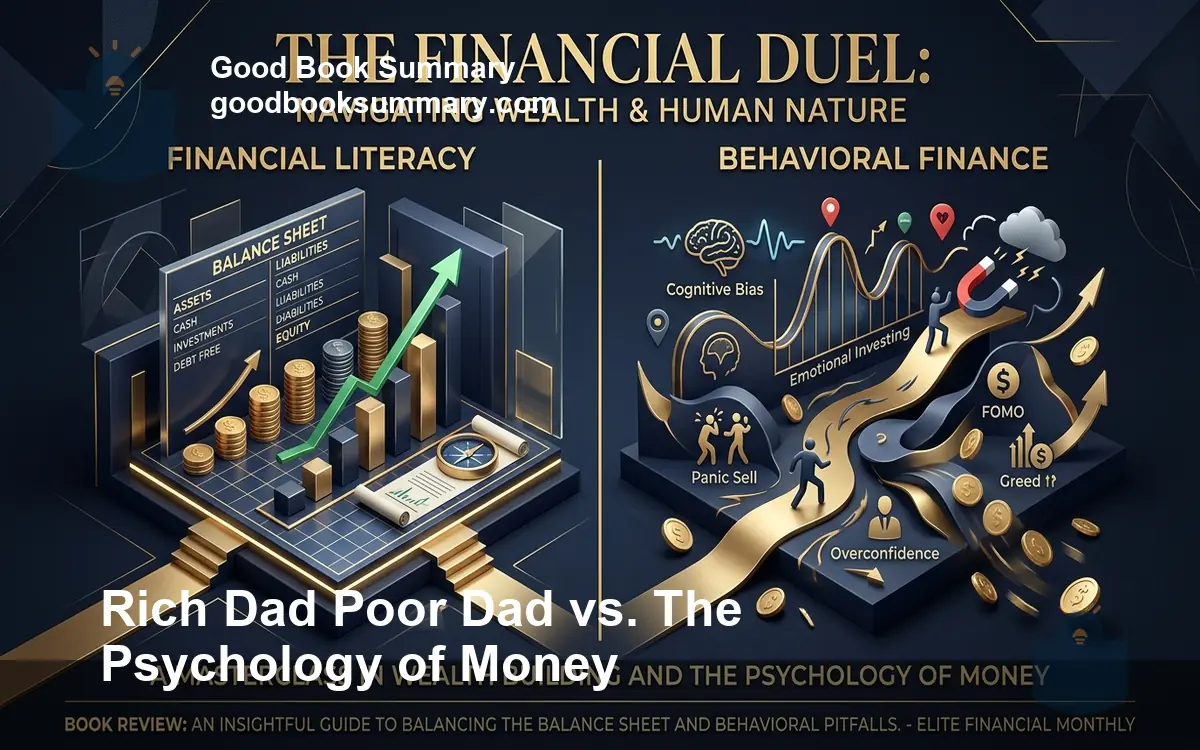
Metric Principle: Rich Dad Poor Dad vs. The Psychology of Money Formula & Application
Metric Principle: Rich Dad Poor Dad vs. The Psychology of Money Formula & Application evaluates how structural asset building and behavioral discipline create long-term wealth.
| Dimension | Kiyosaki (Rich Dad Poor Dad) | Housel (The Psychology of Money) |
|---|---|---|
| Core focus | Financial literacy, accounting, tax law, corporate structure | Behavioral psychology, emotional control, limits of historical data |
| Definition of an asset | Anything that generates cash inflow, excluding a primary home | A flexible hedge that buys time and optionality, including cash |
| Risk posture | Bold, calculated, concentrated early-stage investing | Defensive, survival-first, broadly diversified indexing |
| View of wealth | Active cash flow exceeding monthly expenses | The unspent capital nobody can see |
Kiyosaki's model rewards aggressive asset acquisition, and Housel's model rewards emotional restraint. The two positions are not contradictory. A reader can apply Kiyosaki's accounting distinctions to decide what to buy, then apply Housel's behavioral guardrails to decide how much risk to carry while buying it.
What is the main summary of rich dad poor dad vs the psychology of money?
Both books argue financial freedom is a behavioral and conceptual pursuit rather than a mechanical pursuit of wages. Kiyosaki's Rich Dad Poor Dad explains the corporate use needed to build a cash-flowing asset column and exit paid employment. Housel's The Psychology of Money explains how compounding, a cash buffer, and emotional humility keep that wealth intact over decades.
For a visual breakdown comparing Robert Kiyosaki's active cash flow strategy against Morgan Housel's behavioral discipline, watch the comprehensive video review below:
Kiyosaki's poor dad held a doctorate and a government post yet lived paycheck to paycheck. His rich dad never finished eighth grade but built a business empire in Hawaii by treating money as a subject to study rather than fear. That contrast frames Kiyosaki's central claim: financial outcomes trace back to household programming about money, not classroom grades. Housel opens from a parallel but distinct premise. A Vermont janitor named Ronald Read quietly amassed an eight million dollar portfolio through decades of patient investing in blue-chip stocks, while a Harvard-trained Merrill Lynch executive named Richard Fuscone filed for bankruptcy after over-leveraging his estate during the 2008 crash. Housel uses that pairing to argue that behavior, not credentials, decides who keeps money.
How kiyosaki defines assets and liabilities
Kiyosaki's accounting framework rests on a single test applied to every purchase: does it put cash into your pocket or take cash out of it. An asset generates inflow, a liability generates outflow, and Kiyosaki controversially places a primary residence in the liability column because a mortgage, property tax, and maintenance costs drain cash every month regardless of appreciation. This differs sharply from his poor dad's assumption that a family home is automatically an asset simply because its market price can rise.
Headword: Rich dad poor dad asset formula: Wealth, measured in days of survival, equals monthly passive income from the asset column divided by monthly expenses, multiplied by thirty. A reader earning 1,000 dollars a month in passive cash flow against 2,000 dollars in expenses has a wealth score of 15 days, meaning they could sustain their lifestyle for half a month without active work.
Kiyosaki illustrates the asset-building habit through his own childhood. At age nine he and a friend ran a lending library out of donated comic books, hiring a third child to staff it while they played, an early demonstration of passive cash flow separated from personal labor. Later, as a top Xerox salesman in 1978, he routed his commissions through a personal corporation rather than his own paycheck, which let him buy his first Porsche using pre-tax business income instead of after-tax personal savings. Both cases show the same mechanic: money is directed into an income-producing structure before it is spent on consumption.
Breakdown: 3 Rules
Breakdown: 3 Rules summarizes the financial IQ framework where Kiyosaki compresses financial intelligence into core skills: accounting, investing, market analysis, and law. Accounting supplies the literacy to read a balance sheet. Investing supplies the science of making money generate more money. Market analysis supplies supply-and-demand judgment for entry and exit timing. Law supplies the tax code fluency that lets a corporation deduct board meetings, vehicle costs, and health expenses before paying tax on what remains, compared to an employee who pays tax first and spends what is left.
Employee cash flow:      Earn -> Tax -> Spend remainder
Corporate cash flow:     Earn -> Spend legitimate expenses -> Tax remainder
This single sequencing difference, taxed-then-spent versus spent-then-taxed, is the structural core of Kiyosaki's chapter on the history of taxes and corporations.
How housel defines wealth and behavior
Housel's framework starts from a different unit of analysis: not the balance sheet, but the individual's personal history. He estimates that a person's own lived experience with money represents a vanishingly small slice of global economic history, yet it forms the overwhelming majority of how that person interprets markets for the rest of their life. An investor who came of age during a high-inflation decade will distrust bonds for life, while an investor who came of age during low rates will see bonds as a stabilizer. Neither reaction is irrational once the underlying experience is accounted for, which is the thesis of Housel's opening chapter.
Headword: Psychology of money wealth formula: Wealth equals accumulated leftovers, expressed as the savings rate multiplied by the gap between income and ego. Two households earning identical salaries can build radically different net worths depending entirely on how much of that income status spending consumes.
Luck, risk, and the moving goalpost
Housel treats luck and risk as sibling forces that pull outcomes in opposite directions with equal and often invisible weight. Mark Zuckerberg's refusal of a billion-dollar buyout offer is remembered as visionary, while a series of dot-com era executives who made comparable refusals are remembered as reckless, a difference driven as much by which side of the risk-luck coin landed up as by any measurable difference in judgment. Bill Gates attended one of the only American high schools with a computer terminal in 1968, a stroke of statistical luck that fed directly into Microsoft's founding, while his equally talented classmate and early collaborator died in a mountaineering accident before finishing high school, a comparably rare stroke of misfortune.
Housel's chapter on "never enough" turns to Rajat Gupta, a McKinsey chief executive worth roughly 100 million dollars who was convicted of insider trading after trying to cross into billionaire territory, and to Bernie Madoff, who already ran a legitimate market-making business earning tens of millions annually before fabricating a Ponzi scheme. Neither man lacked money. Both lacked an internal stopping point, which Housel frames as the single most dangerous gap in personal finance: expectations rising faster than results.
Compounding, longevity, and staying wealthy
Warren Buffett supplies Housel's central statistical case for time over talent. Roughly 81.5 billion dollars of Buffett's 84.5 billion dollar net worth, by Housel's accounting, accumulated after his 65th birthday, not because his skill sharpened late in life but because he began investing at age ten and simply let seven decades of compounding run uninterrupted. Jim Simons of Renaissance Technologies posted a 66 percent average annual return, a figure that dwarfs Buffett's roughly 22 percent, yet Simons finished his career with a fraction of Buffett's total wealth because he did not find his investing footing until his fifties, giving compounding far less runway to work.
This leads into Housel's distinction between getting money and keeping it. Getting money rewards optimism, risk-taking, and visibility. Keeping money rewards frugality, paranoia, and a margin of safety. Jesse Livermore shorted the 1929 crash for a fortune equivalent to roughly 100 million dollars in today's terms, then lost it all within a few years through unchecked use. Rick Guerin, an early investing partner of Buffett and Charlie Munger, was forced to sell his Berkshire Hathaway shares for under 40 dollars each after a 1970s margin call, missing out on decades of subsequent compounding that Buffett and Munger captured simply by carrying less debt through the same downturn.
Overcoming the five obstacles kiyosaki identifies
Kiyosaki argues that financial literacy alone does not guarantee wealth, because five behavioral obstacles routinely block even well-informed people: fear, cynicism, laziness, bad habits, and arrogance. Fear shows up as the instinct to avoid any investment that carries visible downside, even when the underlying math favors action. Cynicism shows up as reflexive doubt that stops a person from analyzing an opportunity closely enough to see its actual risk profile, illustrated by investors who accept a five percent bank certificate of deposit while dismissing tax lien certificates paying sixteen percent as too risky without ever examining the mechanism. Laziness shows up in the reflex of saying an expense cannot be afforded, which shuts the brain down, instead of asking how it could be afforded, which forces active problem-solving.
Bad habits, in Kiyosaki's framing, get corrected through the discipline of paying yourself first, directing money into the asset column before creditors or the tax authority take their share, which creates enough pressure to force creative income generation to cover the gap. Arrogance is described as ego covering ignorance, visible in professionals who bluster through a conversation about financial statements to hide gaps in their own investment knowledge. Kiyosaki's own path illustrates the fear obstacle directly: he left a stable job at Standard Oil for a straight-commission sales role at Xerox specifically to confront a paralyzing fear of rejection, a decision that later made him the company's top seller and gave him the capital to fund his first real estate deals.
Getting started: kiyosaki's ten-step process
Chapter nine of Rich Dad Poor Dad compresses the asset-building habit into a repeatable process built on four internal powers. The power of spirit supplies the emotional "why" strong enough to sustain years of deferred gratification, illustrated by a young athlete who wakes before dawn and skips social events because a larger goal outweighs the daily cost. The power of choice governs how time, money, and attention get spent, framed through the gap between the roughly ninety percent of people who spend discretionary income on entertainment versus the minority who spend it on financial education. The power of association favors relationships with financially literate people over relationships chosen purely for social comfort, since proximity to informed people surfaces opportunities and warnings earlier. The power of self-discipline governs whether income actually reaches the asset column before it reaches a shopping cart.
Kiyosaki provides ten steps to awaken financial intelligence, beginning with finding a deep emotional reason or purpose, choosing daily habits deliberately, selecting friends carefully, and learning new income-generating models continuously.
Freedom as the highest dividend housel identifies
Housel emphasizes that the highest form of wealth is the ability to wake up every morning and say, "I can do whatever I want today." Money's greatest intrinsic value is its ability to grant control over your time.
Reasonable over rational, and room for error
Housel's eleventh chapter argues that an investor should optimize for a strategy they can emotionally sustain rather than one that is mathematically optimal on paper. Harry Markowitz, the Nobel laureate who built modern portfolio theory, split his own retirement contributions evenly between stocks and bonds specifically to minimize his own future regret, a choice his own models would not have recommended as mathematically efficient. A separate academic study from Yale found that young savers using two-to-one leverage in their retirement accounts would mathematically outperform unleveraged savers over a multi-decade horizon, yet Housel notes almost no financial advisor recommends this in practice because the emotional cost of a leveraged drawdown outweighs the theoretical gain for most savers.
Chapter thirteen extends the same logic into a formal margin-of-safety principle: build in enough buffer between what you expect to happen and what you can financially survive that a forecast becomes unnecessary. Bill Gates required Microsoft to keep a full year of payroll in cash reserve at all times, a policy that cost the company return on that capital but that also guaranteed survival through any single bad year. A professional card counter operating with a real but modest statistical edge still needs roughly 100 betting units in reserve to avoid going broke during an ordinary run of bad luck, illustrating that even a mathematically favorable edge fails without enough capital cushion behind it.
Investment Mental Model: Margin of Safety and Cash Flow Cushion
Headword: Margin of Safety: The principle of building sufficient operational and financial buffers between expected outcomes and survivable risk thresholds.
Origin: Benjamin Graham and Warren Buffett, introduced in Security Analysis (1934) and expanded by Morgan Housel and Robert Kiyosaki.
Core Logic: Input: Financial assets and cash reserves -> Process: Apply minimum 12-month expense buffer -> Decision: Maintain optionality without forced asset liquidation.
Application Checklist:
- [ ] Maintain a minimum 6 to 12-month cash reserve for unexpected downturns.
- [ ] Verify passive income from assets covers baseline monthly living expenses.
- [ ] Avoid over-leveraging assets to prevent forced liquidation during market drawdowns.
Boundary Conditions:
- Use when: Navigating volatile market cycles, business expansion, or career transitions.
- Avoid when: Holding excess cash during high-inflation regimes without asset allocation.
The Psychology of Principle: Rich Dad Poor Dad vs. The Psychology of Money Biases
The Psychology of Principle: Rich Dad Poor Dad vs. The Psychology of Money Biases details how cognitive distortions affect long-term wealth management.
Bias Table: in Investing
Bias Table: in Investing outlines the behavioral traps identified across both works. The table below aligns Kiyosaki's real estate and corporate examples against Housel's market examples for each bias.
| Bias | Description | Rich dad poor dad example | Psychology of money example |
|---|---|---|---|
| Social conformity | Copying peer spending to signal status rather than tracking real cash flow | Treating a mortgaged home as an asset because convention says so | The "man in the car paradox," where onlookers admire the car, not its owner |
| Compounding blindness | Underestimating exponential growth because the brain defaults to linear math | Missing how a small comic-library business multiplies capital over years | Underestimating that most of Buffett's fortune arrived after age 65 |
| Historians-as-prophets fallacy | Treating past data as a fixed template for future conditions | Schools preparing students for an industrial economy that no longer exists | Applying 1970s Benjamin Graham valuation formulas to modern markets |
Robert T. Kiyosaki vs. Morgan Housel vs Strategy: Comparison
Robert T. Kiyosaki vs. Morgan Housel vs Strategy: Comparison evaluates how technical financial literacy and behavioral self-discipline interact across different market conditions. A two-axis model, plotting technical financial literacy against behavioral self-discipline, sorts the case studies from both books into four outcomes. Low literacy paired with low discipline produces the underperforming class, trapped in consumer debt with no asset column. High literacy paired with low discipline produces the Fuscone and Gupta pattern, where advanced credentials fail to prevent ruin driven by leverage and ego. Low literacy paired with high discipline produces the Ronald Read pattern, where patience alone builds a multi-million dollar estate with no formal training. High literacy paired with high discipline produces the composite Buffett or rich-dad ideal, combining accounting fluency with the psychological margin of safety needed to hold through a downturn without selling.
The matrix matters because it shows literacy and behavior as independent variables. A reader can max out one axis and still fail on the other, which is exactly what happened to Fuscone and Gupta.
What are the key takeaways from rich dad poor dad vs the psychology of money?
Financial success depends far more on emotional discipline than academic credentials. The financially comfortable direct money into passive assets instead of spending everything they earn. Compounding needs decades to produce dramatic results, and surviving downturns without forced selling is the actual mechanism that makes that time possible. Reputation, freedom, and family relationships should never be risked for wealth that is not needed.
Practical layer: applying both frameworks together
The two books combine into a repeatable monthly routine rather than two competing philosophies.
1. Separate income from assets. Use Kiyosaki's cash flow test on every recurring expense: does this line item put money into the pocket or take it out. Recategorize any purchase currently mislabeled as an investment.
2. Pay the asset column first. Route a fixed percentage of every paycheck into income-producing vehicles, index funds, dividend equities, or rental property, before any discretionary spending occurs.
3. Set a personal enough-line. Define the income and asset level that ends the chase, in writing, before ego-driven comparison resets it. Housel's moving-goalpost warning applies directly here.
4. Build a volatility buffer. Hold enough cash reserve to avoid forced selling during a downturn, treating the emotional discomfort of a market drop as an admission fee rather than a fine to be dodged.
5. Mute sunk costs. Abandon career or investment decisions made by an earlier, less informed version of yourself if they no longer serve current goals, rather than continuing them out of consistency alone.
6. Study the technical skills only after the behavioral guardrails are set. Accounting, tax law, and market analysis compound in value once discipline already prevents the account from being drained by panic or lifestyle creep.
How to apply the key concepts of rich dad poor dad vs the psychology of money in daily life?
Draw a clean line between assets that generate cash and liabilities that drain it. Keep active income flowing while directing every extra dollar into the asset column first. Cap lifestyle spending below income growth to prevent ego-driven expectation creep, and hold a cash buffer large enough to avoid selling assets during a downturn.
Where the two authors disagree
The clearest friction point is housing. Kiyosaki treats a mortgaged primary residence as a liability because it produces no cash inflow and consumes maintenance costs every month. Housel treats a paid-off home differently, describing his own decision to pay off his mortgage at low interest rates as the mathematically worst but psychologically best financial choice he made, because it removed a monthly obligation and delivered a sense of independence no spreadsheet return could match. Kiyosaki is optimizing for cash flow. Housel is optimizing for sleep-at-night comfort. Neither is wrong within its own framework, which is the core lesson Housel draws in his closing chapter: there is no single correct financial answer, only the answer that fits a given household's temperament.
A second friction point concerns cash. Kiyosaki treats idle cash as an underperforming asset that should be redeployed into real estate or a business as quickly as possible. Housel treats cash as a strategic hedge, arguing that a company or household that keeps a full year of expenses in reserve, the way Bill Gates insisted Microsoft always keep a year of payroll on hand, converts an unpredictable future into a survivable one. Kiyosaki's aggression suits an investor with high risk tolerance and time to recover from a bad bet. Housel's caution suits an investor for whom a single forced sale during a downturn would end the compounding process permanently.
Synthesis and reader perspective
Kiyosaki's framework rewards readers who are comfortable with concentrated, hands-on bets, willing to study real estate contracts, corporate filings, and tax code line by line. Its 1997 vintage means some legal specifics need updating, and its dismissal of a primary home as a pure liability will not fit every household's actual math, particularly in markets with strong long-term appreciation. Housel's framework rewards readers who prioritize survival and consistency over spectacular returns, and its behavioral lessons age well because they describe psychology rather than tax law. Its limitation is the mirror image of Kiyosaki's strength: Housel offers few concrete mechanical steps for actually acquiring an asset in the first place.
Read as a pair, the books cover both halves of a single problem. Kiyosaki answers how to build the asset column. Housel answers how to keep from losing it once built. A reader who only follows Kiyosaki risks the Fuscone and Gupta pattern, high literacy undone by poor discipline. A reader who only follows Housel risks stalling at the Ronald Read pattern, high discipline with no acceleration from active asset-building. Combining both frameworks covers the full arc from earning the first dollar of passive income to holding onto it across a forty-year horizon.
Related book summaries
- Digital Minimalism summary
- Can't Hurt Me summary
- Die with Zero summary
- The Subtle Art of Not Giving a F*ck summary
Frequently Asked Questions
Is rich dad poor dad still relevant given its outdated tax examples?
Some of Kiyosaki's 1997 tax and corporate structuring examples reflect regulations that have since changed. The underlying accounting logic, tracking cash inflow against cash outflow before labeling anything an asset, remains applicable regardless of the specific tax code cited, though readers should verify any statute-specific claim against current law before acting on it. [VERIFY]
Does the psychology of money recommend against risk entirely?
No. Housel's tail-outcome chapter argues that a small number of extreme wins typically account for most lifetime investment returns, using the example of venture portfolios where a majority of individual bets lose money yet a single outsized winner carries the fund. The book argues against risk that could end the game, specifically used positions that force a sale during a downturn, not against risk broadly.