Comparison: Ancient vs. Modern Beverages as Civilizational Engines
Comparing ancient and modern beverages reveals how the fundamental role of drinks shifted from basic survival and local status to cognitive enhancement and global trade networks. The matrix below highlights the key differences between these two eras of beverage history.
| Dimension | Ancient Beverages (Beer, Wine, Spirits) | Modern Beverages (Coffee, Tea, Cola) |
|---|---|---|
| Primary Function | Nutrition, safe hydration, ritual currency | Cognitive stimulation, imperial trade, mass consumerism |
| Social Venue | Feast halls, symposia, slave barracks | Coffeehouses, tea gardens, soda fountains |
| Economic Role | Wage payment, colonial barter | Financial market incubator, imperial trade deficit driver |
| Political Impact | State formation, American Revolution | Scientific Revolution, Opium Wars, Cold War symbolism |
| Scale of Production | Artisanal and municipal | Industrial and global |
| Key Epoch | Agricultural Revolution to Age of Exploration | Age of Reason to American Century |
What Is the Main Summary of A History of the World in 6 Glasses?
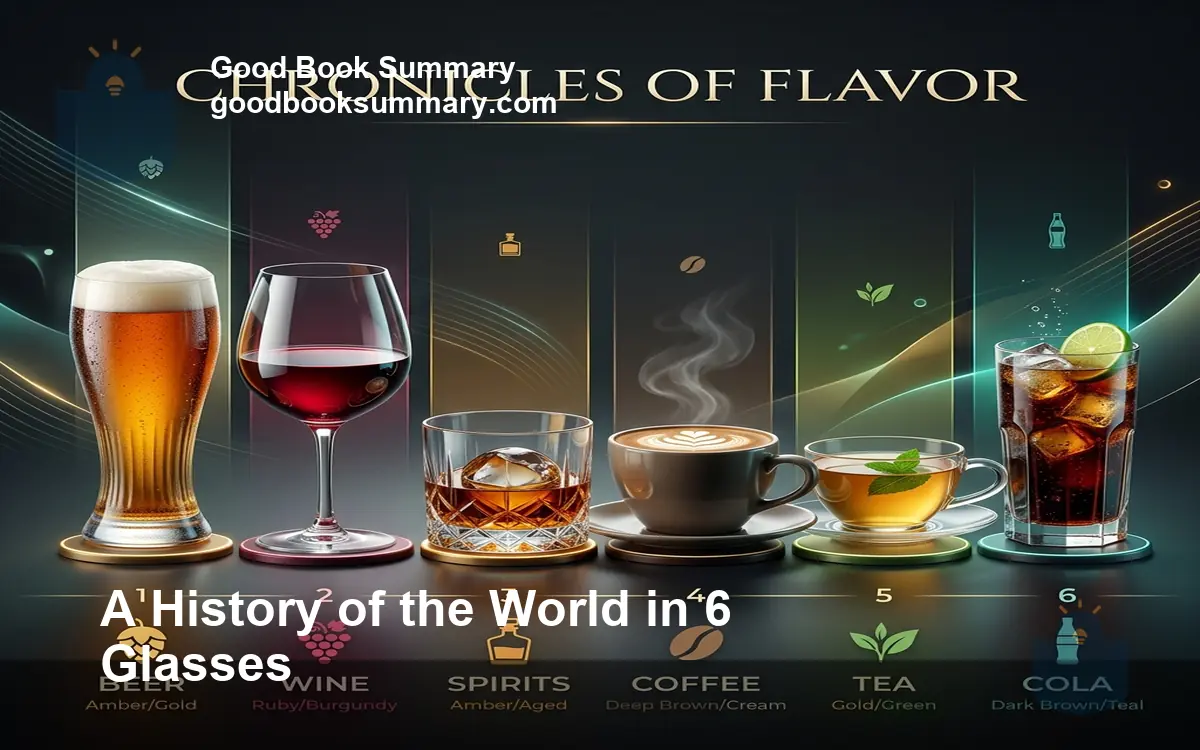
Tom Standage argues that six beverages — beer, wine, distilled spirits, coffee, tea, and Coca-Cola — each defined a pivotal epoch in human history, functioning not merely as refreshments but as engines of cultural, economic, and political transformation. The book traces this arc from the Fertile Crescent to modern globalization, showing how what people drank shaped who they became.
A History of the World in 6 Glasses is organized as six consecutive case studies, each centered on a single drink that encapsulates its era's defining anxieties and ambitions. Standage, then technology editor of The Economist, applies a reporter's precision to historical archaeology, economics, and cultural anthropology. The result is a thesis-driven popular history that uses beverages as lenses rather than subjects — the drinks are always proxies for something larger: agricultural surplus, imperial ambition, Enlightenment rationalism, industrial capitalism.
From Grain to Glass: Beer and the Birth of Civilization
The transition from nomadic foraging to settled agricultural societies represents the fundamental pivot of early human prehistory. While traditionally explained as a search for food security, this civilizational shift was heavily accelerated by the discovery and adoption of beer.
How Beer Triggered the Agricultural Revolution
The standard account of agriculture holds that humans settled down to grow food. Standage interrogates this assumption with archaeological evidence suggesting the true incentive may have been the production of beer. In the uplands of the Fertile Crescent — modern-day Iraq, Syria, Turkey, and Iran — wild wheat and barley grew in dense stands. Hunter-gatherers almost certainly discovered that soaked, sprouted grain (what later brewers would call "malted grain") fermented in the presence of wild yeasts into a mildly intoxicating gruel. This proto-beer was nutritious, packed with B vitamins, and critically safer than untreated water in regions where waterborne pathogens were endemic.
The Nutritional Calculus of Early Brewing
The transition between approximately 9000 BCE and 4000 BCE from nomadic foraging to sedentary farming in the Near East is one of the most consequential events in human history. Standage's analysis suggests that the desire to secure a reliable grain supply — not solely for bread but for fermented drink — provided the sustained motivation required to make that leap. Beer-drinking farmers, receiving a steady supply of calories and safe hydration, held a meaningful biological advantage over those relying on untreated river water.
"[!NOTE]"
"Beer was not invented through deliberate experimentation. Standage describes its discovery as almost certainly accidental — grain left wet and exposed to airborne yeasts, returning to produce something unexpected and pleasurable. The human instinct to replicate that accident is what drove agricultural change."
Beer as the First Written Record
The argument deepens when Standage moves to Mesopotamia and Egypt, where beer had evolved from a chance discovery into the organizing principle of early urban economies. By the third millennium BCE, cities like Uruk were managing populations too large for barter to function efficiently. Beer became a standardized medium of exchange. Workers constructing the pyramids at Giza received daily rations of three or four loaves of bread and two jugs of beer — not as a perquisite but as their salary.
The administrative complexity of tracking these distributions gave rise to "cuneiform," the world's first general-purpose writing system. Early Sumerian clay tablets from Uruk bear pictograms for beer — records of ration allocation, not poetry or philosophy. Writing was not invented to record ideas. Writing was invented to account for beer.
"The Epic of Gilgamesh, one of humanity's oldest literary texts, depicts the wild man Enkidu being civilized through the consumption of bread and beer. This narrative framing is not incidental. It reflects a genuine cultural consensus in ancient Mesopotamia that fermented grain was the boundary marker between the human and the animal — a belief archaeologically grounded in the fact that beer production required, and therefore demonstrated, the full apparatus of settled civilization."
The Symposion and the Convivium: Wine and the Classical World
As civilization expanded around the Mediterranean, the social rituals of drinking evolved from simple community nourishment to sophisticated cultural expression. In the classical era, wine became the primary medium for structuring intellectual debate in Greece and social hierarchy in Rome.
How Wine Shaped Greek Democracy and Roman Hierarchy
Wine's story diverges sharply from beer's. Where beer was the drink of everyone in Mesopotamia and Egypt — a universal ration — wine in the ancient Mediterranean was first and foremost a prestige object, a vehicle for social differentiation, and eventually the medium through which Greek culture disseminated itself across the known world.
The Greek Symposion: Democracy in a Bowl
The "symposion" was not a dinner party. Standage is precise about this: attendees had already eaten before the symposion began. The drinking party was a separate ritual institution, formalized by rules about when and how much to drink, governed by an elected leader who set the ratio of wine to water in the shared "krater." Drinking unmixed wine was a mark of barbarity; the civilized Greek diluted his wine, demonstrating self-control — the cardinal Greek virtue.
The symposion's significance far exceeds its social charm. Plato used the format to stage his most important philosophical dialogues. Athenian democracy was debated, tested, and refined in symposion settings. The drinking party was, in effect, the original peer-reviewed forum — a structured adversarial space where ideas were subjected to collective scrutiny over shared cups.
"[!TIP]"
"For professionals interested in facilitated debate formats, the symposion offers an instructive model: a defined time limit, a neutral moderator, equal access to a shared resource, and adversarial intellectual exchange as the explicit purpose. Modern equivalents — Oxford-style debates, structured brainstorming sessions — replicate the form without acknowledging the ancient precedent."
The Roman Convivium: Wine as Social Stratification
Rome adopted Greek wine culture wholesale and then inverted its egalitarian logic. The "convivium" used wine to display social divisions rather than temporarily set them aside. Guests received different qualities of wine depending on their rank; slaves received "lora," a thin drink pressed from grape skins and seeds, while elite guests consumed the immortal Falernian. The physician Galen, searching the imperial cellars for a suitable medicine for Marcus Aurelius in 170 CE, treated wine selection as a medical and status act simultaneously.
"[!IMPORTANT]"
"Standage's comparison of the Greek symposion and the Roman convivium reveals a fundamental truth about how social structures use shared consumption: the same object (wine) can encode radically different values (equality versus hierarchy) depending on how it is distributed and to whom."
Distillation, Domination, and Revolution: The Age of Spirits
The technology of distillation transformed alcohol from a perishable, low-strength beverage into a highly concentrated, durable commodity. In the era of global exploration, these spirits became a powerful currency that reshaped trade networks, drove colonial expansion, and fueled global conflicts.
How Distilled Alcohol Fueled the Slave Trade and Built America
Distilled spirits represent the technological leap that made alcohol portable, durable, and potent enough to function as the currency of the Age of Exploration. The Arabic refinement of distillation equipment — the alembic still — transformed wine into "aqua vitae," initially celebrated in Latin medical texts as a near-miraculous medicine. European traders quickly recognized that concentrated alcohol survived long sea voyages in a way that beer and wine could not.
Rum and the Triangle of Exploitation
The origins of rum illuminate one of history's most uncomfortable economic chains. Caribbean sugar planters discovered that molasses — the otherwise worthless byproduct of sugar refining — could be fermented and distilled into a powerful drink initially called "kill-devil." New England distilleries imported this cheap French Caribbean molasses and converted it into vast quantities of rum, the colonies' most profitable manufactured export. That rum then traveled to the West African coast, where it functioned as the primary prestige currency demanded by African traders selling enslaved human beings.
"The "Colonial Spirits Economy Matrix" that emerges from Standage's analysis is a three-node system: Caribbean plantations producing molasses; New England distilleries converting it to rum; and West African trading networks accepting rum for enslaved people. Each node was economically rational in isolation. The system as a whole was a machinery of mass atrocity sustained by a single manufactured beverage."
"Grog" and the British Navy
Spirits also shaped military history. "Grog" — rum, water, sugar, and citrus juice — was adopted by the British Royal Navy under Admiral Edward Vernon. The citrus component inadvertently supplied vitamin C, drastically reducing scurvy among sailors and thereby improving the operational effectiveness of the fleet that would eventually dominate global sea-lanes. Naval supremacy and citrus-fortified rum were not unrelated phenomena.
Whiskey and the First Test of American Federal Authority
After independence, rum's association with British colonial trade made it politically toxic for American patriots. As settlers moved inland beyond the Atlantic coast, they began distilling locally grown grain into whiskey, which functioned as both beverage and frontier currency — traded for salt, iron, and votes. When Alexander Hamilton imposed a federal excise on distilled spirits in 1791, frontier farmers in western Pennsylvania responded with armed rebellion. President Washington personally led a militia force to suppress the Whiskey Rebellion of 1794, establishing in a single action that the new federal government possessed the will and the power to enforce tax law. The republic's first domestic crisis was a dispute over distilled grain.
The Coffeehouse Internet: Coffee and the Age of Reason
The introduction of coffee to Europe during the seventeenth century marked a profound dietary and cognitive shift for Western civilization. By replacing intoxicating morning ale with a powerful stimulant, coffee fostered an environment of heightened rationality and shared intellectual discourse.
What Are the Key Takeaways from A History of the World in 6 Glasses by Tom Standage?
The book's key takeaways center on five arguments: beverages are historical forces, not mere accompaniments; each drink both reflects and accelerates its era's defining transformation; the social spaces created around drinks (symposia, coffeehouses, soda fountains) are where civilization's most consequential decisions get made; imperial powers weaponize beverage supply chains to extend control; and water — the original drink — is re-emerging as the defining geopolitical resource of the future.
Coffee's story begins with a reputation: "the great soberer." When European intellectuals and merchants began drinking coffee in the early seventeenth century, they were replacing their morning alcohol — the standard beverage of a civilization where water was unsafe and beer was breakfast — with a stimulant that sharpened rather than dulled perception. Standage connects this dietary shift directly to the Enlightenment's intellectual character.
The Coffeehouse as Innovation Infrastructure
European coffeehouses were not simply pleasant gathering places. Standage calls them "the Internet of the Age of Reason," and the analogy holds in structural terms: coffeehouses were distributed nodes in an information network, linked by the circulation of customers, printed news sheets, and word of mouth. "Penny universities" — English coffeehouses where anyone could join the conversation for the cost of a single cup — allowed Christopher Wren to argue orbital mechanics with Robert Hooke, Edmund Halley to solicit Isaac Newton, and Camille Desmoulins to ignite the French Revolution from a café table.
The coffeehouse gave rise to three enduring institutions:
1. Lloyd's of London — Marine insurers and shipowners congregated at Edward Lloyd's coffeehouse to match risk with capital. The institution formalized into the world's preeminent insurance market without ever entirely abandoning its coffeehouse origins.
2. The London Stock Exchange — Stockbrokers expelled from the Royal Exchange relocated to the surrounding coffeehouses, particularly Jonathan's, where they continued trading stocks and eventually formalized their operations into an exchange.
3. Isaac Newton's *Principia Mathematica — A debate at a London coffeehouse between Hooke, Halley, and Wren about planetary orbits led Halley to consult Newton, who produced mathematical proofs he had never published. Halley personally financed the resulting Principia*, arguably the most consequential scientific text in history.
"[!NOTE]"
"The coffeehouse's specific contribution was not intellectual genius — the geniuses existed before coffee. Its contribution was a physical infrastructure for cross-pollination: a space where a mathematician could encounter a merchant, where a natural philosopher could overhear a naval officer describing tidal patterns he could not explain."
Tea, Empire, and the Industrial Revolution
The rising popularity of tea transformed a rare eastern luxury into the fuel of the British Empire and the industrial factory system. This global obsession structured international trade routes, precipitated wars, and physically sustained the workforce of the industrial era.
How Tea Powered British Global Dominance
Tea's trajectory from Chinese luxury to British national obsession is one of history's most consequential acts of cultural adoption. Catherine of Braganza, the Portuguese princess who married King Charles II in 1662, introduced tea to the English court. Within decades, demand had outpaced supply, and the "British East India Company" — a commercial organization that had evolved into a de facto colonial government — was restructuring global trade routes to satisfy it.
The Opium Solution
The British faced a structural problem: China demanded silver for tea, and British manufacturers produced nothing the Chinese wanted to buy. Silver was finite. The East India Company's solution was the "opium trade": growing opium in Bengal and selling it into China, generating the silver to purchase tea, while simultaneously creating a massive population of addicts who destabilized Chinese society. When China's imperial government moved to halt the trade, Britain fought two Opium Wars to preserve it. The independence of the American colonies and the ruination of Qing China were, Standage argues, the twin geopolitical catastrophes of British tea dependency.
Tea and the Factory System
Domestically, tea performed a different service. The boiling of water required for tea preparation killed waterborne pathogens, making tea safe for the dense urban populations that industrial factories were assembling for the first time. Tea's caffeine extended the working day. The combination of safe hydration and stimulation made tea the ideal beverage for factory workers — and the factory system's voracious appetite for labor made mass tea consumption economically essential. Standage's argument here is at its most provocative: the Industrial Revolution was partly tea-powered.
"The Assam tea discovery — indigenous tea plants found in northeastern India and then cultivated using industrial methods — illustrates the Mass-Market Beverage Globalization Model in action. Britain located an internal (colonial) source, industrialized its production, and within decades had eliminated its dependence on Chinese exports, collapsing Chinese tea merchant families and replacing them with Bengali plantation workers operating under conditions indistinguishable from slavery."
Globalization in a Bottle: Coffee, Cola, and American Hegemony
In the twentieth century, carbonated beverages evolved from regional patent medicines into symbols of mass consumerism and global trade. The rise of Coca-Cola represents the ultimate convergence of industrial scale, branding, and geopolitical influence.
The Birth of Coca-Cola
Soda water originated as European medical curiosity. Joseph Priestley, experimenting beside a brewery fermentation vat in 1767, discovered that carbon dioxide could be dissolved into water. The resulting carbonated water was marketed as a health product mimicking natural mineral springs. The American innovation was to industrialize its production using the "American System of Manufactures" — standardized, interchangeable parts handled by specialized machines — making carbonated beverages cheap, consistent, and globally scalable.
"Patent medicines" — heavily marketed cure-alls typically containing alcohol, caffeine, cocaine, or all three — provided the immediate commercial context for Coca-Cola's invention. Atlanta pharmacist John Pemberton adapted his coca-and-kola-wine into a sweet, nonalcoholic syrup in 1886, motivated by local prohibition ordinances. The resulting drink accidentally met an unmet need: a stimulating, refreshing, socially acceptable nonalcoholic beverage for a society increasingly anxious about temperance.
Coca-Cola as Geopolitical Symbol
Coca-Cola traveled with American soldiers in World War II. General Eisenhower requested that sixty-four bottling plants be constructed close enough to front lines that every American serviceman could access a bottle for five cents. The Coca-Cola Company complied, establishing a global manufacturing footprint that persisted long after the war ended. By the late twentieth century, "Coca-Cola" was the second most widely understood phrase on Earth after "OK."
"[!IMPORTANT]"
"Standage's Cola chapters reframe Cold War cultural history. Soviet condemnation of Coca-Cola as an imperialist symbol was not paranoid — it was an accurate reading of the drink's function. Coca-Cola's presence in a market indicated American political and economic penetration. Its absence, as in the Soviet bloc and Cuba, marked the boundary of a rival system."
How to Apply the Key Concepts of A History of the World in 6 Glasses in Daily Life
Standage's framework can be applied practically through five principles: trace the social spaces around your decisions (who do you think with and where?); examine what the beverages in your environment signal about status and inclusion; recognize that infrastructure (coffeehouses, supply chains) shapes ideas more than genius does; understand that consumer habits carry geopolitical weight; and pay attention to water as the next resource conflict.
The "Beverage Globalization Cycle" that Standage implicitly constructs across his six case studies is immediately applicable as a business and historical analysis framework:
1. Identify the Origin Node — Every global commodity begins as a local or regional product with specific cultural meanings (Mesopotamian beer, Arabian coffee, Chinese tea).
2. Trace the Elite Adoption Phase — Prestige goods achieve initial spread through aristocratic or religious adoption, which confers legitimacy before mass production makes them affordable.
3. Map the Industrialization Inflection Point — The moment when production separates from craft — when the East India Company industrializes Assam tea or John Matthews mechanizes soda-water production — is when a regional product becomes a global commodity.
4. Follow the Marketing Transition — The shift from "medicine" to "lifestyle necessity" is always managed through aggressive marketing. Coffeehouses sold health benefits. Coca-Cola sold refreshment and patriotism.
5. Identify the Imperial Vehicle — Every globally dominant beverage traveled on the back of a superpower: Greek wine on Mediterranean trade ships, British tea on East India Company routes, Coca-Cola on American military logistics.
"[!TIP]"
"Analysts studying emerging consumer categories — plant-based proteins, functional beverages, nootropics — can apply this five-step cycle to assess which products are at the "elite adoption" phase versus which have reached the "industrialization inflection point." The cycle has repeated six times across ten millennia. It is likely repeating again now."
The Practical Standage Synthesis: Analyzing History Through Beverages
Standage's methodology — using a single consumable to anchor a historical epoch — is transferable to virtually any domain of historical or strategic analysis. The structural logic beneath each chapter is consistent:
To model this historical causation framework mathematically, we can express the civilizational impact of a beverage as a function of social, technological, and geopolitical variables:
This formula encapsulates how Standage traces the lifecycle of each drink from its emergence as an adaptation to a specific societal need to its consolidation as an empire-building asset.
1. Identify the dominant social anxiety of the period (unsafe water, alcoholic stupor, silver trade deficit, temperance pressure).
2. Locate the beverage that addressed that anxiety (fermented grain, diluted wine, distilled spirits, caffeinated coffee, boiled tea, nonalcoholic cola).
3. Trace the social infrastructure the beverage created (granaries, symposia, coffeehouses, tea gardens, soda fountains).
4. Map the geopolitical consequences of controlling that beverage's supply chain (pyramid construction, Greek colonization, the slave trade, the Opium Wars, the Whiskey Rebellion, Cold War brand competition).
5. Identify the moment the beverage's dominance begins to wane — always coinciding with a shift in the underlying social anxiety it was addressing.
"Standage's epilogue, which examines water as a re-emerging geopolitical resource, demonstrates the cycle's predictive dimension. Water rights disputes contributed to the Six-Day War of 1967; contemporary aquifer depletion in South Asia, sub-Saharan Africa, and the American Southwest suggests that the next epoch's defining "beverage crisis" may be the absence of any beverage at all."
Reader Perspectives: Balanced Interpretations
Evaluating Tom Standage's thesis requires balancing its compelling narrative synthesis against the complexities of historical causation. The following sections outline the critical strengths and analytical limitations of utilizing beverages as a primary historical lens.
What the Book Does Exceptionally Well
A History of the World in 6 Glasses succeeds because Standage never loses sight of his central mechanism. Each chapter introduces a new drink but deploys it as an explanatory tool rather than a subject in itself. The result is a book that teaches historical thinking as much as historical content — readers finish it with a portable analytical framework, not merely a set of facts. The prose is clear without being condescending, and the research is dense without becoming academic.
The book is particularly strong on the connections between beverages and information infrastructure. The chapters on coffeehouses as proto-internet and on the role of beer rations in motivating pyramid construction are genuinely original contributions to popular history, synthesizing archaeological, economic, and social evidence into coherent arguments.
Where the Book Invites Productive Disagreement
Some historians have noted that Standage's thesis, compelling as it is, occasionally risks overstating the causal role of beverages at the expense of other explanatory factors. The Enlightenment had political, economic, and religious causes that coffee did not create, even if coffeehouses accelerated certain intellectual exchanges. The Industrial Revolution was driven by coal, steam, and enclosure, not merely tea. Readers should treat Standage's central claim as a necessary corrective to beverage-blind historical accounts, rather than as a complete causal theory.
The book also covers its final drink — Coca-Cola — in comparatively less depth than beer and wine receive, which is understandable given that the historical record on prehistory requires interpretive reconstruction, but leaves the reader wanting more on the specific mechanisms of American consumer hegemony.
Related Book Summaries: Semantic Peers
For readers who found A History of the World in 6 Glasses valuable, the following books address adjacent territory through different analytical frames:
- Why Nations Fail by Daron Acemoglu — examines how institutional structures, rather than geography or culture, determine economic outcomes across civilizations
- Sapiens by Yuval Noah Harari — a similar grand narrative of human civilization organized around cognitive, agricultural, and industrial revolutions
- The Art of War by Sun Tzu — for readers interested in how ancient strategic thinking translates across contexts
- The Beauty Myth by Naomi Wolf — explores how social expectations function as forms of control across history